

semiconductor presents a high chemical stability and can be used in a wide pH range,
being able to produce electronic transitions by light absorption in the near ultraviolet
range (UVA). The general mechanism for TiO 2 is:
TiO 2 þ hν ! e CB
À
þ h VB
þ
ð7:129Þ
A þ e CB
À
! A
• À
ð7:130Þ
D þ h VB
þ
! D
• þ
ð7:131Þ
H 2 O ads =OH surf
À
þ h VB
þ
! HO surf
•
ð7:132Þ
2 HO surf
•
! H 2 O 2
ð7:133Þ
H 2 O 2 þ h VB
þ
! HO 2
•
þ H
þ
ð7:134Þ
In this way, HO
• and other ROS are generated, and they participate in oxidation
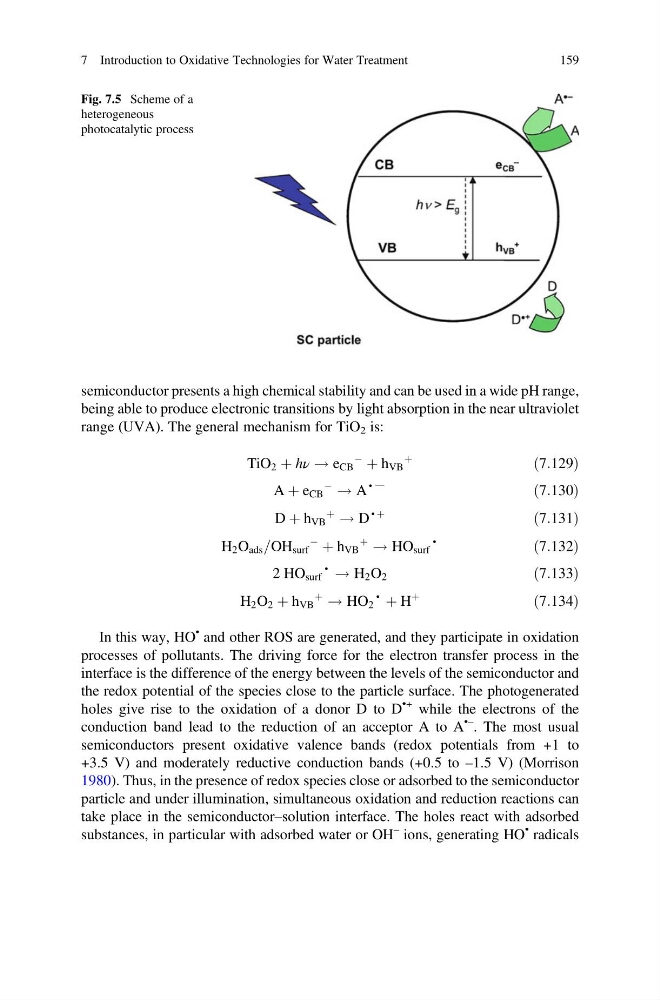
processes of pollutants. The driving force for the electron transfer process in the
interface is the difference of the energy between the levels of the semiconductor and
the redox potential of the species close to the particle surface. The photogenerated
holes give rise to the oxidation of a donor D to D
•+ while the electrons of the
conduction band lead to the reduction of an acceptor A to A
•– . The most usual
semiconductors present oxidative valence bands (redox potentials from +1 to
+3.5 V) and moderately reductive conduction bands (+0.5 to –1.5 V) (Morrison
1980). Thus, in the presence of redox species close or adsorbed to the semiconductor
particle and under illumination, simultaneous oxidation and reduction reactions can
take place in the semiconductor–solution interface. The holes react with adsorbed
substances, in particular with adsorbed water or OH
– ions, generating HO
• radicals
Fig. 7.5 Scheme of a
heterogeneous
photocatalytic process
7 Introduction to Oxidative Technologies for Water Treatment
159
being able to produce electronic transitions by light absorption in the near ultraviolet
range (UVA). The general mechanism for TiO 2 is:
TiO 2 þ hν ! e CB
À
þ h VB
þ
ð7:129Þ
A þ e CB
À
! A
• À
ð7:130Þ
D þ h VB
þ
! D
• þ
ð7:131Þ
H 2 O ads =OH surf
À
þ h VB
þ
! HO surf
•
ð7:132Þ
2 HO surf
•
! H 2 O 2
ð7:133Þ
H 2 O 2 þ h VB
þ
! HO 2
•
þ H
þ
ð7:134Þ
In this way, HO
• and other ROS are generated, and they participate in oxidation
processes of pollutants. The driving force for the electron transfer process in the
interface is the difference of the energy between the levels of the semiconductor and
the redox potential of the species close to the particle surface. The photogenerated
holes give rise to the oxidation of a donor D to D
•+ while the electrons of the
conduction band lead to the reduction of an acceptor A to A
•– . The most usual
semiconductors present oxidative valence bands (redox potentials from +1 to
+3.5 V) and moderately reductive conduction bands (+0.5 to –1.5 V) (Morrison
1980). Thus, in the presence of redox species close or adsorbed to the semiconductor
particle and under illumination, simultaneous oxidation and reduction reactions can
take place in the semiconductor–solution interface. The holes react with adsorbed
substances, in particular with adsorbed water or OH
– ions, generating HO
• radicals
Fig. 7.5 Scheme of a
heterogeneous
photocatalytic process
7 Introduction to Oxidative Technologies for Water Treatment
159