

However, the information is still rare regarding the effects of UV light on the ZVI
system. In the case of nitrate reduction by Fe(0), a detrimental effect of 254-nm
irradiation on Fe(II) dissolution and nitrate removal was reported. It seems that the
role of UV light is strongly dependent on the solution composition (Liao et al. 2003).
These processes deserve profound further research.
7.3.9 UV/Chlorine
Chlorine is commonly used in disinfection processes, e.g., for inactivating pathogens. Hypochlorous acid is a weak acid (pK a ¼ 7.5) and, at pH < 5, the dominant
species is HOCl, whereas at pH > 10, OCl
– is the main species. Chlorine is added
during the primary stages of drinking water treatment to help to control taste and
odor, color, and bacterial growth in filtration beds. However, the detection of known
or suspected carcinogenic disinfection byproducts in distribution systems, from
treatment of raw waters containing even moderate levels of NOM, has led to a closer
inspection and careful monitoring of chlorine dosages and residuals (Watts and
Linden 2007; Chan et al. 2012).
Free chlorine absorbs UVC and/or UVB photons with quantum yields greater
than 1.0. Nowell and Hoigné (1992) confirmed that the predominant active species
from the UV/chlorine process are HO
• , enabling the process to become a potential
AOP. On the other hand, OCl
- absorption is relatively strong in the UV region and
the maximum of the photolysis is at 292 nm, but the high-wavelength tail significantly overlaps the UV end of the solar spectrum. The following reactions occur in
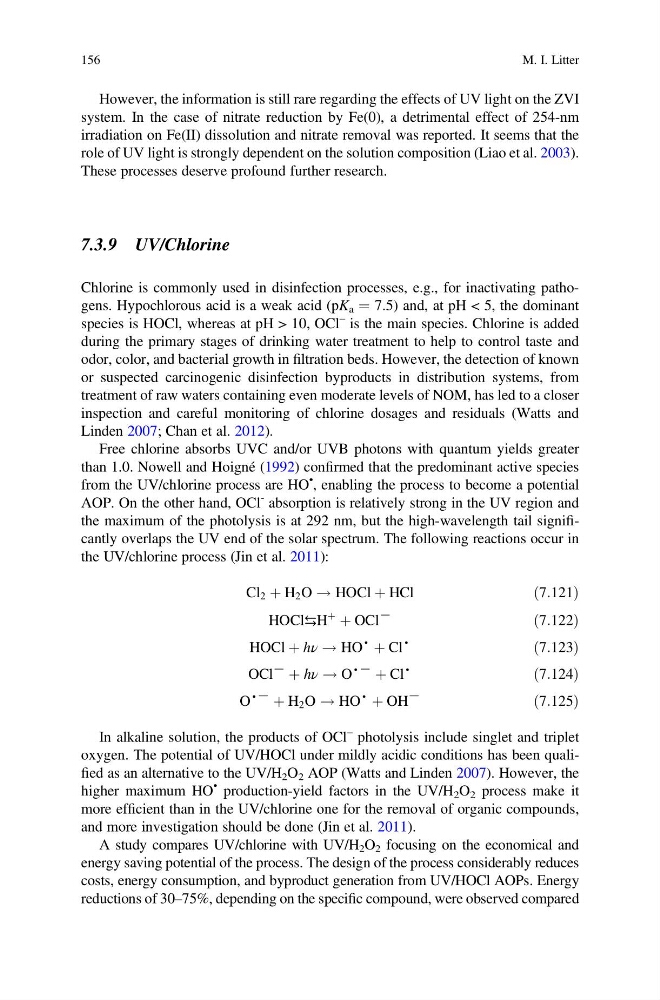
the UV/chlorine process (Jin et al. 2011):
Cl 2 þ H 2 O ! HOCl þ HCl
ð7:121Þ
HOCl⇆H
þ
þ OCl À
ð7:122Þ
HOCl þ hν ! HO
•
þ Cl
•
ð7:123Þ
OCl À þ hν ! O
• À þ Cl
•
ð7:124Þ
O
• À þ H 2 O ! HO
•
þ OH À
ð7:125Þ
In alkaline solution, the products of OCl
– photolysis include singlet and triplet
oxygen. The potential of UV/HOCl under mildly acidic conditions has been qualified as an alternative to the UV/H 2 O 2 AOP (Watts and Linden 2007). However, the
higher maximum HO
• production-yield factors in the UV/H 2 O 2 process make it
more efficient than in the UV/chlorine one for the removal of organic compounds,
and more investigation should be done (Jin et al. 2011).
A study compares UV/chlorine with UV/H 2 O 2 focusing on the economical and
energy saving potential of the process. The design of the process considerably reduces
costs, energy consumption, and byproduct generation from UV/HOCl AOPs. Energy
reductions of 30–75%, depending on the specific compound, were observed compared
156
M. I. Litter
system. In the case of nitrate reduction by Fe(0), a detrimental effect of 254-nm
irradiation on Fe(II) dissolution and nitrate removal was reported. It seems that the
role of UV light is strongly dependent on the solution composition (Liao et al. 2003).
These processes deserve profound further research.
7.3.9 UV/Chlorine
Chlorine is commonly used in disinfection processes, e.g., for inactivating pathogens. Hypochlorous acid is a weak acid (pK a ¼ 7.5) and, at pH < 5, the dominant
species is HOCl, whereas at pH > 10, OCl
– is the main species. Chlorine is added
during the primary stages of drinking water treatment to help to control taste and
odor, color, and bacterial growth in filtration beds. However, the detection of known
or suspected carcinogenic disinfection byproducts in distribution systems, from
treatment of raw waters containing even moderate levels of NOM, has led to a closer
inspection and careful monitoring of chlorine dosages and residuals (Watts and
Linden 2007; Chan et al. 2012).
Free chlorine absorbs UVC and/or UVB photons with quantum yields greater
than 1.0. Nowell and Hoigné (1992) confirmed that the predominant active species
from the UV/chlorine process are HO
• , enabling the process to become a potential
AOP. On the other hand, OCl
- absorption is relatively strong in the UV region and
the maximum of the photolysis is at 292 nm, but the high-wavelength tail significantly overlaps the UV end of the solar spectrum. The following reactions occur in
the UV/chlorine process (Jin et al. 2011):
Cl 2 þ H 2 O ! HOCl þ HCl
ð7:121Þ
HOCl⇆H
þ
þ OCl À
ð7:122Þ
HOCl þ hν ! HO
•
þ Cl
•
ð7:123Þ
OCl À þ hν ! O
• À þ Cl
•
ð7:124Þ
O
• À þ H 2 O ! HO
•
þ OH À
ð7:125Þ
In alkaline solution, the products of OCl
– photolysis include singlet and triplet
oxygen. The potential of UV/HOCl under mildly acidic conditions has been qualified as an alternative to the UV/H 2 O 2 AOP (Watts and Linden 2007). However, the
higher maximum HO
• production-yield factors in the UV/H 2 O 2 process make it
more efficient than in the UV/chlorine one for the removal of organic compounds,
and more investigation should be done (Jin et al. 2011).
A study compares UV/chlorine with UV/H 2 O 2 focusing on the economical and
energy saving potential of the process. The design of the process considerably reduces
costs, energy consumption, and byproduct generation from UV/HOCl AOPs. Energy
reductions of 30–75%, depending on the specific compound, were observed compared
156
M. I. Litter