

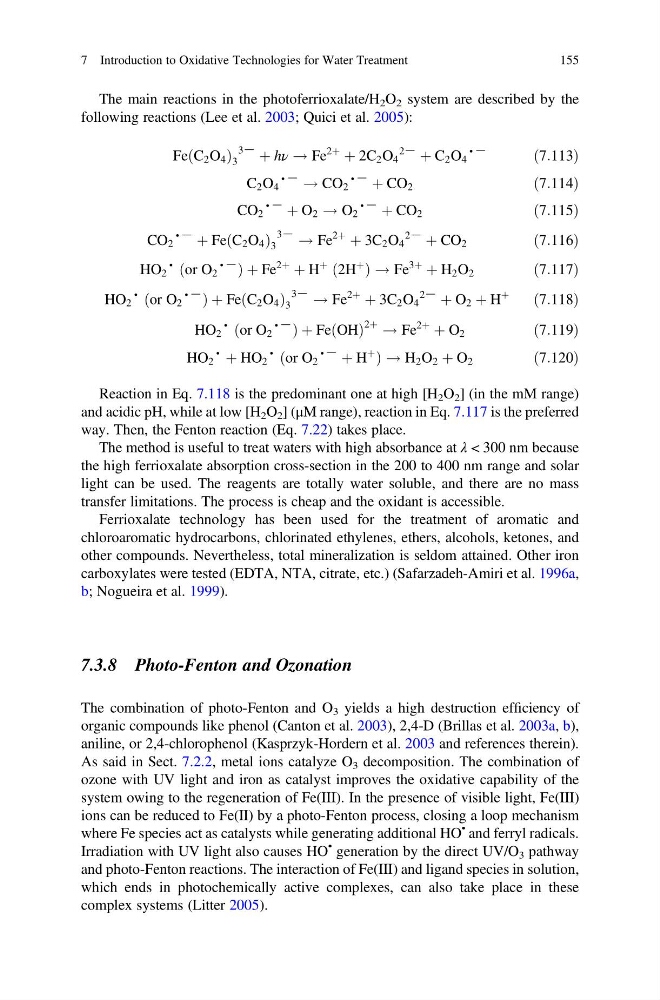
The main reactions in the photoferrioxalate/H 2 O 2 system are described by the
following reactions (Lee et al. 2003; Quici et al. 2005):
FeðC 2 O 4 Þ 3
3À þ hν ! Fe
2þ
þ 2C 2 O 4
2À
þ C 2 O 4
• À
ð7:113Þ
C 2 O 4
• À ! CO 2
• À þ CO 2
ð7:114Þ
CO 2
• À þ O 2 ! O 2
• À þ CO 2
ð7:115Þ
CO 2
• À þ FeðC 2 O 4 Þ 3
3À ! Fe
2þ
þ 3C 2 O 4
2À
þ CO 2
ð7:116Þ
HO 2
•
ðor O 2
• À Þ þ Fe
2þ
þ H
þ
ð2H
þ
Þ ! Fe
3þ
þ H 2 O 2
ð7:117Þ
HO 2
•
ðor O 2
• À Þ þ FeðC 2 O 4 Þ 3
3À ! Fe
2þ
þ 3C 2 O 4
2À
þ O 2 þ H
þ
ð7:118Þ
HO 2
•
ðor O 2
• À Þ þ FeðOHÞ
2þ ! Fe
2þ
þ O 2
ð7:119Þ
HO 2
•
þ HO 2
•
ðor O 2
• À þ H
þ
Þ ! H 2 O 2 þ O 2
ð7:120Þ
Reaction in Eq. 7.118 is the predominant one at high [H 2 O 2 ] (in the mM range)
and acidic pH, while at low [H 2 O 2 ] (μM range), reaction in Eq. 7.117 is the preferred
way. Then, the Fenton reaction (Eq. 7.22) takes place.
The method is useful to treat waters with high absorbance at λ < 300 nm because
the high ferrioxalate absorption cross-section in the 200 to 400 nm range and solar
light can be used. The reagents are totally water soluble, and there are no mass
transfer limitations. The process is cheap and the oxidant is accessible.
Ferrioxalate technology has been used for the treatment of aromatic and
chloroaromatic hydrocarbons, chlorinated ethylenes, ethers, alcohols, ketones, and
other compounds. Nevertheless, total mineralization is seldom attained. Other iron
carboxylates were tested (EDTA, NTA, citrate, etc.) (Safarzadeh-Amiri et al. 1996a,
b; Nogueira et al. 1999).
7.3.8 Photo-Fenton and Ozonation
The combination of photo-Fenton and O 3 yields a high destruction efficiency of
organic compounds like phenol (Canton et al. 2003), 2,4-D (Brillas et al. 2003a, b),
aniline, or 2,4-chlorophenol (Kasprzyk-Hordern et al. 2003 and references therein).
As said in Sect. 7.2.2, metal ions catalyze O 3 decomposition. The combination of
ozone with UV light and iron as catalyst improves the oxidative capability of the
system owing to the regeneration of Fe(III). In the presence of visible light, Fe(III)
ions can be reduced to Fe(II) by a photo-Fenton process, closing a loop mechanism
where Fe species act as catalysts while generating additional HO
• and ferryl radicals.
Irradiation with UV light also causes HO
• generation by the direct UV/O 3 pathway
and photo-Fenton reactions. The interaction of Fe(III) and ligand species in solution,
which ends in photochemically active complexes, can also take place in these
complex systems (Litter 2005).
7 Introduction to Oxidative Technologies for Water Treatment
155
following reactions (Lee et al. 2003; Quici et al. 2005):
FeðC 2 O 4 Þ 3
3À þ hν ! Fe
2þ
þ 2C 2 O 4
2À
þ C 2 O 4
• À
ð7:113Þ
C 2 O 4
• À ! CO 2
• À þ CO 2
ð7:114Þ
CO 2
• À þ O 2 ! O 2
• À þ CO 2
ð7:115Þ
CO 2
• À þ FeðC 2 O 4 Þ 3
3À ! Fe
2þ
þ 3C 2 O 4
2À
þ CO 2
ð7:116Þ
HO 2
•
ðor O 2
• À Þ þ Fe
2þ
þ H
þ
ð2H
þ
Þ ! Fe
3þ
þ H 2 O 2
ð7:117Þ
HO 2
•
ðor O 2
• À Þ þ FeðC 2 O 4 Þ 3
3À ! Fe
2þ
þ 3C 2 O 4
2À
þ O 2 þ H
þ
ð7:118Þ
HO 2
•
ðor O 2
• À Þ þ FeðOHÞ
2þ ! Fe
2þ
þ O 2
ð7:119Þ
HO 2
•
þ HO 2
•
ðor O 2
• À þ H
þ
Þ ! H 2 O 2 þ O 2
ð7:120Þ
Reaction in Eq. 7.118 is the predominant one at high [H 2 O 2 ] (in the mM range)
and acidic pH, while at low [H 2 O 2 ] (μM range), reaction in Eq. 7.117 is the preferred
way. Then, the Fenton reaction (Eq. 7.22) takes place.
The method is useful to treat waters with high absorbance at λ < 300 nm because
the high ferrioxalate absorption cross-section in the 200 to 400 nm range and solar
light can be used. The reagents are totally water soluble, and there are no mass
transfer limitations. The process is cheap and the oxidant is accessible.
Ferrioxalate technology has been used for the treatment of aromatic and
chloroaromatic hydrocarbons, chlorinated ethylenes, ethers, alcohols, ketones, and
other compounds. Nevertheless, total mineralization is seldom attained. Other iron
carboxylates were tested (EDTA, NTA, citrate, etc.) (Safarzadeh-Amiri et al. 1996a,
b; Nogueira et al. 1999).
7.3.8 Photo-Fenton and Ozonation
The combination of photo-Fenton and O 3 yields a high destruction efficiency of
organic compounds like phenol (Canton et al. 2003), 2,4-D (Brillas et al. 2003a, b),
aniline, or 2,4-chlorophenol (Kasprzyk-Hordern et al. 2003 and references therein).
As said in Sect. 7.2.2, metal ions catalyze O 3 decomposition. The combination of
ozone with UV light and iron as catalyst improves the oxidative capability of the
system owing to the regeneration of Fe(III). In the presence of visible light, Fe(III)
ions can be reduced to Fe(II) by a photo-Fenton process, closing a loop mechanism
where Fe species act as catalysts while generating additional HO
• and ferryl radicals.
Irradiation with UV light also causes HO
• generation by the direct UV/O 3 pathway
and photo-Fenton reactions. The interaction of Fe(III) and ligand species in solution,
which ends in photochemically active complexes, can also take place in these
complex systems (Litter 2005).
7 Introduction to Oxidative Technologies for Water Treatment
155