

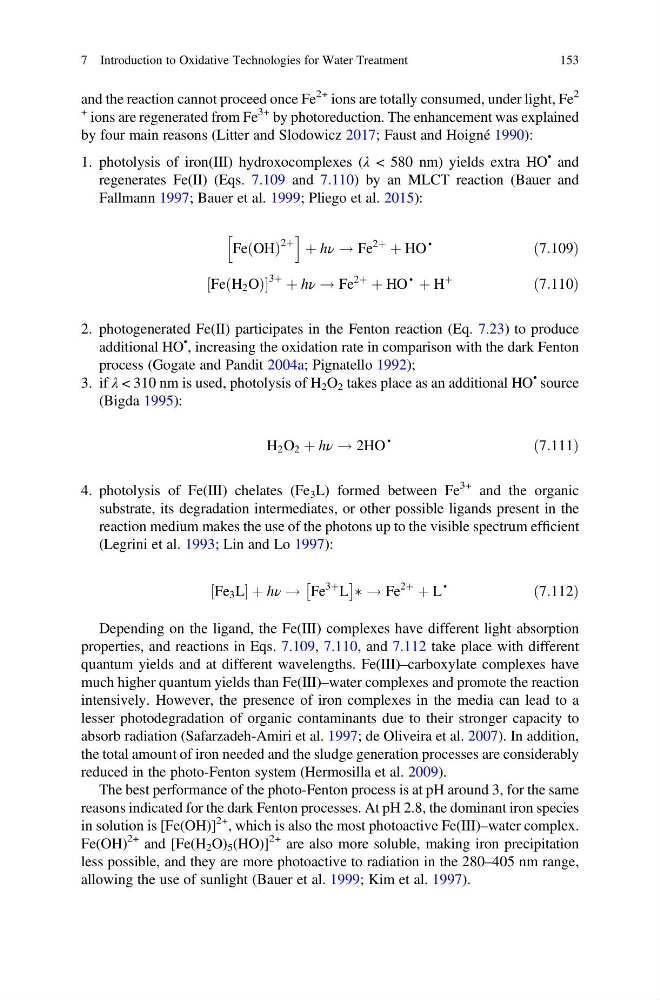
and the reaction cannot proceed once Fe
2+ ions are totally consumed, under light, Fe
2
+ ions are regenerated from Fe
3+ by photoreduction. The enhancement was explained
by four main reasons (Litter and Slodowicz 2017; Faust and Hoigné 1990):
1. photolysis of iron(III) hydroxocomplexes (λ < 580 nm) yields extra HO
• and
regenerates Fe(II) (Eqs. 7.109 and 7.110) by an MLCT reaction (Bauer and
Fallmann 1997; Bauer et al. 1999; Pliego et al. 2015):
Fe OH
ð Þ
2þ
h
i
þ hν ! Fe
2þ
þ HO
•
ð7:109Þ
Fe H 2 O
ð
Þ
½
3þ þ hν ! Fe
2þ
þ HO
•
þ H
þ
ð7:110Þ
2. photogenerated Fe(II) participates in the Fenton reaction (Eq. 7.23) to produce
additional HO
• , increasing the oxidation rate in comparison with the dark Fenton
process (Gogate and Pandit 2004a; Pignatello 1992);
3. if λ < 310 nm is used, photolysis of H 2 O 2 takes place as an additional HO
• source
(Bigda 1995):
H 2 O 2 þ hν ! 2HO
•
ð7:111Þ
4. photolysis of Fe(III) chelates (Fe 3 L) formed between Fe
3+ and the organic
substrate, its degradation intermediates, or other possible ligands present in the
reaction medium makes the use of the photons up to the visible spectrum efficient
(Legrini et al. 1993; Lin and Lo 1997):
Fe 3 L
½
þ hν ! Fe
3þ L
Â
Ã
à ! Fe
2þ
þ L
•
ð7:112Þ
Depending on the ligand, the Fe(III) complexes have different light absorption
properties, and reactions in Eqs. 7.109, 7.110, and 7.112 take place with different
quantum yields and at different wavelengths. Fe(III)–carboxylate complexes have
much higher quantum yields than Fe(III)–water complexes and promote the reaction
intensively. However, the presence of iron complexes in the media can lead to a
lesser photodegradation of organic contaminants due to their stronger capacity to
absorb radiation (Safarzadeh-Amiri et al. 1997; de Oliveira et al. 2007). In addition,
the total amount of iron needed and the sludge generation processes are considerably
reduced in the photo-Fenton system (Hermosilla et al. 2009).
The best performance of the photo-Fenton process is at pH around 3, for the same
reasons indicated for the dark Fenton processes. At pH 2.8, the dominant iron species
in solution is [Fe(OH)]
2+ , which is also the most photoactive Fe(III)–water complex.
Fe(OH)
2+ and [Fe(H 2 O) 5 (HO)]
2+ are also more soluble, making iron precipitation
less possible, and they are more photoactive to radiation in the 280–405 nm range,
allowing the use of sunlight (Bauer et al. 1999; Kim et al. 1997).
7 Introduction to Oxidative Technologies for Water Treatment
153
2+ ions are totally consumed, under light, Fe
2
+ ions are regenerated from Fe
3+ by photoreduction. The enhancement was explained
by four main reasons (Litter and Slodowicz 2017; Faust and Hoigné 1990):
1. photolysis of iron(III) hydroxocomplexes (λ < 580 nm) yields extra HO
• and
regenerates Fe(II) (Eqs. 7.109 and 7.110) by an MLCT reaction (Bauer and
Fallmann 1997; Bauer et al. 1999; Pliego et al. 2015):
Fe OH
ð Þ
2þ
h
i
þ hν ! Fe
2þ
þ HO
•
ð7:109Þ
Fe H 2 O
ð
Þ
½
3þ þ hν ! Fe
2þ
þ HO
•
þ H
þ
ð7:110Þ
2. photogenerated Fe(II) participates in the Fenton reaction (Eq. 7.23) to produce
additional HO
• , increasing the oxidation rate in comparison with the dark Fenton
process (Gogate and Pandit 2004a; Pignatello 1992);
3. if λ < 310 nm is used, photolysis of H 2 O 2 takes place as an additional HO
• source
(Bigda 1995):
H 2 O 2 þ hν ! 2HO
•
ð7:111Þ
4. photolysis of Fe(III) chelates (Fe 3 L) formed between Fe
3+ and the organic
substrate, its degradation intermediates, or other possible ligands present in the
reaction medium makes the use of the photons up to the visible spectrum efficient
(Legrini et al. 1993; Lin and Lo 1997):
Fe 3 L
½
þ hν ! Fe
3þ L
Â
Ã
à ! Fe
2þ
þ L
•
ð7:112Þ
Depending on the ligand, the Fe(III) complexes have different light absorption
properties, and reactions in Eqs. 7.109, 7.110, and 7.112 take place with different
quantum yields and at different wavelengths. Fe(III)–carboxylate complexes have
much higher quantum yields than Fe(III)–water complexes and promote the reaction
intensively. However, the presence of iron complexes in the media can lead to a
lesser photodegradation of organic contaminants due to their stronger capacity to
absorb radiation (Safarzadeh-Amiri et al. 1997; de Oliveira et al. 2007). In addition,
the total amount of iron needed and the sludge generation processes are considerably
reduced in the photo-Fenton system (Hermosilla et al. 2009).
The best performance of the photo-Fenton process is at pH around 3, for the same
reasons indicated for the dark Fenton processes. At pH 2.8, the dominant iron species
in solution is [Fe(OH)]
2+ , which is also the most photoactive Fe(III)–water complex.
Fe(OH)
2+ and [Fe(H 2 O) 5 (HO)]
2+ are also more soluble, making iron precipitation
less possible, and they are more photoactive to radiation in the 280–405 nm range,
allowing the use of sunlight (Bauer et al. 1999; Kim et al. 1997).
7 Introduction to Oxidative Technologies for Water Treatment
153