

It was recently demonstrated that solar light is also because it enhances ozonation,
as proved in the degradation of two model organic compounds, phenol and malic
acid. This process has been called Heliozon. Rates of OM removal were also higher,
and faster and complete mineralization was achieved even at large initial TOC values
(as large as 49,000 ppm). This represents a possible way to increase O 3 reactivity at a
low cost. The simultaneous presence of sunlight and Fe(II) in solution produced also
a beneficial effect in the mineralization, less effective with other metal ions like Cu
(II), Ni(II), Mn(II), and Co(II) (Sánchez et al. 2003).
The method has been applied to potable water, to highly contaminated wastewater, in disinfection, discoloration of waters of the paper industry, degradation of
chlorinated aliphatic hydrocarbons, etc. In Gurol and Akata (1996), the first applications of the technology are mentioned. Ozonation is greatly improved when UV
irradiation is combined with TiO 2 (see Sect. 7.3.12).
The use of O 3 , as indicated in Sect. 7.2.2, requires high capital costs and poses
problems to safety and health.
7.3.5 UV/O 3 /H 2 O 2
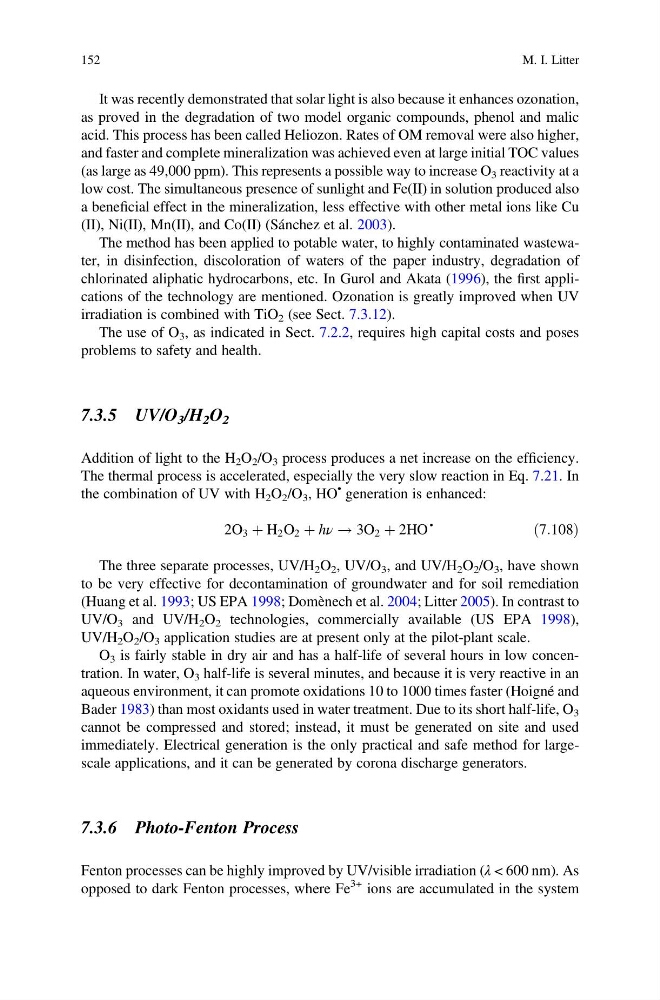
Addition of light to the H 2 O 2 /O 3 process produces a net increase on the efficiency.
The thermal process is accelerated, especially the very slow reaction in Eq. 7.21. In
the combination of UV with H 2 O 2 /O 3 , HO
• generation is enhanced:
2O 3 þ H 2 O 2 þ hν ! 3O 2 þ 2HO
•
ð7:108Þ
The three separate processes, UV/H 2 O 2 , UV/O 3 , and UV/H 2 O 2 /O 3 , have shown
to be very effective for decontamination of groundwater and for soil remediation
(Huang et al. 1993; US EPA 1998; Domènech et al. 2004; Litter 2005). In contrast to
UV/O 3 and UV/H 2 O 2 technologies, commercially available (US EPA 1998),
UV/H 2 O 2 /O 3 application studies are at present only at the pilot-plant scale.
O 3 is fairly stable in dry air and has a half-life of several hours in low concentration. In water, O 3 half-life is several minutes, and because it is very reactive in an
aqueous environment, it can promote oxidations 10 to 1000 times faster (Hoigné and
Bader 1983) than most oxidants used in water treatment. Due to its short half-life, O 3
cannot be compressed and stored; instead, it must be generated on site and used
immediately. Electrical generation is the only practical and safe method for largescale applications, and it can be generated by corona discharge generators.
7.3.6 Photo-Fenton Process
Fenton processes can be highly improved by UV/visible irradiation (λ < 600 nm). As
opposed to dark Fenton processes, where Fe
3+ ions are accumulated in the system
152
M. I. Litter
as proved in the degradation of two model organic compounds, phenol and malic
acid. This process has been called Heliozon. Rates of OM removal were also higher,
and faster and complete mineralization was achieved even at large initial TOC values
(as large as 49,000 ppm). This represents a possible way to increase O 3 reactivity at a
low cost. The simultaneous presence of sunlight and Fe(II) in solution produced also
a beneficial effect in the mineralization, less effective with other metal ions like Cu
(II), Ni(II), Mn(II), and Co(II) (Sánchez et al. 2003).
The method has been applied to potable water, to highly contaminated wastewater, in disinfection, discoloration of waters of the paper industry, degradation of
chlorinated aliphatic hydrocarbons, etc. In Gurol and Akata (1996), the first applications of the technology are mentioned. Ozonation is greatly improved when UV
irradiation is combined with TiO 2 (see Sect. 7.3.12).
The use of O 3 , as indicated in Sect. 7.2.2, requires high capital costs and poses
problems to safety and health.
7.3.5 UV/O 3 /H 2 O 2
Addition of light to the H 2 O 2 /O 3 process produces a net increase on the efficiency.
The thermal process is accelerated, especially the very slow reaction in Eq. 7.21. In
the combination of UV with H 2 O 2 /O 3 , HO
• generation is enhanced:
2O 3 þ H 2 O 2 þ hν ! 3O 2 þ 2HO
•
ð7:108Þ
The three separate processes, UV/H 2 O 2 , UV/O 3 , and UV/H 2 O 2 /O 3 , have shown
to be very effective for decontamination of groundwater and for soil remediation
(Huang et al. 1993; US EPA 1998; Domènech et al. 2004; Litter 2005). In contrast to
UV/O 3 and UV/H 2 O 2 technologies, commercially available (US EPA 1998),
UV/H 2 O 2 /O 3 application studies are at present only at the pilot-plant scale.
O 3 is fairly stable in dry air and has a half-life of several hours in low concentration. In water, O 3 half-life is several minutes, and because it is very reactive in an
aqueous environment, it can promote oxidations 10 to 1000 times faster (Hoigné and
Bader 1983) than most oxidants used in water treatment. Due to its short half-life, O 3
cannot be compressed and stored; instead, it must be generated on site and used
immediately. Electrical generation is the only practical and safe method for largescale applications, and it can be generated by corona discharge generators.
7.3.6 Photo-Fenton Process
Fenton processes can be highly improved by UV/visible irradiation (λ < 600 nm). As
opposed to dark Fenton processes, where Fe
3+ ions are accumulated in the system
152
M. I. Litter