

in improving the biodegradability of the effluent, while VUV was more effective in
photolyzing the residual organic compounds and inorganic N-species in the
bio-treated effluent (Xing et al. 2015).
7.3.3 UV/H 2 O 2
The oxidizing power of H 2 O 2 can be sensibly improved by HO
• generation through
cleavage of the O–O union with photons of enough energy (>213 kJ/mol, the energy
bond, corresponding to λ < 280 nm). The reaction has a low quantum yield
(ϕ H2O2 ¼ 0.5) due to strong recombination of the radicals in solution (Litter 2005;
Boczkaj and Fernandes 2017; Lopez et al. 2000; Bircher et al. 1997), and produces
almost quantitatively one HO
• per quantum of radiation absorbed in the 200–300 nm
range, i.e., ϕ HO• ¼ 0.5:
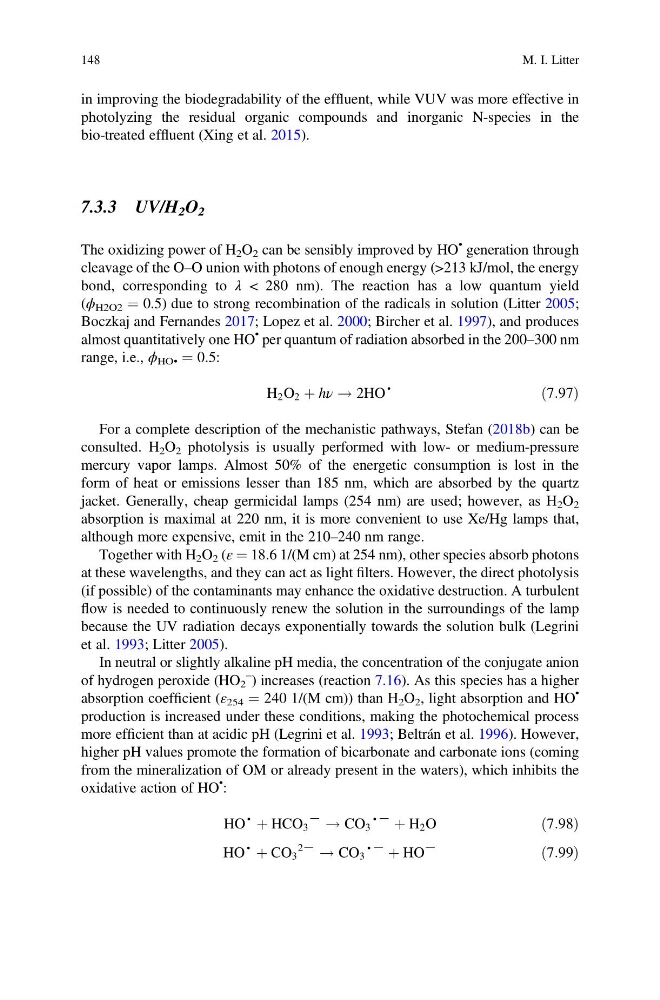
H 2 O 2 þ hν ! 2HO
•
ð7:97Þ
For a complete description of the mechanistic pathways, Stefan (2018b) can be
consulted. H 2 O 2 photolysis is usually performed with low- or medium-pressure
mercury vapor lamps. Almost 50% of the energetic consumption is lost in the
form of heat or emissions lesser than 185 nm, which are absorbed by the quartz
jacket. Generally, cheap germicidal lamps (254 nm) are used; however, as H 2 O 2
absorption is maximal at 220 nm, it is more convenient to use Xe/Hg lamps that,
although more expensive, emit in the 210–240 nm range.
Together with H 2 O 2 (ε ¼ 18.6 1/(M cm) at 254 nm), other species absorb photons
at these wavelengths, and they can act as light filters. However, the direct photolysis
(if possible) of the contaminants may enhance the oxidative destruction. A turbulent
flow is needed to continuously renew the solution in the surroundings of the lamp
because the UV radiation decays exponentially towards the solution bulk (Legrini
et al. 1993; Litter 2005).
In neutral or slightly alkaline pH media, the concentration of the conjugate anion
of hydrogen peroxide (HO 2
– ) increases (reaction 7.16). As this species has a higher
absorption coefficient (ε 254 ¼ 240 1/(M cm)) than H 2 O 2 , light absorption and HO
•
production is increased under these conditions, making the photochemical process
more efficient than at acidic pH (Legrini et al. 1993; Beltrán et al. 1996). However,
higher pH values promote the formation of bicarbonate and carbonate ions (coming
from the mineralization of OM or already present in the waters), which inhibits the
oxidative action of HO
• :
HO
•
þ HCO 3
À ! CO 3
• À þ H 2 O
ð7:98Þ
HO
•
þ CO 3
2À
! CO 3
• À þ HO À
ð7:99Þ
148
M. I. Litter
photolyzing the residual organic compounds and inorganic N-species in the
bio-treated effluent (Xing et al. 2015).
7.3.3 UV/H 2 O 2
The oxidizing power of H 2 O 2 can be sensibly improved by HO
• generation through
cleavage of the O–O union with photons of enough energy (>213 kJ/mol, the energy
bond, corresponding to λ < 280 nm). The reaction has a low quantum yield
(ϕ H2O2 ¼ 0.5) due to strong recombination of the radicals in solution (Litter 2005;
Boczkaj and Fernandes 2017; Lopez et al. 2000; Bircher et al. 1997), and produces
almost quantitatively one HO
• per quantum of radiation absorbed in the 200–300 nm
range, i.e., ϕ HO• ¼ 0.5:
H 2 O 2 þ hν ! 2HO
•
ð7:97Þ
For a complete description of the mechanistic pathways, Stefan (2018b) can be
consulted. H 2 O 2 photolysis is usually performed with low- or medium-pressure
mercury vapor lamps. Almost 50% of the energetic consumption is lost in the
form of heat or emissions lesser than 185 nm, which are absorbed by the quartz
jacket. Generally, cheap germicidal lamps (254 nm) are used; however, as H 2 O 2
absorption is maximal at 220 nm, it is more convenient to use Xe/Hg lamps that,
although more expensive, emit in the 210–240 nm range.
Together with H 2 O 2 (ε ¼ 18.6 1/(M cm) at 254 nm), other species absorb photons
at these wavelengths, and they can act as light filters. However, the direct photolysis
(if possible) of the contaminants may enhance the oxidative destruction. A turbulent
flow is needed to continuously renew the solution in the surroundings of the lamp
because the UV radiation decays exponentially towards the solution bulk (Legrini
et al. 1993; Litter 2005).
In neutral or slightly alkaline pH media, the concentration of the conjugate anion
of hydrogen peroxide (HO 2
– ) increases (reaction 7.16). As this species has a higher
absorption coefficient (ε 254 ¼ 240 1/(M cm)) than H 2 O 2 , light absorption and HO
•
production is increased under these conditions, making the photochemical process
more efficient than at acidic pH (Legrini et al. 1993; Beltrán et al. 1996). However,
higher pH values promote the formation of bicarbonate and carbonate ions (coming
from the mineralization of OM or already present in the waters), which inhibits the
oxidative action of HO
• :
HO
•
þ HCO 3
À ! CO 3
• À þ H 2 O
ð7:98Þ
HO
•
þ CO 3
2À
! CO 3
• À þ HO À
ð7:99Þ
148
M. I. Litter