

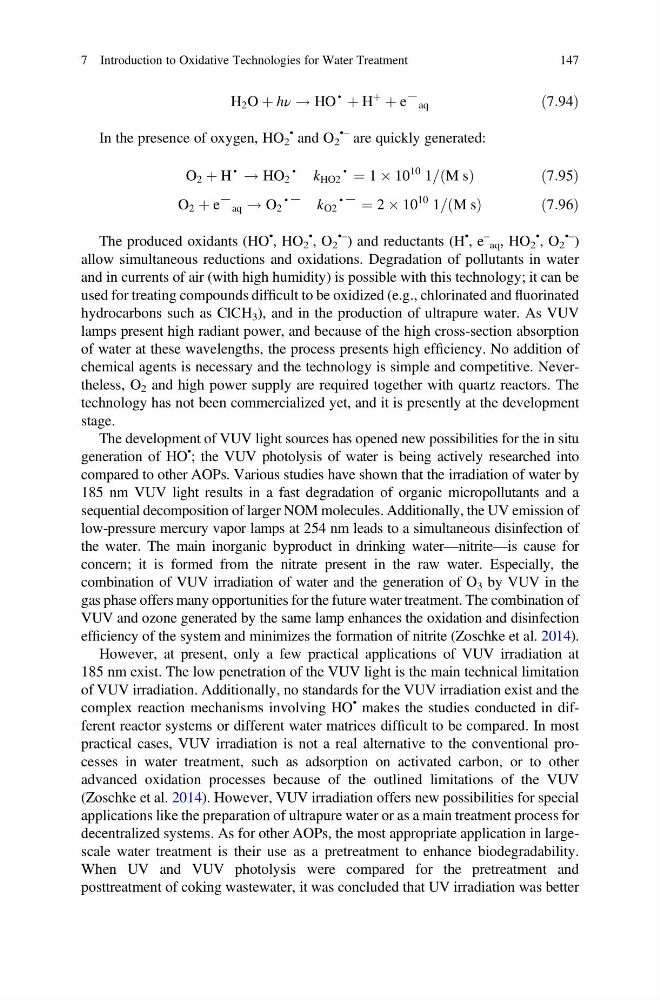
H 2 O þ hν ! HO
•
þ H
þ
þ e À
aq
ð7:94Þ
In the presence of oxygen, HO 2
• and O 2
•– are quickly generated:
O 2 þ H
•
! HO 2
•
k HO2
•
¼ 1 Â 10
10 1= M s
ð
Þ
ð7:95Þ
O 2 þ e À
aq ! O 2
• À k O2
• À ¼ 2 Â 10
10 1=ðM sÞ
ð 7:96Þ
The produced oxidants (HO
•
, HO 2
•
, O 2
•–
) and reductants (H
•
, e
–
aq , HO 2
• , O 2
•–
)
allow simultaneous reductions and oxidations. Degradation of pollutants in water
and in currents of air (with high humidity) is possible with this technology; it can be
used for treating compounds difficult to be oxidized (e.g., chlorinated and fluorinated
hydrocarbons such as ClCH 3 ), and in the production of ultrapure water. As VUV
lamps present high radiant power, and because of the high cross-section absorption
of water at these wavelengths, the process presents high efficiency. No addition of
chemical agents is necessary and the technology is simple and competitive. Nevertheless, O 2 and high power supply are required together with quartz reactors. The
technology has not been commercialized yet, and it is presently at the development
stage.
The development of VUV light sources has opened new possibilities for the in situ
generation of HO
•
; the VUV photolysis of water is being actively researched into
compared to other AOPs. Various studies have shown that the irradiation of water by
185 nm VUV light results in a fast degradation of organic micropollutants and a
sequential decomposition of larger NOM molecules. Additionally, the UV emission of
low-pressure mercury vapor lamps at 254 nm leads to a simultaneous disinfection of
the water. The main inorganic byproduct in drinking water—nitrite—is cause for
concern; it is formed from the nitrate present in the raw water. Especially, the
combination of VUV irradiation of water and the generation of O 3 by VUV in the
gas phase offers many opportunities for the future water treatment. The combination of
VUV and ozone generated by the same lamp enhances the oxidation and disinfection
efficiency of the system and minimizes the formation of nitrite (Zoschke et al. 2014).
However, at present, only a few practical applications of VUV irradiation at
185 nm exist. The low penetration of the VUV light is the main technical limitation
of VUV irradiation. Additionally, no standards for the VUV irradiation exist and the
complex reaction mechanisms involving HO
• makes the studies conducted in different reactor systems or different water matrices difficult to be compared. In most
practical cases, VUV irradiation is not a real alternative to the conventional processes in water treatment, such as adsorption on activated carbon, or to other
advanced oxidation processes because of the outlined limitations of the VUV
(Zoschke et al. 2014). However, VUV irradiation offers new possibilities for special
applications like the preparation of ultrapure water or as a main treatment process for
decentralized systems. As for other AOPs, the most appropriate application in largescale water treatment is their use as a pretreatment to enhance biodegradability.
When UV and VUV photolysis were compared for the pretreatment and
posttreatment of coking wastewater, it was concluded that UV irradiation was better
7 Introduction to Oxidative Technologies for Water Treatment
147
•
þ H
þ
þ e À
aq
ð7:94Þ
In the presence of oxygen, HO 2
• and O 2
•– are quickly generated:
O 2 þ H
•
! HO 2
•
k HO2
•
¼ 1 Â 10
10 1= M s
ð
Þ
ð7:95Þ
O 2 þ e À
aq ! O 2
• À k O2
• À ¼ 2 Â 10
10 1=ðM sÞ
ð 7:96Þ
The produced oxidants (HO
•
, HO 2
•
, O 2
•–
) and reductants (H
•
, e
–
aq , HO 2
• , O 2
•–
)
allow simultaneous reductions and oxidations. Degradation of pollutants in water
and in currents of air (with high humidity) is possible with this technology; it can be
used for treating compounds difficult to be oxidized (e.g., chlorinated and fluorinated
hydrocarbons such as ClCH 3 ), and in the production of ultrapure water. As VUV
lamps present high radiant power, and because of the high cross-section absorption
of water at these wavelengths, the process presents high efficiency. No addition of
chemical agents is necessary and the technology is simple and competitive. Nevertheless, O 2 and high power supply are required together with quartz reactors. The
technology has not been commercialized yet, and it is presently at the development
stage.
The development of VUV light sources has opened new possibilities for the in situ
generation of HO
•
; the VUV photolysis of water is being actively researched into
compared to other AOPs. Various studies have shown that the irradiation of water by
185 nm VUV light results in a fast degradation of organic micropollutants and a
sequential decomposition of larger NOM molecules. Additionally, the UV emission of
low-pressure mercury vapor lamps at 254 nm leads to a simultaneous disinfection of
the water. The main inorganic byproduct in drinking water—nitrite—is cause for
concern; it is formed from the nitrate present in the raw water. Especially, the
combination of VUV irradiation of water and the generation of O 3 by VUV in the
gas phase offers many opportunities for the future water treatment. The combination of
VUV and ozone generated by the same lamp enhances the oxidation and disinfection
efficiency of the system and minimizes the formation of nitrite (Zoschke et al. 2014).
However, at present, only a few practical applications of VUV irradiation at
185 nm exist. The low penetration of the VUV light is the main technical limitation
of VUV irradiation. Additionally, no standards for the VUV irradiation exist and the
complex reaction mechanisms involving HO
• makes the studies conducted in different reactor systems or different water matrices difficult to be compared. In most
practical cases, VUV irradiation is not a real alternative to the conventional processes in water treatment, such as adsorption on activated carbon, or to other
advanced oxidation processes because of the outlined limitations of the VUV
(Zoschke et al. 2014). However, VUV irradiation offers new possibilities for special
applications like the preparation of ultrapure water or as a main treatment process for
decentralized systems. As for other AOPs, the most appropriate application in largescale water treatment is their use as a pretreatment to enhance biodegradability.
When UV and VUV photolysis were compared for the pretreatment and
posttreatment of coking wastewater, it was concluded that UV irradiation was better
7 Introduction to Oxidative Technologies for Water Treatment
147