

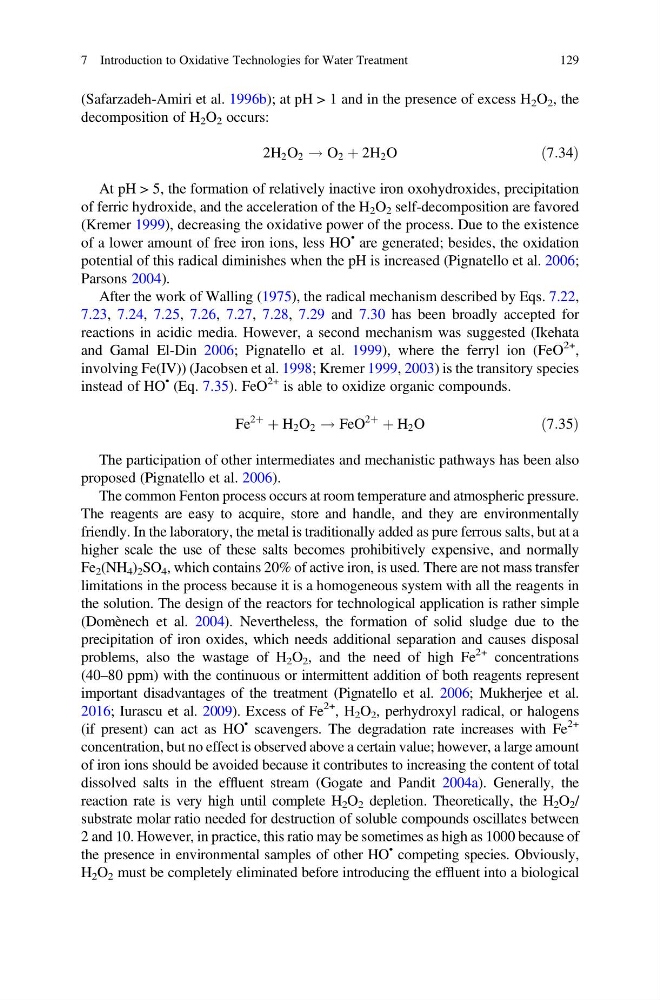
(Safarzadeh-Amiri et al. 1996b); at pH > 1 and in the presence of excess H 2 O 2 , the
decomposition of H 2 O 2 occurs:
2H 2 O 2 ! O 2 þ 2H 2 O
ð7:34Þ
At pH > 5, the formation of relatively inactive iron oxohydroxides, precipitation
of ferric hydroxide, and the acceleration of the H 2 O 2 self-decomposition are favored
(Kremer 1999), decreasing the oxidative power of the process. Due to the existence
of a lower amount of free iron ions, less HO
• are generated; besides, the oxidation
potential of this radical diminishes when the pH is increased (Pignatello et al. 2006;
Parsons 2004).
After the work of Walling (1975), the radical mechanism described by Eqs. 7.22,
7.23, 7.24, 7.25, 7.26, 7.27, 7.28, 7.29 and 7.30 has been broadly accepted for
reactions in acidic media. However, a second mechanism was suggested (Ikehata
and Gamal El-Din 2006; Pignatello et al. 1999), where the ferryl ion (FeO
2+ ,
involving Fe(IV)) (Jacobsen et al. 1998; Kremer 1999, 2003) is the transitory species
instead of HO
• (Eq. 7.35). FeO
2+ is able to oxidize organic compounds.
Fe
2þ
þ H 2 O 2 ! FeO
2þ
þ H 2 O
ð7:35Þ
The participation of other intermediates and mechanistic pathways has been also
proposed (Pignatello et al. 2006).
The common Fenton process occurs at room temperature and atmospheric pressure.
The reagents are easy to acquire, store and handle, and they are environmentally
friendly. In the laboratory, the metal is traditionally added as pure ferrous salts, but at a
higher scale the use of these salts becomes prohibitively expensive, and normally
Fe 2 (NH 4 ) 2 SO 4 , which contains 20% of active iron, is used. There are not mass transfer
limitations in the process because it is a homogeneous system with all the reagents in
the solution. The design of the reactors for technological application is rather simple
(Domènech et al. 2004). Nevertheless, the formation of solid sludge due to the
precipitation of iron oxides, which needs additional separation and causes disposal
problems, also the wastage of H 2 O 2 , and the need of high Fe
2+ concentrations
(40–80 ppm) with the continuous or intermittent addition of both reagents represent
important disadvantages of the treatment (Pignatello et al. 2006; Mukherjee et al.
2016; Iurascu et al. 2009). Excess of Fe
2+
, H 2 O 2 , perhydroxyl radical, or halogens
(if present) can act as HO
• scavengers. The degradation rate increases with Fe
2+
concentration, but no effect is observed above a certain value; however, a large amount
of iron ions should be avoided because it contributes to increasing the content of total
dissolved salts in the effluent stream (Gogate and Pandit 2004a). Generally, the
reaction rate is very high until complete H 2 O 2 depletion. Theoretically, the H 2 O 2 /
substrate molar ratio needed for destruction of soluble compounds oscillates between
2 and 10. However, in practice, this ratio may be sometimes as high as 1000 because of
the presence in environmental samples of other HO
• competing species. Obviously,
H 2 O 2 must be completely eliminated before introducing the effluent into a biological
7 Introduction to Oxidative Technologies for Water Treatment
129
decomposition of H 2 O 2 occurs:
2H 2 O 2 ! O 2 þ 2H 2 O
ð7:34Þ
At pH > 5, the formation of relatively inactive iron oxohydroxides, precipitation
of ferric hydroxide, and the acceleration of the H 2 O 2 self-decomposition are favored
(Kremer 1999), decreasing the oxidative power of the process. Due to the existence
of a lower amount of free iron ions, less HO
• are generated; besides, the oxidation
potential of this radical diminishes when the pH is increased (Pignatello et al. 2006;
Parsons 2004).
After the work of Walling (1975), the radical mechanism described by Eqs. 7.22,
7.23, 7.24, 7.25, 7.26, 7.27, 7.28, 7.29 and 7.30 has been broadly accepted for
reactions in acidic media. However, a second mechanism was suggested (Ikehata
and Gamal El-Din 2006; Pignatello et al. 1999), where the ferryl ion (FeO
2+ ,
involving Fe(IV)) (Jacobsen et al. 1998; Kremer 1999, 2003) is the transitory species
instead of HO
• (Eq. 7.35). FeO
2+ is able to oxidize organic compounds.
Fe
2þ
þ H 2 O 2 ! FeO
2þ
þ H 2 O
ð7:35Þ
The participation of other intermediates and mechanistic pathways has been also
proposed (Pignatello et al. 2006).
The common Fenton process occurs at room temperature and atmospheric pressure.
The reagents are easy to acquire, store and handle, and they are environmentally
friendly. In the laboratory, the metal is traditionally added as pure ferrous salts, but at a
higher scale the use of these salts becomes prohibitively expensive, and normally
Fe 2 (NH 4 ) 2 SO 4 , which contains 20% of active iron, is used. There are not mass transfer
limitations in the process because it is a homogeneous system with all the reagents in
the solution. The design of the reactors for technological application is rather simple
(Domènech et al. 2004). Nevertheless, the formation of solid sludge due to the
precipitation of iron oxides, which needs additional separation and causes disposal
problems, also the wastage of H 2 O 2 , and the need of high Fe
2+ concentrations
(40–80 ppm) with the continuous or intermittent addition of both reagents represent
important disadvantages of the treatment (Pignatello et al. 2006; Mukherjee et al.
2016; Iurascu et al. 2009). Excess of Fe
2+
, H 2 O 2 , perhydroxyl radical, or halogens
(if present) can act as HO
• scavengers. The degradation rate increases with Fe
2+
concentration, but no effect is observed above a certain value; however, a large amount
of iron ions should be avoided because it contributes to increasing the content of total
dissolved salts in the effluent stream (Gogate and Pandit 2004a). Generally, the
reaction rate is very high until complete H 2 O 2 depletion. Theoretically, the H 2 O 2 /
substrate molar ratio needed for destruction of soluble compounds oscillates between
2 and 10. However, in practice, this ratio may be sometimes as high as 1000 because of
the presence in environmental samples of other HO
• competing species. Obviously,
H 2 O 2 must be completely eliminated before introducing the effluent into a biological
7 Introduction to Oxidative Technologies for Water Treatment
129