

7.2.4 Fenton and Related Reactions
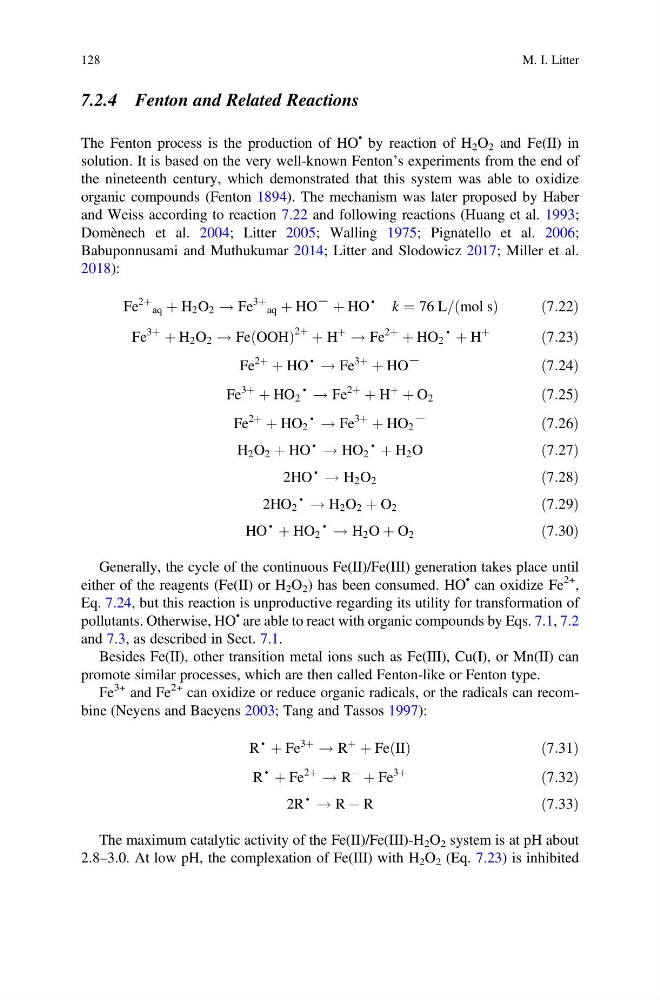
The Fenton process is the production of HO
• by reaction of H 2 O 2 and Fe(II) in
solution. It is based on the very well-known Fenton’s experiments from the end of
the nineteenth century, which demonstrated that this system was able to oxidize
organic compounds (Fenton 1894). The mechanism was later proposed by Haber
and Weiss according to reaction 7.22 and following reactions (Huang et al. 1993;
Domènech et al. 2004; Litter 2005; Walling 1975; Pignatello et al. 2006;
Babuponnusami and Muthukumar 2014; Litter and Slodowicz 2017; Miller et al.
2018):
Fe
2þ
aq þ H 2 O 2 ! Fe
3þ
aq þ HO À þ HO
•
k ¼ 76 L=ðmol sÞ
ð7:22Þ
Fe
3þ
þ H 2 O 2 ! Fe OOH
ð
Þ
2þ þ H
þ
! Fe
2þ
þ HO 2
•
þ H
þ
ð7:23Þ
Fe
2þ
þ HO
•
! Fe
3þ
þ HO À
ð7:24Þ
Fe
3þ
þ HO 2
•
! Fe
2þ
þ H
þ
þ O 2
ð7:25Þ
Fe
2þ
þ HO 2
•
! Fe
3þ
þ HO 2
À
ð7:26Þ
H 2 O 2 þ HO
•
! HO 2
•
þ H 2 O
ð7:27Þ
2HO
•
! H 2 O 2
ð7:28Þ
2HO 2
•
! H 2 O 2 þ O 2
ð7:29Þ
HO
•
þ HO 2
•
! H 2 O þ O 2
ð7:30Þ
Generally, the cycle of the continuous Fe(II)/Fe(III) generation takes place until
either of the reagents (Fe(II) or H 2 O 2 ) has been consumed. HO
• can oxidize Fe
2+ ,
Eq. 7.24, but this reaction is unproductive regarding its utility for transformation of
pollutants. Otherwise, HO
• are able to react with organic compounds by Eqs. 7.1, 7.2
and 7.3, as described in Sect. 7.1.
Besides Fe(II), other transition metal ions such as Fe(III), Cu(I), or Mn(II) can
promote similar processes, which are then called Fenton-like or Fenton type.
Fe
3+ and Fe
2+ can oxidize or reduce organic radicals, or the radicals can recombine (Neyens and Baeyens 2003; Tang and Tassos 1997):
R
•
þ Fe
3þ
! R
þ
þ Fe II
ð Þ
ð7:31Þ
R
•
þ Fe
2þ
! R
À
þ Fe
3þ
ð7:32Þ
2R
•
! R À R
ð7:33Þ
The maximum catalytic activity of the Fe(II)/Fe(III)-H 2 O 2 system is at pH about
2.8–3.0. At low pH, the complexation of Fe(III) with H 2 O 2 (Eq. 7.23) is inhibited
128
M. I. Litter
The Fenton process is the production of HO
• by reaction of H 2 O 2 and Fe(II) in
solution. It is based on the very well-known Fenton’s experiments from the end of
the nineteenth century, which demonstrated that this system was able to oxidize
organic compounds (Fenton 1894). The mechanism was later proposed by Haber
and Weiss according to reaction 7.22 and following reactions (Huang et al. 1993;
Domènech et al. 2004; Litter 2005; Walling 1975; Pignatello et al. 2006;
Babuponnusami and Muthukumar 2014; Litter and Slodowicz 2017; Miller et al.
2018):
Fe
2þ
aq þ H 2 O 2 ! Fe
3þ
aq þ HO À þ HO
•
k ¼ 76 L=ðmol sÞ
ð7:22Þ
Fe
3þ
þ H 2 O 2 ! Fe OOH
ð
Þ
2þ þ H
þ
! Fe
2þ
þ HO 2
•
þ H
þ
ð7:23Þ
Fe
2þ
þ HO
•
! Fe
3þ
þ HO À
ð7:24Þ
Fe
3þ
þ HO 2
•
! Fe
2þ
þ H
þ
þ O 2
ð7:25Þ
Fe
2þ
þ HO 2
•
! Fe
3þ
þ HO 2
À
ð7:26Þ
H 2 O 2 þ HO
•
! HO 2
•
þ H 2 O
ð7:27Þ
2HO
•
! H 2 O 2
ð7:28Þ
2HO 2
•
! H 2 O 2 þ O 2
ð7:29Þ
HO
•
þ HO 2
•
! H 2 O þ O 2
ð7:30Þ
Generally, the cycle of the continuous Fe(II)/Fe(III) generation takes place until
either of the reagents (Fe(II) or H 2 O 2 ) has been consumed. HO
• can oxidize Fe
2+ ,
Eq. 7.24, but this reaction is unproductive regarding its utility for transformation of
pollutants. Otherwise, HO
• are able to react with organic compounds by Eqs. 7.1, 7.2
and 7.3, as described in Sect. 7.1.
Besides Fe(II), other transition metal ions such as Fe(III), Cu(I), or Mn(II) can
promote similar processes, which are then called Fenton-like or Fenton type.
Fe
3+ and Fe
2+ can oxidize or reduce organic radicals, or the radicals can recombine (Neyens and Baeyens 2003; Tang and Tassos 1997):
R
•
þ Fe
3þ
! R
þ
þ Fe II
ð Þ
ð7:31Þ
R
•
þ Fe
2þ
! R
À
þ Fe
3þ
ð7:32Þ
2R
•
! R À R
ð7:33Þ
The maximum catalytic activity of the Fe(II)/Fe(III)-H 2 O 2 system is at pH about
2.8–3.0. At low pH, the complexation of Fe(III) with H 2 O 2 (Eq. 7.23) is inhibited
128
M. I. Litter