

organoleptic properties of water or can be just used to discolor dark industrial wastes.
In most cases, they consume much less energy than some conventional methods, for
example, incineration. Usually, these technologies do not generate sludge, which
would require additional treatment or disposal. Nevertheless, it must be taken into
account that wastes with relatively high chemical oxygen demand (COD) contents
(>5.0 g/L) or with very recalcitrant pollutants cannot be suitably treated by AOTs
because they would require large amounts of expensive reagents or electrical energy
for irradiation (Andreozzi et al. 1999).
As total destruction of the pollutant is not always required, AOTs are especially
useful in two cases: (a) as a pretreatment to transform recalcitrant pollutants into
more biodegradable compounds, or (b) as a posttreatment to polish waters before
their discharge to the receptor bodies (Scott and Ollis 1995). The main idea of this
combination is to use the more expensive technology only during the first or the final
step of the treatment in order to reduce the cost.
AOTs can provide effective technological solutions for water treatment; the applicability can cover areas such as: (1) industrial effluents (distillery, agrochemical, kraftbleaching, pulp and paper, textile dyes, oilfield and metal-plating wastes); (2) hazardous effluents (hospital and slaughterhouse wastes); (3) removal of pathogens and
persistent (endocrine-disrupting) pharmaceutical residues from municipal wastewater
treatment plant (WWTP) effluents; (4) removal of organic micropollutants such as
pesticides, heavy metals (lead, etc.), and arsenic; (5) conditioning and stabilization of
biological sludge from WWTPs (Comninellis et al. 2008).
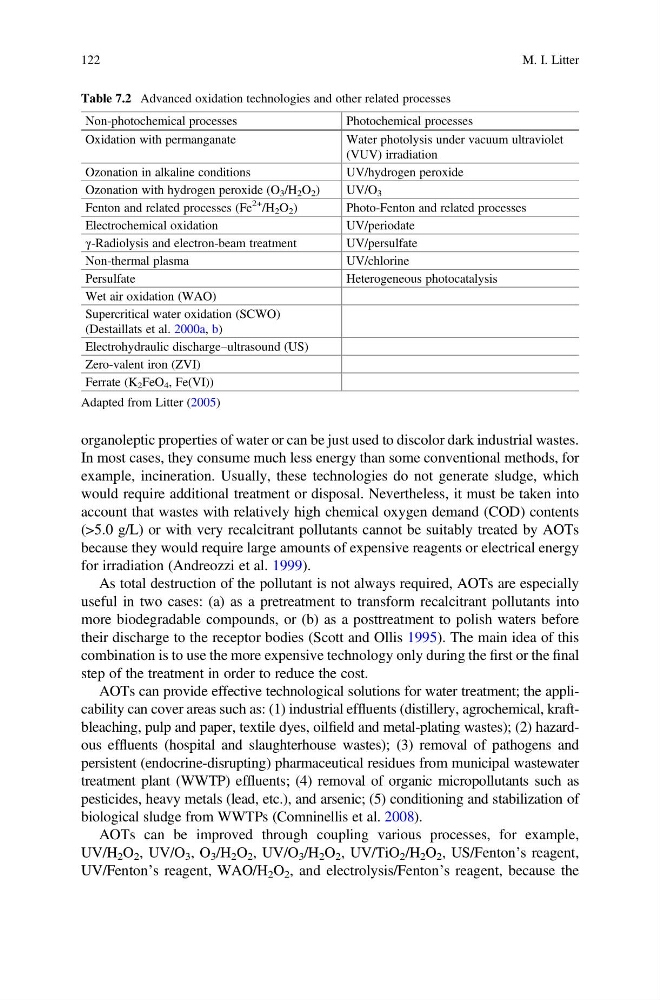
AOTs can be improved through coupling various processes, for example,
UV/H 2 O 2 , UV/O 3 , O 3 /H 2 O 2 , UV/O 3 /H 2 O 2 , UV/TiO 2 /H 2 O 2 , US/Fenton’s reagent,
UV/Fenton’s reagent, WAO/H 2 O 2 , and electrolysis/Fenton’s reagent, because the
Table 7.2 Advanced oxidation technologies and other related processes
Non-photochemical processes
Photochemical processes
Oxidation with permanganate
Water photolysis under vacuum ultraviolet
(VUV) irradiation
Ozonation in alkaline conditions
UV/hydrogen peroxide
Ozonation with hydrogen peroxide (O 3 /H 2 O 2 )
UV/O 3
Fenton and related processes (Fe
2+ /H 2 O 2 )
Photo-Fenton and related processes
Electrochemical oxidation
UV/periodate
γ-Radiolysis and electron-beam treatment
UV/persulfate
Non-thermal plasma
UV/chlorine
Persulfate
Heterogeneous photocatalysis
Wet air oxidation (WAO)
Supercritical water oxidation (SCWO)
(Destaillats et al. 2000a, b)
Electrohydraulic discharge–ultrasound (US)
Zero-valent iron (ZVI)
Ferrate (K 2 FeO 4 , Fe(VI))
Adapted from Litter (2005)
122
M. I. Litter
In most cases, they consume much less energy than some conventional methods, for
example, incineration. Usually, these technologies do not generate sludge, which
would require additional treatment or disposal. Nevertheless, it must be taken into
account that wastes with relatively high chemical oxygen demand (COD) contents
(>5.0 g/L) or with very recalcitrant pollutants cannot be suitably treated by AOTs
because they would require large amounts of expensive reagents or electrical energy
for irradiation (Andreozzi et al. 1999).
As total destruction of the pollutant is not always required, AOTs are especially
useful in two cases: (a) as a pretreatment to transform recalcitrant pollutants into
more biodegradable compounds, or (b) as a posttreatment to polish waters before
their discharge to the receptor bodies (Scott and Ollis 1995). The main idea of this
combination is to use the more expensive technology only during the first or the final
step of the treatment in order to reduce the cost.
AOTs can provide effective technological solutions for water treatment; the applicability can cover areas such as: (1) industrial effluents (distillery, agrochemical, kraftbleaching, pulp and paper, textile dyes, oilfield and metal-plating wastes); (2) hazardous effluents (hospital and slaughterhouse wastes); (3) removal of pathogens and
persistent (endocrine-disrupting) pharmaceutical residues from municipal wastewater
treatment plant (WWTP) effluents; (4) removal of organic micropollutants such as
pesticides, heavy metals (lead, etc.), and arsenic; (5) conditioning and stabilization of
biological sludge from WWTPs (Comninellis et al. 2008).
AOTs can be improved through coupling various processes, for example,
UV/H 2 O 2 , UV/O 3 , O 3 /H 2 O 2 , UV/O 3 /H 2 O 2 , UV/TiO 2 /H 2 O 2 , US/Fenton’s reagent,
UV/Fenton’s reagent, WAO/H 2 O 2 , and electrolysis/Fenton’s reagent, because the
Table 7.2 Advanced oxidation technologies and other related processes
Non-photochemical processes
Photochemical processes
Oxidation with permanganate
Water photolysis under vacuum ultraviolet
(VUV) irradiation
Ozonation in alkaline conditions
UV/hydrogen peroxide
Ozonation with hydrogen peroxide (O 3 /H 2 O 2 )
UV/O 3
Fenton and related processes (Fe
2+ /H 2 O 2 )
Photo-Fenton and related processes
Electrochemical oxidation
UV/periodate
γ-Radiolysis and electron-beam treatment
UV/persulfate
Non-thermal plasma
UV/chlorine
Persulfate
Heterogeneous photocatalysis
Wet air oxidation (WAO)
Supercritical water oxidation (SCWO)
(Destaillats et al. 2000a, b)
Electrohydraulic discharge–ultrasound (US)
Zero-valent iron (ZVI)
Ferrate (K 2 FeO 4 , Fe(VI))
Adapted from Litter (2005)
122
M. I. Litter