

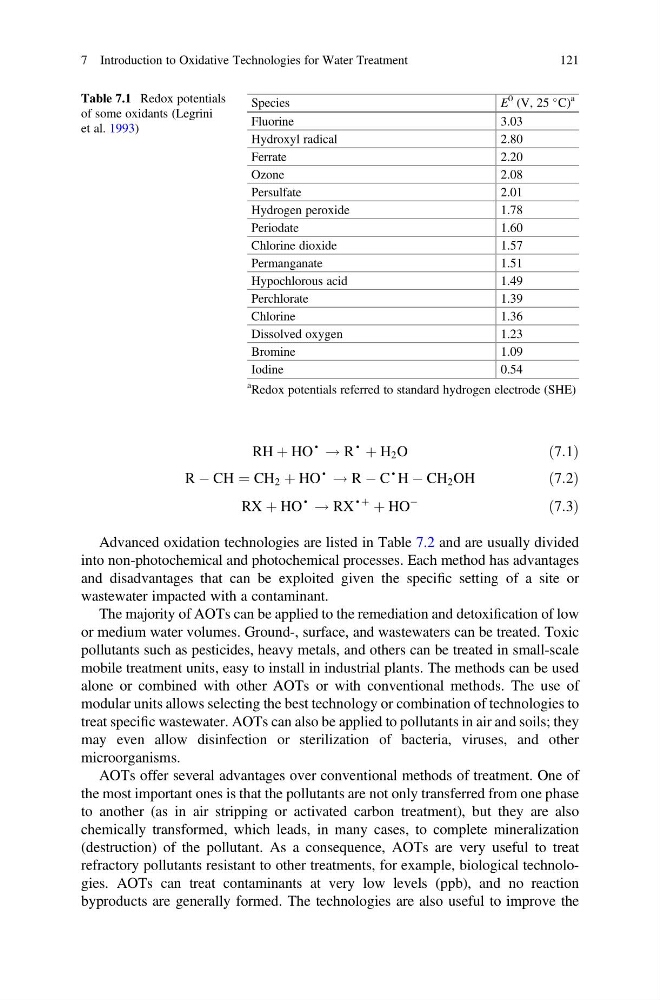
RH þ HO
•
! R
•
þ H 2 O
ð7:1Þ
R À CH ¼ CH 2 þ HO
•
! R À C
• H À CH 2 OH
ð7:2Þ
RX þ HO
•
! RX
• þ
þ HO
À
ð7:3Þ
Advanced oxidation technologies are listed in Table 7.2 and are usually divided
into non-photochemical and photochemical processes. Each method has advantages
and disadvantages that can be exploited given the specific setting of a site or
wastewater impacted with a contaminant.
The majority of AOTs can be applied to the remediation and detoxification of low
or medium water volumes. Ground-, surface, and wastewaters can be treated. Toxic
pollutants such as pesticides, heavy metals, and others can be treated in small-scale
mobile treatment units, easy to install in industrial plants. The methods can be used
alone or combined with other AOTs or with conventional methods. The use of
modular units allows selecting the best technology or combination of technologies to
treat specific wastewater. AOTs can also be applied to pollutants in air and soils; they
may even allow disinfection or sterilization of bacteria, viruses, and other
microorganisms.
AOTs offer several advantages over conventional methods of treatment. One of
the most important ones is that the pollutants are not only transferred from one phase
to another (as in air stripping or activated carbon treatment), but they are also
chemically transformed, which leads, in many cases, to complete mineralization
(destruction) of the pollutant. As a consequence, AOTs are very useful to treat
refractory pollutants resistant to other treatments, for example, biological technologies. AOTs can treat contaminants at very low levels (ppb), and no reaction
byproducts are generally formed. The technologies are also useful to improve the
Table 7.1 Redox potentials
of some oxidants (Legrini
et al. 1993)
Species
E
0 (V, 25
C)
a
Fluorine
3.03
Hydroxyl radical
2.80
Ferrate
2.20
Ozone
2.08
Persulfate
2.01
Hydrogen peroxide
1.78
Periodate
1.60
Chlorine dioxide
1.57
Permanganate
1.51
Hypochlorous acid
1.49
Perchlorate
1.39
Chlorine
1.36
Dissolved oxygen
1.23
Bromine
1.09
Iodine
0.54
a Redox potentials referred to standard hydrogen electrode (SHE)
7 Introduction to Oxidative Technologies for Water Treatment
121
•
! R
•
þ H 2 O
ð7:1Þ
R À CH ¼ CH 2 þ HO
•
! R À C
• H À CH 2 OH
ð7:2Þ
RX þ HO
•
! RX
• þ
þ HO
À
ð7:3Þ
Advanced oxidation technologies are listed in Table 7.2 and are usually divided
into non-photochemical and photochemical processes. Each method has advantages
and disadvantages that can be exploited given the specific setting of a site or
wastewater impacted with a contaminant.
The majority of AOTs can be applied to the remediation and detoxification of low
or medium water volumes. Ground-, surface, and wastewaters can be treated. Toxic
pollutants such as pesticides, heavy metals, and others can be treated in small-scale
mobile treatment units, easy to install in industrial plants. The methods can be used
alone or combined with other AOTs or with conventional methods. The use of
modular units allows selecting the best technology or combination of technologies to
treat specific wastewater. AOTs can also be applied to pollutants in air and soils; they
may even allow disinfection or sterilization of bacteria, viruses, and other
microorganisms.
AOTs offer several advantages over conventional methods of treatment. One of
the most important ones is that the pollutants are not only transferred from one phase
to another (as in air stripping or activated carbon treatment), but they are also
chemically transformed, which leads, in many cases, to complete mineralization
(destruction) of the pollutant. As a consequence, AOTs are very useful to treat
refractory pollutants resistant to other treatments, for example, biological technologies. AOTs can treat contaminants at very low levels (ppb), and no reaction
byproducts are generally formed. The technologies are also useful to improve the
Table 7.1 Redox potentials
of some oxidants (Legrini
et al. 1993)
Species
E
0 (V, 25
C)
a
Fluorine
3.03
Hydroxyl radical
2.80
Ferrate
2.20
Ozone
2.08
Persulfate
2.01
Hydrogen peroxide
1.78
Periodate
1.60
Chlorine dioxide
1.57
Permanganate
1.51
Hypochlorous acid
1.49
Perchlorate
1.39
Chlorine
1.36
Dissolved oxygen
1.23
Bromine
1.09
Iodine
0.54
a Redox potentials referred to standard hydrogen electrode (SHE)
7 Introduction to Oxidative Technologies for Water Treatment
121