

for our well-being. Trace level detection of mercury is reported by various different
methodologies including Electrochemical, Florescence spectroscopy, Colorimetry,
SERS, ICP-MS and others [38, 53–55]. Some excellent reviews exist in the field of
detection of trace level mercury [53, 56]. As per the theme of this chapter, we will
limit our discussion to nanofiber related sensors only.
A very interesting article by Senthamizhan et al. [57] offers real time selective
visual monitoring of Hg
2+ ions utilizing fluorescent gold nanoclusters decorated
over polycaprolactone nanofibers. For immobilization, the nanofibers were kept
immersed in a solution of bovine serum albumin (BSA) coated gold nanocluster for
different time periods. The detection was extremely selective towards Hg
2+ and
exhibits stability of over four months. The nanofiber helped in avoiding Au
nanoparticle aggregation and was used as a support matrix. Another article by Yu
et al. [58] utilizes BSA nanofibers coated with gold nanoclusters and graphene
oxide for fluorescence based detection of mercury. The LOD reported was
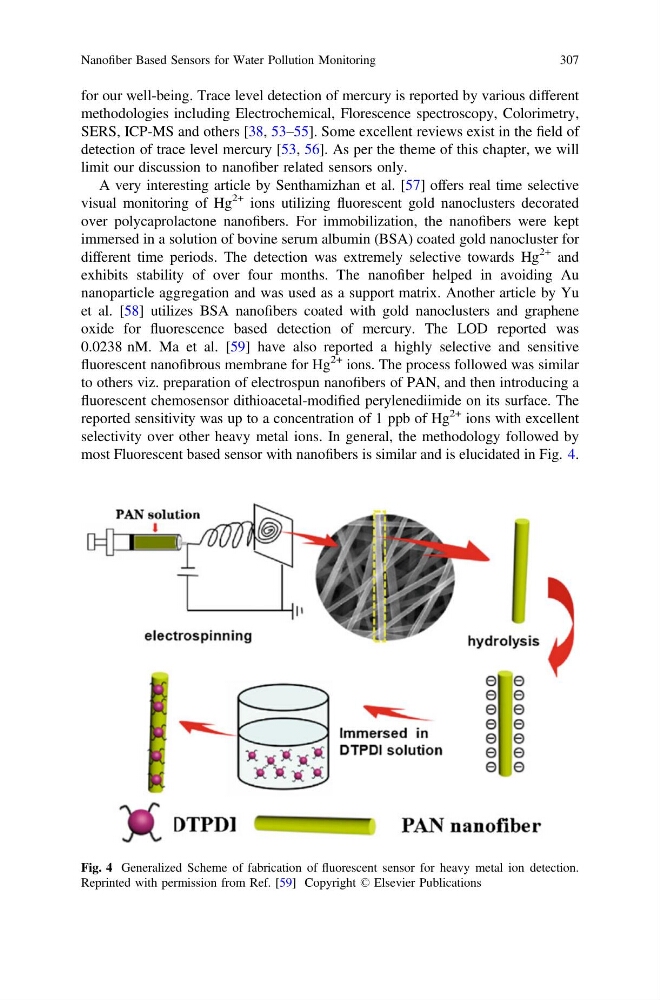
0.0238 nM. Ma et al. [59] have also reported a highly selective and sensitive
fluorescent nanofibrous membrane for Hg
2+ ions. The process followed was similar
to others viz. preparation of electrospun nanofibers of PAN, and then introducing a
fluorescent chemosensor dithioacetal-modified perylenediimide on its surface. The
reported sensitivity was up to a concentration of 1 ppb of Hg
2+ ions with excellent
selectivity over other heavy metal ions. In general, the methodology followed by
most Fluorescent based sensor with nanofibers is similar and is elucidated in Fig. 4.
Fig. 4 Generalized Scheme of fabrication of fluorescent sensor for heavy metal ion detection.
Reprinted with permission from Ref. [59] Copyright © Elsevier Publications
Nanofiber Based Sensors for Water Pollution Monitoring
307
methodologies including Electrochemical, Florescence spectroscopy, Colorimetry,
SERS, ICP-MS and others [38, 53–55]. Some excellent reviews exist in the field of
detection of trace level mercury [53, 56]. As per the theme of this chapter, we will
limit our discussion to nanofiber related sensors only.
A very interesting article by Senthamizhan et al. [57] offers real time selective
visual monitoring of Hg
2+ ions utilizing fluorescent gold nanoclusters decorated
over polycaprolactone nanofibers. For immobilization, the nanofibers were kept
immersed in a solution of bovine serum albumin (BSA) coated gold nanocluster for
different time periods. The detection was extremely selective towards Hg
2+ and
exhibits stability of over four months. The nanofiber helped in avoiding Au
nanoparticle aggregation and was used as a support matrix. Another article by Yu
et al. [58] utilizes BSA nanofibers coated with gold nanoclusters and graphene
oxide for fluorescence based detection of mercury. The LOD reported was
0.0238 nM. Ma et al. [59] have also reported a highly selective and sensitive
fluorescent nanofibrous membrane for Hg
2+ ions. The process followed was similar
to others viz. preparation of electrospun nanofibers of PAN, and then introducing a
fluorescent chemosensor dithioacetal-modified perylenediimide on its surface. The
reported sensitivity was up to a concentration of 1 ppb of Hg
2+ ions with excellent
selectivity over other heavy metal ions. In general, the methodology followed by
most Fluorescent based sensor with nanofibers is similar and is elucidated in Fig. 4.
Fig. 4 Generalized Scheme of fabrication of fluorescent sensor for heavy metal ion detection.
Reprinted with permission from Ref. [59] Copyright © Elsevier Publications
Nanofiber Based Sensors for Water Pollution Monitoring
307