

by the nanofiber nets, high porosity and tree network structure of sensing material
aided in better sensitivity and detection limits.
Zhang et al. [50] have reported amplified detection of picomolar concentration of
metal ions by Plasmon-enhanced fluorescence. Similar to SERS, the substrate of
polyacrylonitrile/noble metal/SiO 2 nanofiber mats were prepared. This enhanced
the fluorescence intensity of conjugated polyelectrolytes which was further dramatically quenched in presence of the picomolar concentration of heavy metal ions
including Pb
2+ . Electrochemistry based approaches also find nanofiber as a suitable
material for electrode fabrication/modification. Rafols et al. [51] have used
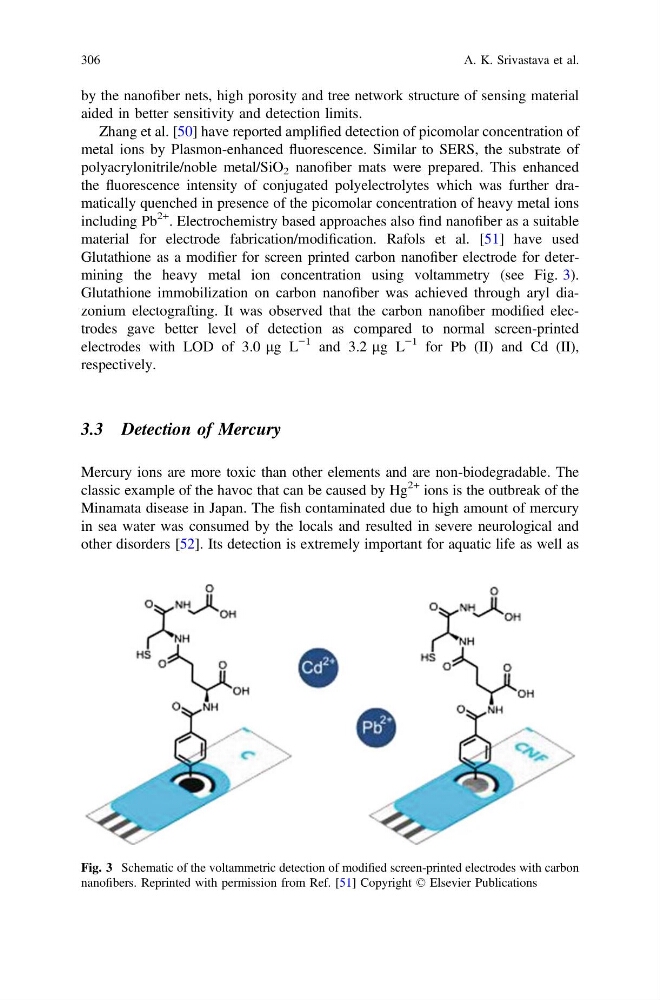
Glutathione as a modifier for screen printed carbon nanofiber electrode for determining the heavy metal ion concentration using voltammetry (see Fig. 3).
Glutathione immobilization on carbon nanofiber was achieved through aryl diazonium electografting. It was observed that the carbon nanofiber modified electrodes gave better level of detection as compared to normal screen-printed
electrodes with LOD of 3.0 lg L
−1 and 3.2 lg L
−1 for Pb (II) and Cd (II),
respectively.
3.3 Detection of Mercury
Mercury ions are more toxic than other elements and are non-biodegradable. The
classic example of the havoc that can be caused by Hg
2+ ions is the outbreak of the
Minamata disease in Japan. The fish contaminated due to high amount of mercury
in sea water was consumed by the locals and resulted in severe neurological and
other disorders [52]. Its detection is extremely important for aquatic life as well as
Fig. 3 Schematic of the voltammetric detection of modified screen-printed electrodes with carbon
nanofibers. Reprinted with permission from Ref. [51] Copyright © Elsevier Publications
306
A. K. Srivastava et al.
aided in better sensitivity and detection limits.
Zhang et al. [50] have reported amplified detection of picomolar concentration of
metal ions by Plasmon-enhanced fluorescence. Similar to SERS, the substrate of
polyacrylonitrile/noble metal/SiO 2 nanofiber mats were prepared. This enhanced
the fluorescence intensity of conjugated polyelectrolytes which was further dramatically quenched in presence of the picomolar concentration of heavy metal ions
including Pb
2+ . Electrochemistry based approaches also find nanofiber as a suitable
material for electrode fabrication/modification. Rafols et al. [51] have used
Glutathione as a modifier for screen printed carbon nanofiber electrode for determining the heavy metal ion concentration using voltammetry (see Fig. 3).
Glutathione immobilization on carbon nanofiber was achieved through aryl diazonium electografting. It was observed that the carbon nanofiber modified electrodes gave better level of detection as compared to normal screen-printed
electrodes with LOD of 3.0 lg L
−1 and 3.2 lg L
−1 for Pb (II) and Cd (II),
respectively.
3.3 Detection of Mercury
Mercury ions are more toxic than other elements and are non-biodegradable. The
classic example of the havoc that can be caused by Hg
2+ ions is the outbreak of the
Minamata disease in Japan. The fish contaminated due to high amount of mercury
in sea water was consumed by the locals and resulted in severe neurological and
other disorders [52]. Its detection is extremely important for aquatic life as well as
Fig. 3 Schematic of the voltammetric detection of modified screen-printed electrodes with carbon
nanofibers. Reprinted with permission from Ref. [51] Copyright © Elsevier Publications
306
A. K. Srivastava et al.