

but it was used for therapeutic purposes so not discussed here. Using paper as a
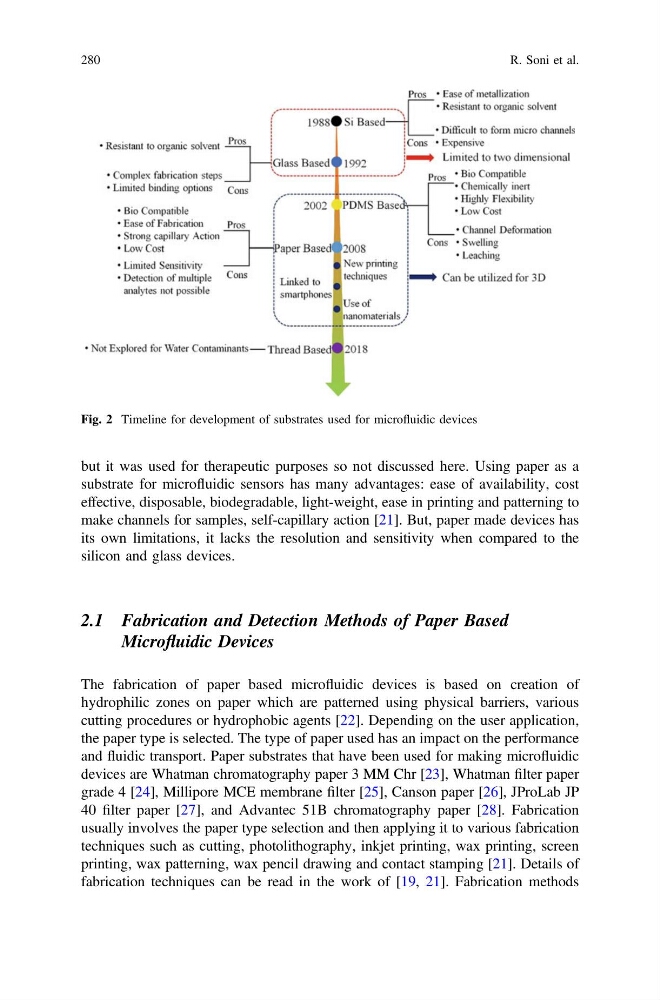
substrate for microfluidic sensors has many advantages: ease of availability, cost
effective, disposable, biodegradable, light-weight, ease in printing and patterning to
make channels for samples, self-capillary action [21]. But, paper made devices has
its own limitations, it lacks the resolution and sensitivity when compared to the
silicon and glass devices.
2.1 Fabrication and Detection Methods of Paper Based
Microfluidic Devices
The fabrication of paper based microfluidic devices is based on creation of
hydrophilic zones on paper which are patterned using physical barriers, various
cutting procedures or hydrophobic agents [22]. Depending on the user application,
the paper type is selected. The type of paper used has an impact on the performance
and fluidic transport. Paper substrates that have been used for making microfluidic
devices are Whatman chromatography paper 3 MM Chr [23], Whatman filter paper
grade 4 [24], Millipore MCE membrane filter [25], Canson paper [26], JProLab JP
40 filter paper [27], and Advantec 51B chromatography paper [28]. Fabrication
usually involves the paper type selection and then applying it to various fabrication
techniques such as cutting, photolithography, inkjet printing, wax printing, screen
printing, wax patterning, wax pencil drawing and contact stamping [21]. Details of
fabrication techniques can be read in the work of [19, 21]. Fabrication methods
Fig. 2 Timeline for development of substrates used for microfluidic devices
280
R. Soni et al.
substrate for microfluidic sensors has many advantages: ease of availability, cost
effective, disposable, biodegradable, light-weight, ease in printing and patterning to
make channels for samples, self-capillary action [21]. But, paper made devices has
its own limitations, it lacks the resolution and sensitivity when compared to the
silicon and glass devices.
2.1 Fabrication and Detection Methods of Paper Based
Microfluidic Devices
The fabrication of paper based microfluidic devices is based on creation of
hydrophilic zones on paper which are patterned using physical barriers, various
cutting procedures or hydrophobic agents [22]. Depending on the user application,
the paper type is selected. The type of paper used has an impact on the performance
and fluidic transport. Paper substrates that have been used for making microfluidic
devices are Whatman chromatography paper 3 MM Chr [23], Whatman filter paper
grade 4 [24], Millipore MCE membrane filter [25], Canson paper [26], JProLab JP
40 filter paper [27], and Advantec 51B chromatography paper [28]. Fabrication
usually involves the paper type selection and then applying it to various fabrication
techniques such as cutting, photolithography, inkjet printing, wax printing, screen
printing, wax patterning, wax pencil drawing and contact stamping [21]. Details of
fabrication techniques can be read in the work of [19, 21]. Fabrication methods
Fig. 2 Timeline for development of substrates used for microfluidic devices
280
R. Soni et al.