

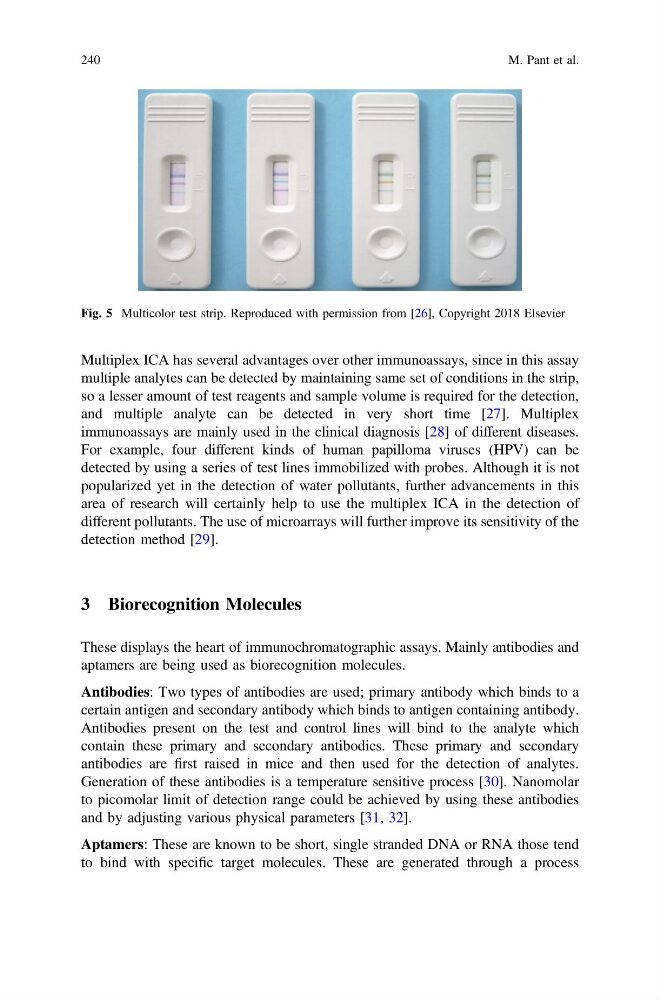
Multiplex ICA has several advantages over other immunoassays, since in this assay
multiple analytes can be detected by maintaining same set of conditions in the strip,
so a lesser amount of test reagents and sample volume is required for the detection,
and multiple analyte can be detected in very short time [27]. Multiplex
immunoassays are mainly used in the clinical diagnosis [28] of different diseases.
For example, four different kinds of human papilloma viruses (HPV) can be
detected by using a series of test lines immobilized with probes. Although it is not
popularized yet in the detection of water pollutants, further advancements in this
area of research will certainly help to use the multiplex ICA in the detection of
different pollutants. The use of microarrays will further improve its sensitivity of the
detection method [29].
3 Biorecognition Molecules
These displays the heart of immunochromatographic assays. Mainly antibodies and
aptamers are being used as biorecognition molecules.
Antibodies: Two types of antibodies are used; primary antibody which binds to a
certain antigen and secondary antibody which binds to antigen containing antibody.
Antibodies present on the test and control lines will bind to the analyte which
contain these primary and secondary antibodies. These primary and secondary
antibodies are first raised in mice and then used for the detection of analytes.
Generation of these antibodies is a temperature sensitive process [30]. Nanomolar
to picomolar limit of detection range could be achieved by using these antibodies
and by adjusting various physical parameters [31, 32].
Aptamers: These are known to be short, single stranded DNA or RNA those tend
to bind with specific target molecules. These are generated through a process
Fig. 5 Multicolor test strip. Reproduced with permission from [26], Copyright 2018 Elsevier
240
M. Pant et al.
multiple analytes can be detected by maintaining same set of conditions in the strip,
so a lesser amount of test reagents and sample volume is required for the detection,
and multiple analyte can be detected in very short time [27]. Multiplex
immunoassays are mainly used in the clinical diagnosis [28] of different diseases.
For example, four different kinds of human papilloma viruses (HPV) can be
detected by using a series of test lines immobilized with probes. Although it is not
popularized yet in the detection of water pollutants, further advancements in this
area of research will certainly help to use the multiplex ICA in the detection of
different pollutants. The use of microarrays will further improve its sensitivity of the
detection method [29].
3 Biorecognition Molecules
These displays the heart of immunochromatographic assays. Mainly antibodies and
aptamers are being used as biorecognition molecules.
Antibodies: Two types of antibodies are used; primary antibody which binds to a
certain antigen and secondary antibody which binds to antigen containing antibody.
Antibodies present on the test and control lines will bind to the analyte which
contain these primary and secondary antibodies. These primary and secondary
antibodies are first raised in mice and then used for the detection of analytes.
Generation of these antibodies is a temperature sensitive process [30]. Nanomolar
to picomolar limit of detection range could be achieved by using these antibodies
and by adjusting various physical parameters [31, 32].
Aptamers: These are known to be short, single stranded DNA or RNA those tend
to bind with specific target molecules. These are generated through a process
Fig. 5 Multicolor test strip. Reproduced with permission from [26], Copyright 2018 Elsevier
240
M. Pant et al.