

more sensitive (0.5 nM) than a DNA-zyme coupled with electrochemical system
(0.3 lM) [77]. These examples underline that DNA is the favoured type of nucleic
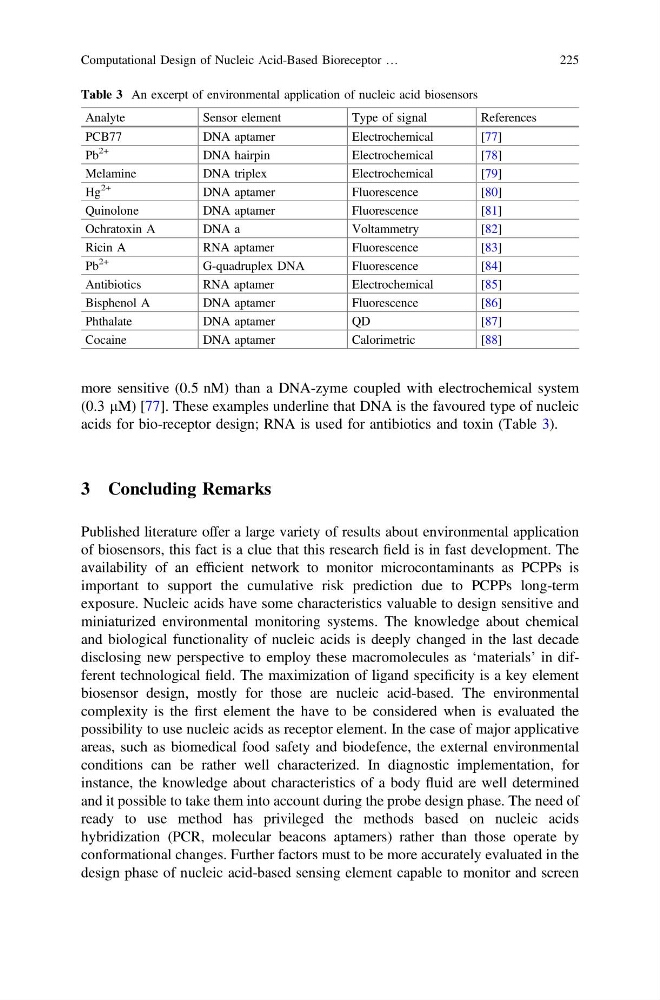
acids for bio-receptor design; RNA is used for antibiotics and toxin (Table 3).
3 Concluding Remarks
Published literature offer a large variety of results about environmental application
of biosensors, this fact is a clue that this research field is in fast development. The
availability of an efficient network to monitor microcontaminants as PCPPs is
important to support the cumulative risk prediction due to PCPPs long-term
exposure. Nucleic acids have some characteristics valuable to design sensitive and
miniaturized environmental monitoring systems. The knowledge about chemical
and biological functionality of nucleic acids is deeply changed in the last decade
disclosing new perspective to employ these macromolecules as ‘materials’ in different technological field. The maximization of ligand specificity is a key element
biosensor design, mostly for those are nucleic acid-based. The environmental
complexity is the first element the have to be considered when is evaluated the
possibility to use nucleic acids as receptor element. In the case of major applicative
areas, such as biomedical food safety and biodefence, the external environmental
conditions can be rather well characterized. In diagnostic implementation, for
instance, the knowledge about characteristics of a body fluid are well determined
and it possible to take them into account during the probe design phase. The need of
ready to use method has privileged the methods based on nucleic acids
hybridization (PCR, molecular beacons aptamers) rather than those operate by
conformational changes. Further factors must to be more accurately evaluated in the
design phase of nucleic acid-based sensing element capable to monitor and screen
Table 3 An excerpt of environmental application of nucleic acid biosensors
Analyte
Sensor element
Type of signal
References
PCB77
DNA aptamer
Electrochemical
[77]
Pb
2+
DNA hairpin
Electrochemical
[78]
Melamine
DNA triplex
Electrochemical
[79]
Hg
2+
DNA aptamer
Fluorescence
[80]
Quinolone
DNA aptamer
Fluorescence
[81]
Ochratoxin A
DNA a
Voltammetry
[82]
Ricin A
RNA aptamer
Fluorescence
[83]
Pb
2+
G-quadruplex DNA
Fluorescence
[84]
Antibiotics
RNA aptamer
Electrochemical
[85]
Bisphenol A
DNA aptamer
Fluorescence
[86]
Phthalate
DNA aptamer
QD
[87]
Cocaine
DNA aptamer
Calorimetric
[88]
Computational Design of Nucleic Acid-Based Bioreceptor …
225
(0.3 lM) [77]. These examples underline that DNA is the favoured type of nucleic
acids for bio-receptor design; RNA is used for antibiotics and toxin (Table 3).
3 Concluding Remarks
Published literature offer a large variety of results about environmental application
of biosensors, this fact is a clue that this research field is in fast development. The
availability of an efficient network to monitor microcontaminants as PCPPs is
important to support the cumulative risk prediction due to PCPPs long-term
exposure. Nucleic acids have some characteristics valuable to design sensitive and
miniaturized environmental monitoring systems. The knowledge about chemical
and biological functionality of nucleic acids is deeply changed in the last decade
disclosing new perspective to employ these macromolecules as ‘materials’ in different technological field. The maximization of ligand specificity is a key element
biosensor design, mostly for those are nucleic acid-based. The environmental
complexity is the first element the have to be considered when is evaluated the
possibility to use nucleic acids as receptor element. In the case of major applicative
areas, such as biomedical food safety and biodefence, the external environmental
conditions can be rather well characterized. In diagnostic implementation, for
instance, the knowledge about characteristics of a body fluid are well determined
and it possible to take them into account during the probe design phase. The need of
ready to use method has privileged the methods based on nucleic acids
hybridization (PCR, molecular beacons aptamers) rather than those operate by
conformational changes. Further factors must to be more accurately evaluated in the
design phase of nucleic acid-based sensing element capable to monitor and screen
Table 3 An excerpt of environmental application of nucleic acid biosensors
Analyte
Sensor element
Type of signal
References
PCB77
DNA aptamer
Electrochemical
[77]
Pb
2+
DNA hairpin
Electrochemical
[78]
Melamine
DNA triplex
Electrochemical
[79]
Hg
2+
DNA aptamer
Fluorescence
[80]
Quinolone
DNA aptamer
Fluorescence
[81]
Ochratoxin A
DNA a
Voltammetry
[82]
Ricin A
RNA aptamer
Fluorescence
[83]
Pb
2+
G-quadruplex DNA
Fluorescence
[84]
Antibiotics
RNA aptamer
Electrochemical
[85]
Bisphenol A
DNA aptamer
Fluorescence
[86]
Phthalate
DNA aptamer
QD
[87]
Cocaine
DNA aptamer
Calorimetric
[88]
Computational Design of Nucleic Acid-Based Bioreceptor …
225