

and their biosynthetic pathways [48]. When possible and available, it is essential,
for the design of a good bio-receptor, to acquire information about ligands to
estimate both the sensitivity of the probe and the effects on receptor stability. The
potential target can be easily extracted from chemical or toxicological databases.
There are other repositories, highly valuable for bioreceptor design, containing
specific information about ligands (inorganic or organic) interacting with nucleic
acids. Information can be also stored in generalist databases and even in small
database such as the following: (1) MINAS that contains experimental data about
metal ions interacting with nucleic acids [49]; (2) NPIDB that store data about
protein-nucleic acid interactions [50]; (3) BioMe is repository of data about ionic
binding site in protein and nucleic acids [51]; (4) SMMRNA consists of data
concerning the small molecules modulating RNAs [52]. The selection and design of
a biosensor depend on the ligand to be detected; it is different, for instance, to
design a structure for molecular beacons [53] or for immobilization of the sensing
element on a transducing surface or for a nanoparticle design. An initial ‘in silico’
structural analysis could consent to select the type of nucleic acid that better fit to
sense a specific organic small molecule. The conformational characterization of a
candidate probe can be performed using different bioinformatic tools. There is a
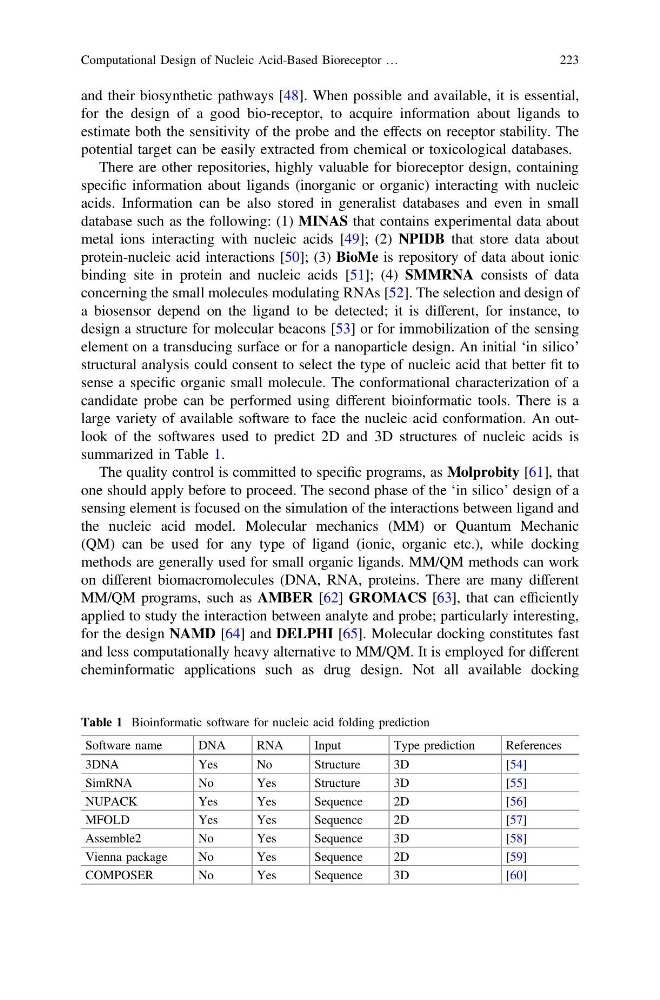
large variety of available software to face the nucleic acid conformation. An outlook of the softwares used to predict 2D and 3D structures of nucleic acids is
summarized in Table 1.
The quality control is committed to specific programs, as Molprobity [61], that
one should apply before to proceed. The second phase of the ‘in silico’ design of a
sensing element is focused on the simulation of the interactions between ligand and
the nucleic acid model. Molecular mechanics (MM) or Quantum Mechanic
(QM) can be used for any type of ligand (ionic, organic etc.), while docking
methods are generally used for small organic ligands. MM/QM methods can work
on different biomacromolecules (DNA, RNA, proteins. There are many different
MM/QM programs, such as AMBER [62] GROMACS [63], that can efficiently
applied to study the interaction between analyte and probe; particularly interesting,
for the design NAMD [64] and DELPHI [65]. Molecular docking constitutes fast
and less computationally heavy alternative to MM/QM. It is employed for different
cheminformatic applications such as drug design. Not all available docking
Table 1 Bioinformatic software for nucleic acid folding prediction
Software name
DNA
RNA
Input
Type prediction
References
3DNA
Yes
No
Structure
3D
[54]
SimRNA
No
Yes
Structure
3D
[55]
NUPACK
Yes
Yes
Sequence
2D
[56]
MFOLD
Yes
Yes
Sequence
2D
[57]
Assemble2
No
Yes
Sequence
3D
[58]
Vienna package
No
Yes
Sequence
2D
[59]
COMPOSER
No
Yes
Sequence
3D
[60]
Computational Design of Nucleic Acid-Based Bioreceptor …
223
for the design of a good bio-receptor, to acquire information about ligands to
estimate both the sensitivity of the probe and the effects on receptor stability. The
potential target can be easily extracted from chemical or toxicological databases.
There are other repositories, highly valuable for bioreceptor design, containing
specific information about ligands (inorganic or organic) interacting with nucleic
acids. Information can be also stored in generalist databases and even in small
database such as the following: (1) MINAS that contains experimental data about
metal ions interacting with nucleic acids [49]; (2) NPIDB that store data about
protein-nucleic acid interactions [50]; (3) BioMe is repository of data about ionic
binding site in protein and nucleic acids [51]; (4) SMMRNA consists of data
concerning the small molecules modulating RNAs [52]. The selection and design of
a biosensor depend on the ligand to be detected; it is different, for instance, to
design a structure for molecular beacons [53] or for immobilization of the sensing
element on a transducing surface or for a nanoparticle design. An initial ‘in silico’
structural analysis could consent to select the type of nucleic acid that better fit to
sense a specific organic small molecule. The conformational characterization of a
candidate probe can be performed using different bioinformatic tools. There is a
large variety of available software to face the nucleic acid conformation. An outlook of the softwares used to predict 2D and 3D structures of nucleic acids is
summarized in Table 1.
The quality control is committed to specific programs, as Molprobity [61], that
one should apply before to proceed. The second phase of the ‘in silico’ design of a
sensing element is focused on the simulation of the interactions between ligand and
the nucleic acid model. Molecular mechanics (MM) or Quantum Mechanic
(QM) can be used for any type of ligand (ionic, organic etc.), while docking
methods are generally used for small organic ligands. MM/QM methods can work
on different biomacromolecules (DNA, RNA, proteins. There are many different
MM/QM programs, such as AMBER [62] GROMACS [63], that can efficiently
applied to study the interaction between analyte and probe; particularly interesting,
for the design NAMD [64] and DELPHI [65]. Molecular docking constitutes fast
and less computationally heavy alternative to MM/QM. It is employed for different
cheminformatic applications such as drug design. Not all available docking
Table 1 Bioinformatic software for nucleic acid folding prediction
Software name
DNA
RNA
Input
Type prediction
References
3DNA
Yes
No
Structure
3D
[54]
SimRNA
No
Yes
Structure
3D
[55]
NUPACK
Yes
Yes
Sequence
2D
[56]
MFOLD
Yes
Yes
Sequence
2D
[57]
Assemble2
No
Yes
Sequence
3D
[58]
Vienna package
No
Yes
Sequence
2D
[59]
COMPOSER
No
Yes
Sequence
3D
[60]
Computational Design of Nucleic Acid-Based Bioreceptor …
223