

The RNAs, unlike DNA, can be employed to model a scaffold. A scaffold is
natural or synthetic functional RNA structure able to optimize a reaction, recognize
a molecule or intervent in molecular interactions [32]. The RNA scaffolds are
designed using different computational methods and, for instance, applied for
CRISP-Cas9 transcriptional control [33]. The RNA scaffolds could be included
among nucleic acids nanostructures. Today there is the knowledge and technology
to engineer complex nucleic acids nanoparticles. They can be utilized to control
cellular processes, as carrier for drug delivery and to screen specific substances.
Even if the majority of applications are biomedical it is reasonable to apply DNA
and RNA biosensors in different sectors such as for instance, environmental
monitoring. The design of DNA based nanostructure could be carried out using
different approaches: (1) tile self-assembly [34] utilizes basic structural elements to
originate an intermediate structure (the tile) capable to be arranged in a more
complex architecture; (2) Folding method is founded on the capability of a large
DNA to fold itself (DNA origami); (3) Kinetic based method requires the direct
control of dynamic parameters governing the self-assembly process. The folding
method, often indicated as DNA origami, seems to be the widely used; it is necessary to underline that the selection can be made taking the application into
account. The term “DNA origami” defines the operational protocol to generate a
complete DNA nanostructure starting from a ssDNA [35] or dsDNA and short
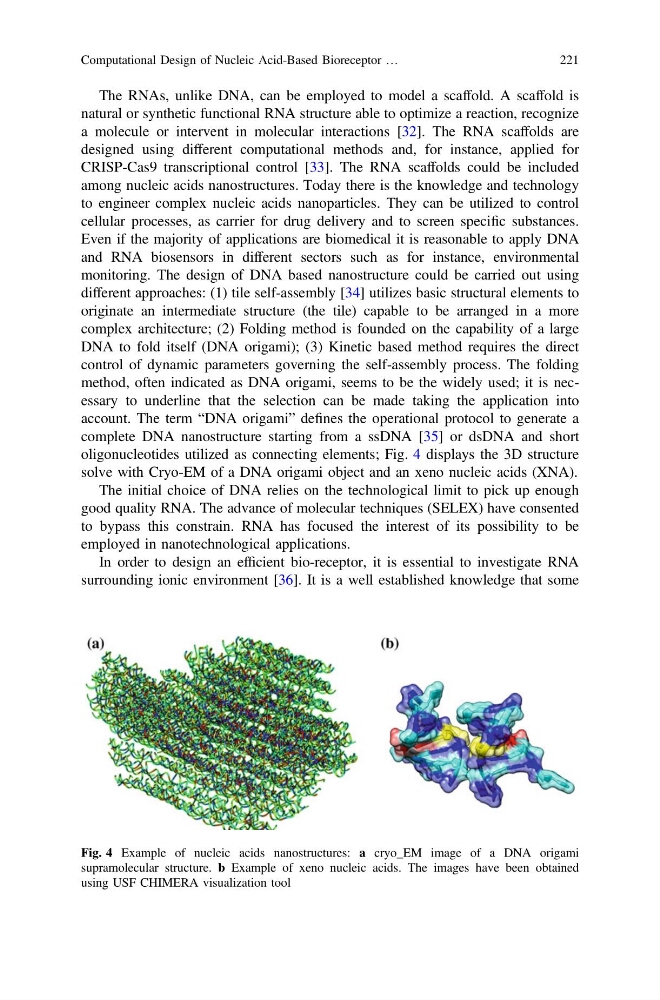
oligonucleotides utilized as connecting elements; Fig. 4 displays the 3D structure
solve with Cryo-EM of a DNA origami object and an xeno nucleic acids (XNA).
The initial choice of DNA relies on the technological limit to pick up enough
good quality RNA. The advance of molecular techniques (SELEX) have consented
to bypass this constrain. RNA has focused the interest of its possibility to be
employed in nanotechnological applications.
In order to design an efficient bio-receptor, it is essential to investigate RNA
surrounding ionic environment [36]. It is a well established knowledge that some
Fig. 4 Example of nucleic acids nanostructures: a cryo_EM image of a DNA origami
supramolecular structure. b Example of xeno nucleic acids. The images have been obtained
using USF CHIMERA visualization tool
Computational Design of Nucleic Acid-Based Bioreceptor …
221
natural or synthetic functional RNA structure able to optimize a reaction, recognize
a molecule or intervent in molecular interactions [32]. The RNA scaffolds are
designed using different computational methods and, for instance, applied for
CRISP-Cas9 transcriptional control [33]. The RNA scaffolds could be included
among nucleic acids nanostructures. Today there is the knowledge and technology
to engineer complex nucleic acids nanoparticles. They can be utilized to control
cellular processes, as carrier for drug delivery and to screen specific substances.
Even if the majority of applications are biomedical it is reasonable to apply DNA
and RNA biosensors in different sectors such as for instance, environmental
monitoring. The design of DNA based nanostructure could be carried out using
different approaches: (1) tile self-assembly [34] utilizes basic structural elements to
originate an intermediate structure (the tile) capable to be arranged in a more
complex architecture; (2) Folding method is founded on the capability of a large
DNA to fold itself (DNA origami); (3) Kinetic based method requires the direct
control of dynamic parameters governing the self-assembly process. The folding
method, often indicated as DNA origami, seems to be the widely used; it is necessary to underline that the selection can be made taking the application into
account. The term “DNA origami” defines the operational protocol to generate a
complete DNA nanostructure starting from a ssDNA [35] or dsDNA and short
oligonucleotides utilized as connecting elements; Fig. 4 displays the 3D structure
solve with Cryo-EM of a DNA origami object and an xeno nucleic acids (XNA).
The initial choice of DNA relies on the technological limit to pick up enough
good quality RNA. The advance of molecular techniques (SELEX) have consented
to bypass this constrain. RNA has focused the interest of its possibility to be
employed in nanotechnological applications.
In order to design an efficient bio-receptor, it is essential to investigate RNA
surrounding ionic environment [36]. It is a well established knowledge that some
Fig. 4 Example of nucleic acids nanostructures: a cryo_EM image of a DNA origami
supramolecular structure. b Example of xeno nucleic acids. The images have been obtained
using USF CHIMERA visualization tool
Computational Design of Nucleic Acid-Based Bioreceptor …
221