

DNAzymes (Deoxyribonucleotide enzymes) are catalytic DNAs with activity
comparable to Ribozyme [30]. The break of dsDNA generates ssDNA capable to
fold itself in different conformations that can have catalytic activity. DNAzyme
have been considered for biosensor development but they are not yet well characterized. Ribozymes are natural catalytic RNAs, known also as metalloenzymes
[31]. RNAs are capable to catalyze different complex chemical reactions such as
esterification, isomerization, etc. Ribozymes are roughly classified on the basis of
their length. The short and medium length ribozymes, including hairpin, hammerhead and pistol, have been employed for bioreceptor development. The
knowledge of natural ribozyme is an advantage for the design of artificial ribozymes sensing particular analytes. A ribozyme can be embedded in supramolecular
structure; the aptazyme.
An aptazyme has different functional modules: (a) a sensing element committed
to recognize the ligand; (b) an effector element, the true ribozyme, that perform the
catalysis; (c) a connector element that bridge together sensor and effector.
Riboswitches are natural regulatory elements, mostly recognized in bacteria, that
control the gene expression sensing specific small molecules or ions. They are
generally located in the 5′ region of a bacterial mRNA and can activate or deactivate the gene expression. A riboswitch is a complex structure formed by an
aptamer to sense the ligand and an expression platform in which there is the gene to
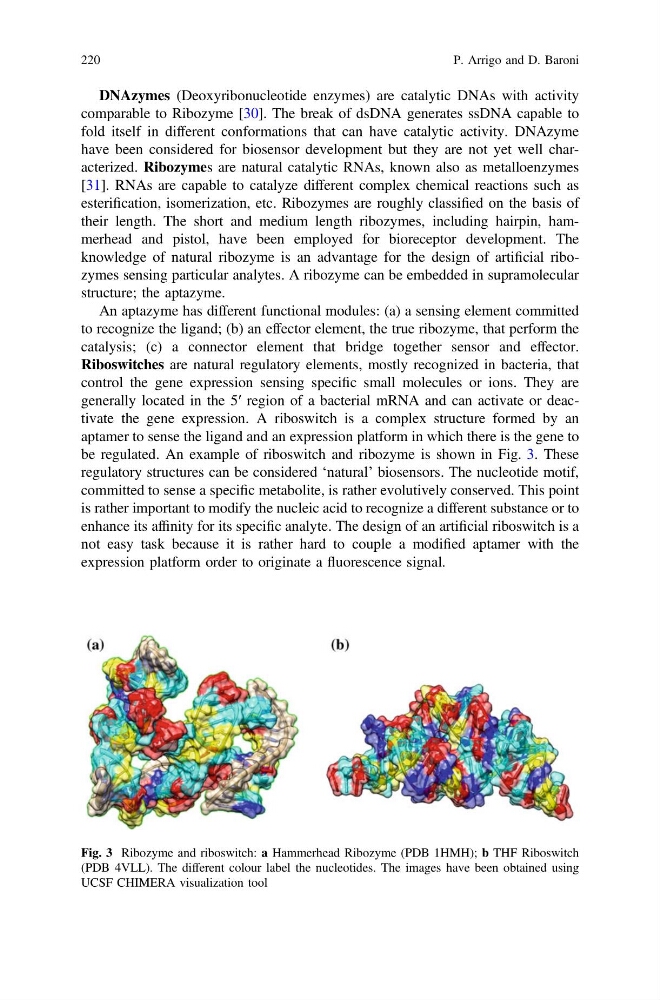
be regulated. An example of riboswitch and ribozyme is shown in Fig. 3. These
regulatory structures can be considered ‘natural’ biosensors. The nucleotide motif,
committed to sense a specific metabolite, is rather evolutively conserved. This point
is rather important to modify the nucleic acid to recognize a different substance or to
enhance its affinity for its specific analyte. The design of an artificial riboswitch is a
not easy task because it is rather hard to couple a modified aptamer with the
expression platform order to originate a fluorescence signal.
Fig. 3 Ribozyme and riboswitch: a Hammerhead Ribozyme (PDB 1HMH); b THF Riboswitch
(PDB 4VLL). The different colour label the nucleotides. The images have been obtained using
UCSF CHIMERA visualization tool
220
P. Arrigo and D. Baroni
comparable to Ribozyme [30]. The break of dsDNA generates ssDNA capable to
fold itself in different conformations that can have catalytic activity. DNAzyme
have been considered for biosensor development but they are not yet well characterized. Ribozymes are natural catalytic RNAs, known also as metalloenzymes
[31]. RNAs are capable to catalyze different complex chemical reactions such as
esterification, isomerization, etc. Ribozymes are roughly classified on the basis of
their length. The short and medium length ribozymes, including hairpin, hammerhead and pistol, have been employed for bioreceptor development. The
knowledge of natural ribozyme is an advantage for the design of artificial ribozymes sensing particular analytes. A ribozyme can be embedded in supramolecular
structure; the aptazyme.
An aptazyme has different functional modules: (a) a sensing element committed
to recognize the ligand; (b) an effector element, the true ribozyme, that perform the
catalysis; (c) a connector element that bridge together sensor and effector.
Riboswitches are natural regulatory elements, mostly recognized in bacteria, that
control the gene expression sensing specific small molecules or ions. They are
generally located in the 5′ region of a bacterial mRNA and can activate or deactivate the gene expression. A riboswitch is a complex structure formed by an
aptamer to sense the ligand and an expression platform in which there is the gene to
be regulated. An example of riboswitch and ribozyme is shown in Fig. 3. These
regulatory structures can be considered ‘natural’ biosensors. The nucleotide motif,
committed to sense a specific metabolite, is rather evolutively conserved. This point
is rather important to modify the nucleic acid to recognize a different substance or to
enhance its affinity for its specific analyte. The design of an artificial riboswitch is a
not easy task because it is rather hard to couple a modified aptamer with the
expression platform order to originate a fluorescence signal.
Fig. 3 Ribozyme and riboswitch: a Hammerhead Ribozyme (PDB 1HMH); b THF Riboswitch
(PDB 4VLL). The different colour label the nucleotides. The images have been obtained using
UCSF CHIMERA visualization tool
220
P. Arrigo and D. Baroni