

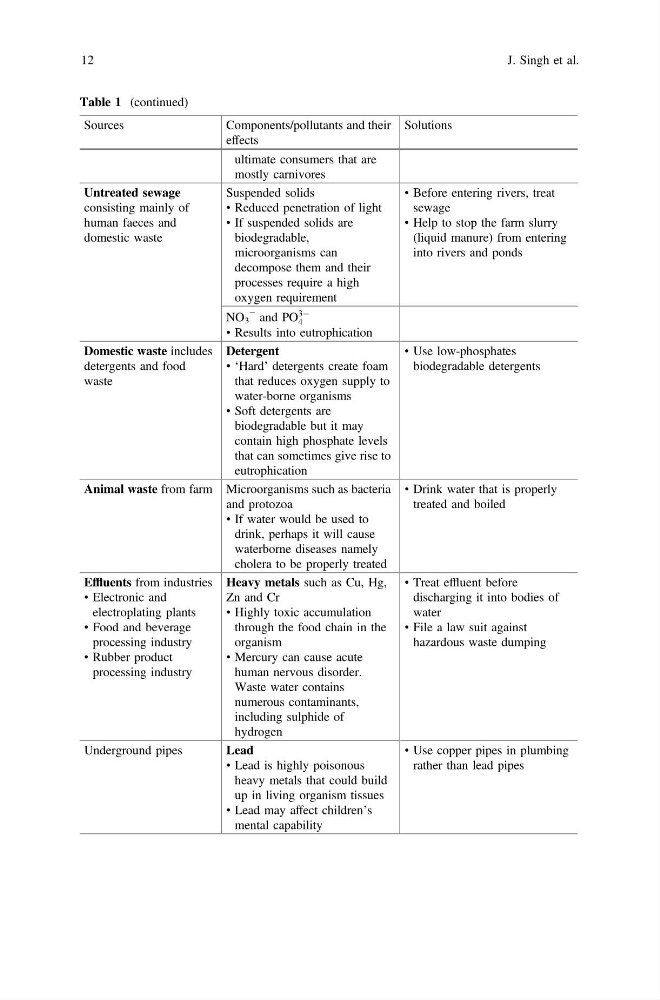
Table 1 (continued)
Sources
Components/pollutants and their
effects
Solutions
ultimate consumers that are
mostly carnivores
Untreated sewage
consisting mainly of
human faeces and
domestic waste
Suspended solids
• Reduced penetration of light
• If suspended solids are
biodegradable,
microorganisms can
decompose them and their
processes require a high
oxygen requirement
• Before entering rivers, treat
sewage
• Help to stop the farm slurry
(liquid manure) from entering
into rivers and ponds
NO 3
− and PO
3À
4
• Results into eutrophication
Domestic waste includes
detergents and food
waste
Detergent
• ‘Hard’ detergents create foam
that reduces oxygen supply to
water-borne organisms
• Soft detergents are
biodegradable but it may
contain high phosphate levels
that can sometimes give rise to
eutrophication
• Use low-phosphates
biodegradable detergents
Animal waste from farm Microorganisms such as bacteria
and protozoa
• If water would be used to
drink, perhaps it will cause
waterborne diseases namely
cholera to be properly treated
• Drink water that is properly
treated and boiled
Effluents from industries
• Electronic and
electroplating plants
• Food and beverage
processing industry
• Rubber product
processing industry
Heavy metals such as Cu, Hg,
Zn and Cr
• Highly toxic accumulation
through the food chain in the
organism
• Mercury can cause acute
human nervous disorder.
Waste water contains
numerous contaminants,
including sulphide of
hydrogen
• Treat effluent before
discharging it into bodies of
water
• File a law suit against
hazardous waste dumping
Underground pipes
Lead
• Lead is highly poisonous
heavy metals that could build
up in living organism tissues
• Lead may affect children’s
mental capability
• Use copper pipes in plumbing
rather than lead pipes
12
J. Singh et al.
Sources
Components/pollutants and their
effects
Solutions
ultimate consumers that are
mostly carnivores
Untreated sewage
consisting mainly of
human faeces and
domestic waste
Suspended solids
• Reduced penetration of light
• If suspended solids are
biodegradable,
microorganisms can
decompose them and their
processes require a high
oxygen requirement
• Before entering rivers, treat
sewage
• Help to stop the farm slurry
(liquid manure) from entering
into rivers and ponds
NO 3
− and PO
3À
4
• Results into eutrophication
Domestic waste includes
detergents and food
waste
Detergent
• ‘Hard’ detergents create foam
that reduces oxygen supply to
water-borne organisms
• Soft detergents are
biodegradable but it may
contain high phosphate levels
that can sometimes give rise to
eutrophication
• Use low-phosphates
biodegradable detergents
Animal waste from farm Microorganisms such as bacteria
and protozoa
• If water would be used to
drink, perhaps it will cause
waterborne diseases namely
cholera to be properly treated
• Drink water that is properly
treated and boiled
Effluents from industries
• Electronic and
electroplating plants
• Food and beverage
processing industry
• Rubber product
processing industry
Heavy metals such as Cu, Hg,
Zn and Cr
• Highly toxic accumulation
through the food chain in the
organism
• Mercury can cause acute
human nervous disorder.
Waste water contains
numerous contaminants,
including sulphide of
hydrogen
• Treat effluent before
discharging it into bodies of
water
• File a law suit against
hazardous waste dumping
Underground pipes
Lead
• Lead is highly poisonous
heavy metals that could build
up in living organism tissues
• Lead may affect children’s
mental capability
• Use copper pipes in plumbing
rather than lead pipes
12
J. Singh et al.