

The major problems associated with sewage are production of odors and spread
of enteric diseases besides organic pollution which leads to oxygen depletion and
fish-kill. Sewage also contains huge quantities of nutrients in the form of N 2 and
PO
3À
4
even after secondary treatment that often result in the problem of
eutrophication.
Another common way of sewage disposal is its land treatment or crop irrigation.
However, disposal in this way, without scientific considerations, can lead to the
severe health hazards and deterioration of land in the long run [10].
(c) Agricultural Wastes
Agricultural waste is the waste that originate generally from run-off from cultivated
arenas and animal farms. In the recent time, for promoting the growth of fruits and
vegetables, farmers add various kinds of agrochemicals that cause many kinds of
pollution problems. It can cause toxicity to aquatic life also [11].
(d) Industrial Wastes
Industrial waste is a waste that possess the potential for polluting water reservoirs
directly. Nature of industrial waste can vary from industry to industry and also on
time as it depends on the usage and type of raw materials used, different processes
and also operational factors. It is mentioned that industrial wastes are rich in organic
matter [1].
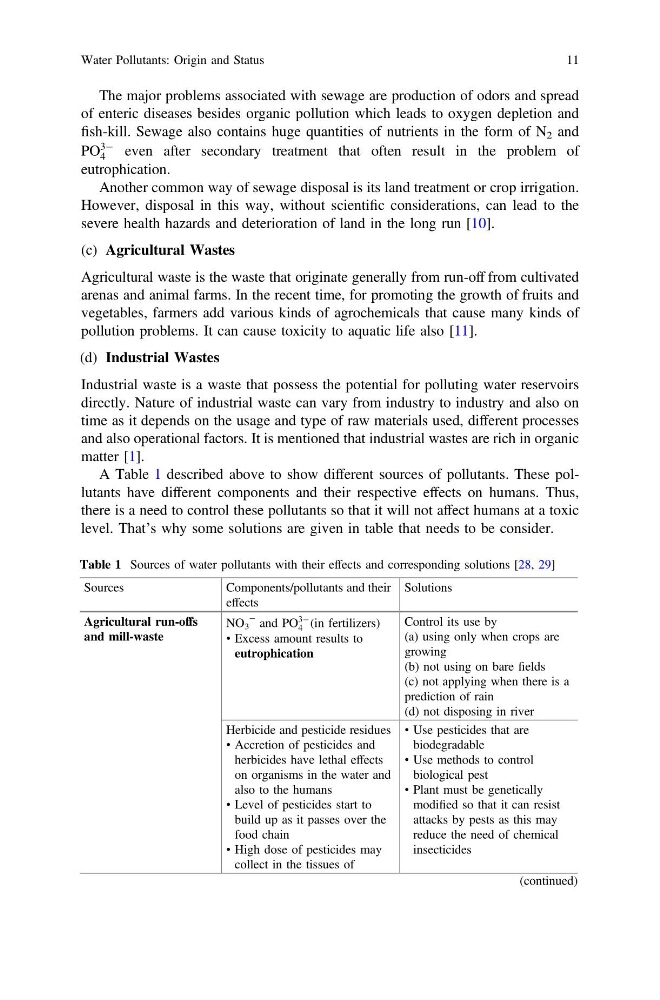
A Table 1 described above to show different sources of pollutants. These pollutants have different components and their respective effects on humans. Thus,
there is a need to control these pollutants so that it will not affect humans at a toxic
level. That’s why some solutions are given in table that needs to be consider.
Table 1 Sources of water pollutants with their effects and corresponding solutions [28, 29]
Sources
Components/pollutants and their
effects
Solutions
Agricultural run-offs
and mill-waste
NO 3
− and PO
3À
4 (in fertilizers)
• Excess amount results to
eutrophication
Control its use by
(a) using only when crops are
growing
(b) not using on bare fields
(c) not applying when there is a
prediction of rain
(d) not disposing in river
Herbicide and pesticide residues
• Accretion of pesticides and
herbicides have lethal effects
on organisms in the water and
also to the humans
• Level of pesticides start to
build up as it passes over the
food chain
• High dose of pesticides may
collect in the tissues of
• Use pesticides that are
biodegradable
• Use methods to control
biological pest
• Plant must be genetically
modified so that it can resist
attacks by pests as this may
reduce the need of chemical
insecticides
(continued)
Water Pollutants: Origin and Status
11
of enteric diseases besides organic pollution which leads to oxygen depletion and
fish-kill. Sewage also contains huge quantities of nutrients in the form of N 2 and
PO
3À
4
even after secondary treatment that often result in the problem of
eutrophication.
Another common way of sewage disposal is its land treatment or crop irrigation.
However, disposal in this way, without scientific considerations, can lead to the
severe health hazards and deterioration of land in the long run [10].
(c) Agricultural Wastes
Agricultural waste is the waste that originate generally from run-off from cultivated
arenas and animal farms. In the recent time, for promoting the growth of fruits and
vegetables, farmers add various kinds of agrochemicals that cause many kinds of
pollution problems. It can cause toxicity to aquatic life also [11].
(d) Industrial Wastes
Industrial waste is a waste that possess the potential for polluting water reservoirs
directly. Nature of industrial waste can vary from industry to industry and also on
time as it depends on the usage and type of raw materials used, different processes
and also operational factors. It is mentioned that industrial wastes are rich in organic
matter [1].
A Table 1 described above to show different sources of pollutants. These pollutants have different components and their respective effects on humans. Thus,
there is a need to control these pollutants so that it will not affect humans at a toxic
level. That’s why some solutions are given in table that needs to be consider.
Table 1 Sources of water pollutants with their effects and corresponding solutions [28, 29]
Sources
Components/pollutants and their
effects
Solutions
Agricultural run-offs
and mill-waste
NO 3
− and PO
3À
4 (in fertilizers)
• Excess amount results to
eutrophication
Control its use by
(a) using only when crops are
growing
(b) not using on bare fields
(c) not applying when there is a
prediction of rain
(d) not disposing in river
Herbicide and pesticide residues
• Accretion of pesticides and
herbicides have lethal effects
on organisms in the water and
also to the humans
• Level of pesticides start to
build up as it passes over the
food chain
• High dose of pesticides may
collect in the tissues of
• Use pesticides that are
biodegradable
• Use methods to control
biological pest
• Plant must be genetically
modified so that it can resist
attacks by pests as this may
reduce the need of chemical
insecticides
(continued)
Water Pollutants: Origin and Status
11