

species in the sample. A large section of such electrochemical sensors work on the
‘zero current potentiometry’ mode. These sensors convert ion-recognition event
into a potential signal and provides analytical information. The recognition membrane undergoes equilibrium and therefore changes in membrane potential are
recorded. The potential difference between analytical electrodes and reference
electrodes is used for obtaining information about the analyte. These sensors are
further categorized into symmetrical devices such as ISEs and asymmetrical configurations of selective membranes in reference to sample under analysis.
Asymmetrical potentiometric sensors (ASPs) hold an additional advantage of
robustness and high stability over symmetrical potentiometric sensors (SPSs). The
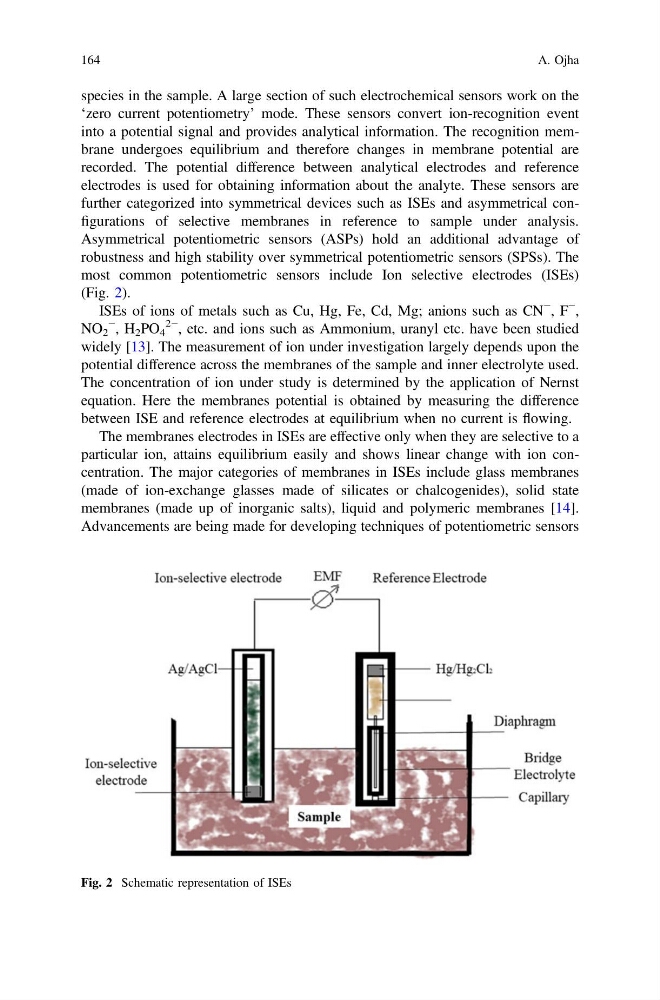
most common potentiometric sensors include Ion selective electrodes (ISEs)
(Fig. 2).
ISEs of ions of metals such as Cu, Hg, Fe, Cd, Mg; anions such as CN
− , F
− ,
NO 2
− , H 2 PO 4
2−
, etc. and ions such as Ammonium, uranyl etc. have been studied
widely [13]. The measurement of ion under investigation largely depends upon the
potential difference across the membranes of the sample and inner electrolyte used.
The concentration of ion under study is determined by the application of Nernst
equation. Here the membranes potential is obtained by measuring the difference
between ISE and reference electrodes at equilibrium when no current is flowing.
The membranes electrodes in ISEs are effective only when they are selective to a
particular ion, attains equilibrium easily and shows linear change with ion concentration. The major categories of membranes in ISEs include glass membranes
(made of ion-exchange glasses made of silicates or chalcogenides), solid state
membranes (made up of inorganic salts), liquid and polymeric membranes [14].
Advancements are being made for developing techniques of potentiometric sensors
Fig. 2 Schematic representation of ISEs
164
A. Ojha
‘zero current potentiometry’ mode. These sensors convert ion-recognition event
into a potential signal and provides analytical information. The recognition membrane undergoes equilibrium and therefore changes in membrane potential are
recorded. The potential difference between analytical electrodes and reference
electrodes is used for obtaining information about the analyte. These sensors are
further categorized into symmetrical devices such as ISEs and asymmetrical configurations of selective membranes in reference to sample under analysis.
Asymmetrical potentiometric sensors (ASPs) hold an additional advantage of
robustness and high stability over symmetrical potentiometric sensors (SPSs). The
most common potentiometric sensors include Ion selective electrodes (ISEs)
(Fig. 2).
ISEs of ions of metals such as Cu, Hg, Fe, Cd, Mg; anions such as CN
− , F
− ,
NO 2
− , H 2 PO 4
2−
, etc. and ions such as Ammonium, uranyl etc. have been studied
widely [13]. The measurement of ion under investigation largely depends upon the
potential difference across the membranes of the sample and inner electrolyte used.
The concentration of ion under study is determined by the application of Nernst
equation. Here the membranes potential is obtained by measuring the difference
between ISE and reference electrodes at equilibrium when no current is flowing.
The membranes electrodes in ISEs are effective only when they are selective to a
particular ion, attains equilibrium easily and shows linear change with ion concentration. The major categories of membranes in ISEs include glass membranes
(made of ion-exchange glasses made of silicates or chalcogenides), solid state
membranes (made up of inorganic salts), liquid and polymeric membranes [14].
Advancements are being made for developing techniques of potentiometric sensors
Fig. 2 Schematic representation of ISEs
164
A. Ojha