

additional benefit of real time trace level detection of pollutants such as toxic metals
or carcinogenic organic compounds in solution under analysis. Some of the key
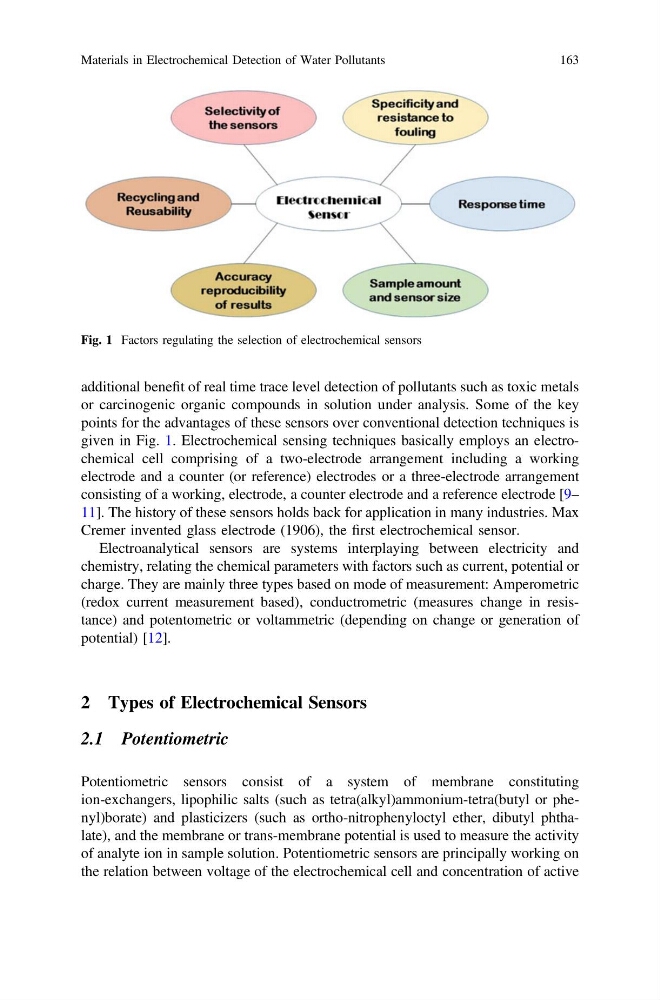
points for the advantages of these sensors over conventional detection techniques is
given in Fig. 1. Electrochemical sensing techniques basically employs an electrochemical cell comprising of a two-electrode arrangement including a working
electrode and a counter (or reference) electrodes or a three-electrode arrangement
consisting of a working, electrode, a counter electrode and a reference electrode [9–
11]. The history of these sensors holds back for application in many industries. Max
Cremer invented glass electrode (1906), the first electrochemical sensor.
Electroanalytical sensors are systems interplaying between electricity and
chemistry, relating the chemical parameters with factors such as current, potential or
charge. They are mainly three types based on mode of measurement: Amperometric
(redox current measurement based), conductrometric (measures change in resistance) and potentometric or voltammetric (depending on change or generation of
potential) [12].
2 Types of Electrochemical Sensors
2.1 Potentiometric
Potentiometric sensors consist of a system of membrane constituting
ion-exchangers, lipophilic salts (such as tetra(alkyl)ammonium-tetra(butyl or phenyl)borate) and plasticizers (such as ortho-nitrophenyloctyl ether, dibutyl phthalate), and the membrane or trans-membrane potential is used to measure the activity
of analyte ion in sample solution. Potentiometric sensors are principally working on
the relation between voltage of the electrochemical cell and concentration of active
Fig. 1 Factors regulating the selection of electrochemical sensors
Materials in Electrochemical Detection of Water Pollutants
163
or carcinogenic organic compounds in solution under analysis. Some of the key
points for the advantages of these sensors over conventional detection techniques is
given in Fig. 1. Electrochemical sensing techniques basically employs an electrochemical cell comprising of a two-electrode arrangement including a working
electrode and a counter (or reference) electrodes or a three-electrode arrangement
consisting of a working, electrode, a counter electrode and a reference electrode [9–
11]. The history of these sensors holds back for application in many industries. Max
Cremer invented glass electrode (1906), the first electrochemical sensor.
Electroanalytical sensors are systems interplaying between electricity and
chemistry, relating the chemical parameters with factors such as current, potential or
charge. They are mainly three types based on mode of measurement: Amperometric
(redox current measurement based), conductrometric (measures change in resistance) and potentometric or voltammetric (depending on change or generation of
potential) [12].
2 Types of Electrochemical Sensors
2.1 Potentiometric
Potentiometric sensors consist of a system of membrane constituting
ion-exchangers, lipophilic salts (such as tetra(alkyl)ammonium-tetra(butyl or phenyl)borate) and plasticizers (such as ortho-nitrophenyloctyl ether, dibutyl phthalate), and the membrane or trans-membrane potential is used to measure the activity
of analyte ion in sample solution. Potentiometric sensors are principally working on
the relation between voltage of the electrochemical cell and concentration of active
Fig. 1 Factors regulating the selection of electrochemical sensors
Materials in Electrochemical Detection of Water Pollutants
163