

ampoule contains an auto-ID barcode that is read by the AQ4000 colorimeter and
used to spontaneously recognize the test water pollutant parameter [30].
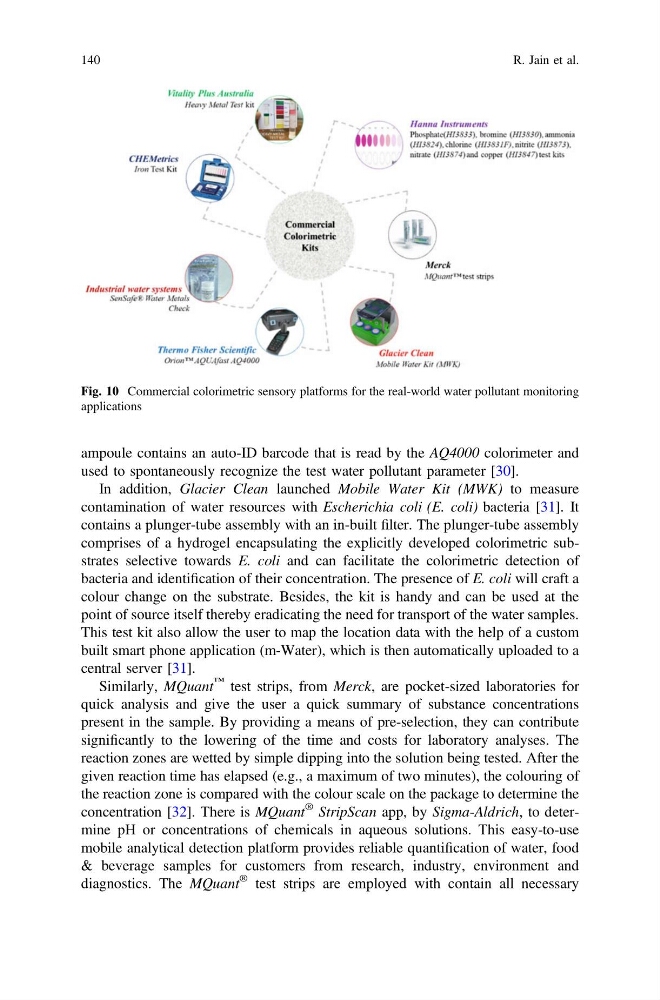
In addition, Glacier Clean launched Mobile Water Kit (MWK) to measure
contamination of water resources with Escherichia coli (E. coli) bacteria [31]. It
contains a plunger-tube assembly with an in-built filter. The plunger-tube assembly
comprises of a hydrogel encapsulating the explicitly developed colorimetric substrates selective towards E. coli and can facilitate the colorimetric detection of
bacteria and identification of their concentration. The presence of E. coli will craft a
colour change on the substrate. Besides, the kit is handy and can be used at the
point of source itself thereby eradicating the need for transport of the water samples.
This test kit also allow the user to map the location data with the help of a custom
built smart phone application (m-Water), which is then automatically uploaded to a
central server [31].
Similarly, MQuant
™ test strips, from Merck, are pocket-sized laboratories for
quick analysis and give the user a quick summary of substance concentrations
present in the sample. By providing a means of pre-selection, they can contribute
significantly to the lowering of the time and costs for laboratory analyses. The
reaction zones are wetted by simple dipping into the solution being tested. After the
given reaction time has elapsed (e.g., a maximum of two minutes), the colouring of
the reaction zone is compared with the colour scale on the package to determine the
concentration [32]. There is MQuant
®
StripScan app, by Sigma-Aldrich, to determine pH or concentrations of chemicals in aqueous solutions. This easy-to-use
mobile analytical detection platform provides reliable quantification of water, food
& beverage samples for customers from research, industry, environment and
diagnostics. The MQuant
® test strips are employed with contain all necessary
Fig. 10 Commercial colorimetric sensory platforms for the real-world water pollutant monitoring
applications
140
R. Jain et al.
used to spontaneously recognize the test water pollutant parameter [30].
In addition, Glacier Clean launched Mobile Water Kit (MWK) to measure
contamination of water resources with Escherichia coli (E. coli) bacteria [31]. It
contains a plunger-tube assembly with an in-built filter. The plunger-tube assembly
comprises of a hydrogel encapsulating the explicitly developed colorimetric substrates selective towards E. coli and can facilitate the colorimetric detection of
bacteria and identification of their concentration. The presence of E. coli will craft a
colour change on the substrate. Besides, the kit is handy and can be used at the
point of source itself thereby eradicating the need for transport of the water samples.
This test kit also allow the user to map the location data with the help of a custom
built smart phone application (m-Water), which is then automatically uploaded to a
central server [31].
Similarly, MQuant
™ test strips, from Merck, are pocket-sized laboratories for
quick analysis and give the user a quick summary of substance concentrations
present in the sample. By providing a means of pre-selection, they can contribute
significantly to the lowering of the time and costs for laboratory analyses. The
reaction zones are wetted by simple dipping into the solution being tested. After the
given reaction time has elapsed (e.g., a maximum of two minutes), the colouring of
the reaction zone is compared with the colour scale on the package to determine the
concentration [32]. There is MQuant
®
StripScan app, by Sigma-Aldrich, to determine pH or concentrations of chemicals in aqueous solutions. This easy-to-use
mobile analytical detection platform provides reliable quantification of water, food
& beverage samples for customers from research, industry, environment and
diagnostics. The MQuant
® test strips are employed with contain all necessary
Fig. 10 Commercial colorimetric sensory platforms for the real-world water pollutant monitoring
applications
140
R. Jain et al.