

2.2.2 Forster Resonance Energy Transfer (FRET)
FRET occurs when there is transfer of energy from the donor fluorophore to
acceptor fluorophore which are in close proximity between 1 and 10 nm in the
absence of radiation through dipole-dipole interactions. For the FRET to occur,
there should be a spectral overlap between the absorption of acceptor and emission
of receptor and high quantum yield as shown with the help of example in Fig. 4a.
Recently Wanichacheva and his co-workers developed a FRET based Hg(II)
sensor where helicene dyes used as energy donor fluorophores and exhibits high
quantum yield and rhodamine 6G dyes as energy acceptor as it has absorption and
emission wavelengths in the visible region, large molar extinction coefficient and
high quantum yield as well [4]. Further, large stokes shifts of donor minimizes
interference and small stokes shifts of the acceptor fluorophores which could leads
to self-absorption. This small stokes shift of the rhodamine 6G dyes also changes
the ring structure of the amide, which produces a fluorescent enhancement and
colorimetric change. The both donor and acceptor molecules connected to each
other by hydrazine moiety and upon the addition of Hg(II) to the sensor, the color
change from greenish yellow to orange is observed by the naked eyes and also
confirmed by UV/Vis Spectroscopy as shown in Fig. 4b [4].
Further, rhodamine-6G in another work is appended with benzothiazole conjugated quinoline derivative and used as a ratiometric probe for the detection of Fe
(III) using FRET mechanism. Here, color change to yellowish orange from
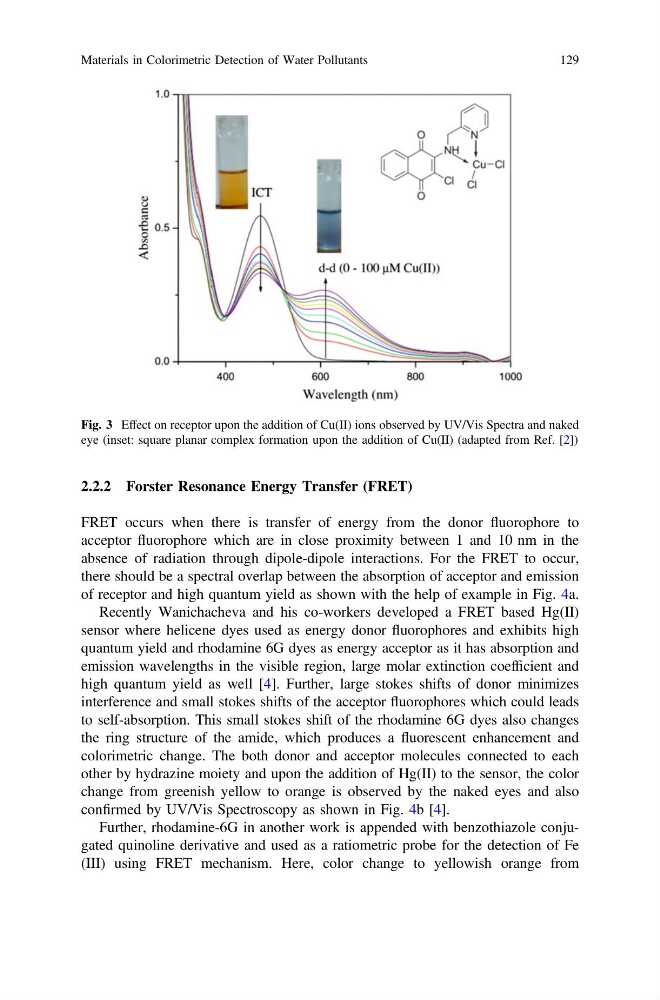
Fig. 3 Effect on receptor upon the addition of Cu(II) ions observed by UV/Vis Spectra and naked
eye (inset: square planar complex formation upon the addition of Cu(II) (adapted from Ref. [2])
Materials in Colorimetric Detection of Water Pollutants
129
FRET occurs when there is transfer of energy from the donor fluorophore to
acceptor fluorophore which are in close proximity between 1 and 10 nm in the
absence of radiation through dipole-dipole interactions. For the FRET to occur,
there should be a spectral overlap between the absorption of acceptor and emission
of receptor and high quantum yield as shown with the help of example in Fig. 4a.
Recently Wanichacheva and his co-workers developed a FRET based Hg(II)
sensor where helicene dyes used as energy donor fluorophores and exhibits high
quantum yield and rhodamine 6G dyes as energy acceptor as it has absorption and
emission wavelengths in the visible region, large molar extinction coefficient and
high quantum yield as well [4]. Further, large stokes shifts of donor minimizes
interference and small stokes shifts of the acceptor fluorophores which could leads
to self-absorption. This small stokes shift of the rhodamine 6G dyes also changes
the ring structure of the amide, which produces a fluorescent enhancement and
colorimetric change. The both donor and acceptor molecules connected to each
other by hydrazine moiety and upon the addition of Hg(II) to the sensor, the color
change from greenish yellow to orange is observed by the naked eyes and also
confirmed by UV/Vis Spectroscopy as shown in Fig. 4b [4].
Further, rhodamine-6G in another work is appended with benzothiazole conjugated quinoline derivative and used as a ratiometric probe for the detection of Fe
(III) using FRET mechanism. Here, color change to yellowish orange from
Fig. 3 Effect on receptor upon the addition of Cu(II) ions observed by UV/Vis Spectra and naked
eye (inset: square planar complex formation upon the addition of Cu(II) (adapted from Ref. [2])
Materials in Colorimetric Detection of Water Pollutants
129