

67
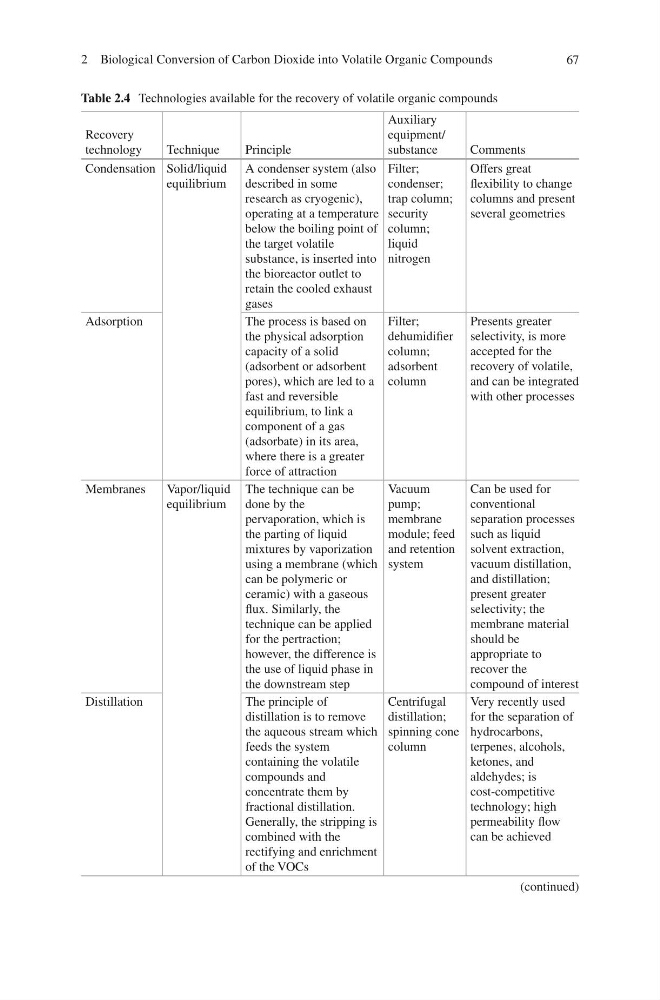
Table 2.4 Technologies available for the recovery of volatile organic compounds
Recovery
technology
Technique
Principle
Auxiliary
equipment/
substance
Comments
Condensation Solid/liquid
equilibrium
A condenser system (also
described in some
research as cryogenic),
operating at a temperature
below the boiling point of
the target volatile
substance, is inserted into
the bioreactor outlet to
retain the cooled exhaust
gases
Filter;
condenser;
trap column;
security
column;
liquid
nitrogen
Offers great
flexibility to change
columns and present
several geometries
Adsorption
The process is based on
the physical adsorption
capacity of a solid
(adsorbent or adsorbent
pores), which are led to a
fast and reversible
equilibrium, to link a
component of a gas
(adsorbate) in its area,
where there is a greater
force of attraction
Filter;
dehumidifier
column;
adsorbent
column
Presents greater
selectivity, is more
accepted for the
recovery of volatile,
and can be integrated
with other processes
Membranes
Vapor/liquid
equilibrium
The technique can be
done by the
pervaporation, which is
the parting of liquid
mixtures by vaporization
using a membrane (which
can be polymeric or
ceramic) with a gaseous
flux. Similarly, the
technique can be applied
for the pertraction;
however, the difference is
the use of liquid phase in
the downstream step
Vacuum
pump;
membrane
module; feed
and retention
system
Can be used for
conventional
separation processes
such as liquid
solvent extraction,
vacuum distillation,
and distillation;
present greater
selectivity; the
membrane material
should be
appropriate to
recover the
compound of interest
Distillation
The principle of
distillation is to remove
the aqueous stream which
feeds the system
containing the volatile
compounds and
concentrate them by
fractional distillation.
Generally, the stripping is
combined with the
rectifying and enrichment
of the VOCs
Centrifugal
distillation;
spinning cone
column
Very recently used
for the separation of
hydrocarbons,
terpenes, alcohols,
ketones, and
aldehydes; is
cost-competitive
technology; high
permeability flow
can be achieved
(continued)
2 Biological Conversion of Carbon Dioxide into Volatile Organic Compounds
Table 2.4 Technologies available for the recovery of volatile organic compounds
Recovery
technology
Technique
Principle
Auxiliary
equipment/
substance
Comments
Condensation Solid/liquid
equilibrium
A condenser system (also
described in some
research as cryogenic),
operating at a temperature
below the boiling point of
the target volatile
substance, is inserted into
the bioreactor outlet to
retain the cooled exhaust
gases
Filter;
condenser;
trap column;
security
column;
liquid
nitrogen
Offers great
flexibility to change
columns and present
several geometries
Adsorption
The process is based on
the physical adsorption
capacity of a solid
(adsorbent or adsorbent
pores), which are led to a
fast and reversible
equilibrium, to link a
component of a gas
(adsorbate) in its area,
where there is a greater
force of attraction
Filter;
dehumidifier
column;
adsorbent
column
Presents greater
selectivity, is more
accepted for the
recovery of volatile,
and can be integrated
with other processes
Membranes
Vapor/liquid
equilibrium
The technique can be
done by the
pervaporation, which is
the parting of liquid
mixtures by vaporization
using a membrane (which
can be polymeric or
ceramic) with a gaseous
flux. Similarly, the
technique can be applied
for the pertraction;
however, the difference is
the use of liquid phase in
the downstream step
Vacuum
pump;
membrane
module; feed
and retention
system
Can be used for
conventional
separation processes
such as liquid
solvent extraction,
vacuum distillation,
and distillation;
present greater
selectivity; the
membrane material
should be
appropriate to
recover the
compound of interest
Distillation
The principle of
distillation is to remove
the aqueous stream which
feeds the system
containing the volatile
compounds and
concentrate them by
fractional distillation.
Generally, the stripping is
combined with the
rectifying and enrichment
of the VOCs
Centrifugal
distillation;
spinning cone
column
Very recently used
for the separation of
hydrocarbons,
terpenes, alcohols,
ketones, and
aldehydes; is
cost-competitive
technology; high
permeability flow
can be achieved
(continued)
2 Biological Conversion of Carbon Dioxide into Volatile Organic Compounds