

48
From a morphological point of view, microalgae are highly diversified in shape
and size, displaying a wide range which ranges from 0.5 to 200 μm. Such a conformation is denominated thallus, independent of being unicellular or multicellular,
and may present as unicellular, colonial, and multicellular stalks (Van den Hoek
et al. 1995).
In contrast, the cellular structure of microalgae is divided into prokaryotic and
eukaryotic. Prokaryotic organisms include bacteria and two microalgae divisions
(Cyanophyta and Prochlorophyta). Already the eukaryotes include the divisions of
most algae, being Chlorophyta, Euglenophyta, Rhodophyta, Haptophyta,
Heterokontophyta, Cryptophyta, Dinophyta, Glaucophyta, and Chlorarachniophyta.
Although each group presents peculiar characteristics, these microorganisms have
similar physiological behaviors. Metabolically, photosynthesis is the preferred energetic route of microalgae (Suganya et al. 2016).
The photosynthesis in microalgae and cyanobacteria occurs into chloroplasts and
thylakoids (located in the cytoplasm), respectively. This mechanism involves a complex metabolism and can be subdivided into two stages: (i) the photochemical (or
light reactions) and (ii) carbon bioconversion (dark reactions). Usually, microalgae
use light energy to generate reducing equivalents and incorporate CO 2 into organic
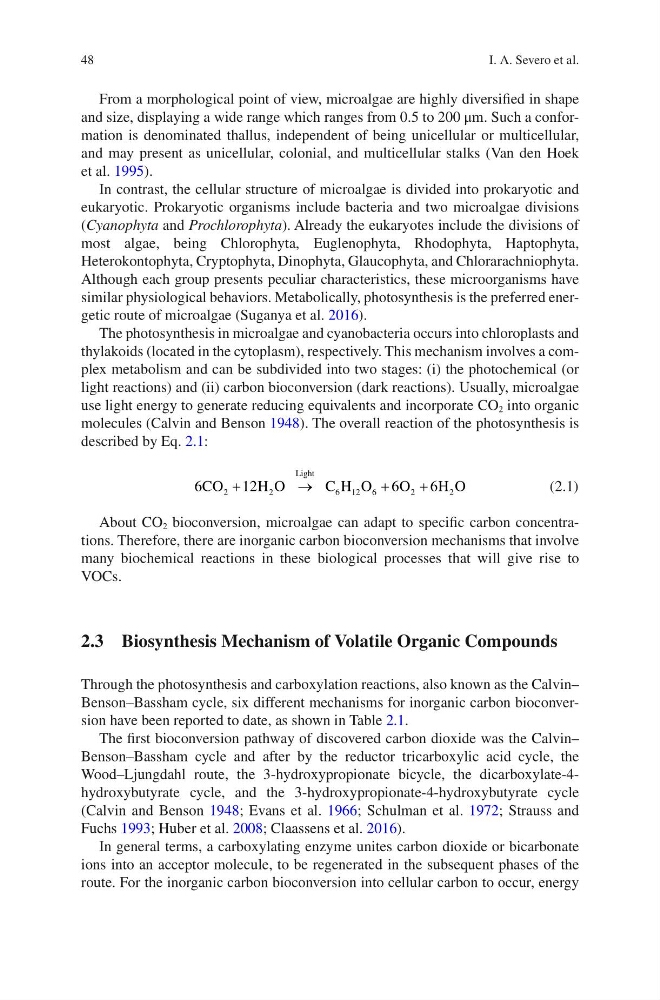
molecules (Calvin and Benson 1948). The overall reaction of the photosynthesis is
described by Eq. 2.1:
6
12
6
6
2
2
6 12 6
2
2
CO
H O
C H O
O
H O
Light
+
→
+
+
(2.1)
About CO 2 bioconversion, microalgae can adapt to specific carbon concentrations. Therefore, there are inorganic carbon bioconversion mechanisms that involve
many biochemical reactions in these biological processes that will give rise to
VOCs.
2.3 Biosynthesis Mechanism of Volatile Organic Compounds
Through the photosynthesis and carboxylation reactions, also known as the Calvin–
Benson–Bassham cycle, six different mechanisms for inorganic carbon bioconversion have been reported to date, as shown in Table 2.1.
The first bioconversion pathway of discovered carbon dioxide was the Calvin–
Benson–Bassham cycle and after by the reductor tricarboxylic acid cycle, the
Wood–Ljungdahl route, the 3-hydroxypropionate bicycle, the dicarboxylate-4hydroxybutyrate cycle, and the 3-hydroxypropionate-4-hydroxybutyrate cycle
(Calvin and Benson 1948; Evans et al. 1966; Schulman et al. 1972; Strauss and
Fuchs 1993; Huber et al. 2008; Claassens et al. 2016).
In general terms, a carboxylating enzyme unites carbon dioxide or bicarbonate
ions into an acceptor molecule, to be regenerated in the subsequent phases of the
route. For the inorganic carbon bioconversion into cellular carbon to occur, energy
I. A. Severo et al.
From a morphological point of view, microalgae are highly diversified in shape
and size, displaying a wide range which ranges from 0.5 to 200 μm. Such a conformation is denominated thallus, independent of being unicellular or multicellular,
and may present as unicellular, colonial, and multicellular stalks (Van den Hoek
et al. 1995).
In contrast, the cellular structure of microalgae is divided into prokaryotic and
eukaryotic. Prokaryotic organisms include bacteria and two microalgae divisions
(Cyanophyta and Prochlorophyta). Already the eukaryotes include the divisions of
most algae, being Chlorophyta, Euglenophyta, Rhodophyta, Haptophyta,
Heterokontophyta, Cryptophyta, Dinophyta, Glaucophyta, and Chlorarachniophyta.
Although each group presents peculiar characteristics, these microorganisms have
similar physiological behaviors. Metabolically, photosynthesis is the preferred energetic route of microalgae (Suganya et al. 2016).
The photosynthesis in microalgae and cyanobacteria occurs into chloroplasts and
thylakoids (located in the cytoplasm), respectively. This mechanism involves a complex metabolism and can be subdivided into two stages: (i) the photochemical (or
light reactions) and (ii) carbon bioconversion (dark reactions). Usually, microalgae
use light energy to generate reducing equivalents and incorporate CO 2 into organic
molecules (Calvin and Benson 1948). The overall reaction of the photosynthesis is
described by Eq. 2.1:
6
12
6
6
2
2
6 12 6
2
2
CO
H O
C H O
O
H O
Light
+
→
+
+
(2.1)
About CO 2 bioconversion, microalgae can adapt to specific carbon concentrations. Therefore, there are inorganic carbon bioconversion mechanisms that involve
many biochemical reactions in these biological processes that will give rise to
VOCs.
2.3 Biosynthesis Mechanism of Volatile Organic Compounds
Through the photosynthesis and carboxylation reactions, also known as the Calvin–
Benson–Bassham cycle, six different mechanisms for inorganic carbon bioconversion have been reported to date, as shown in Table 2.1.
The first bioconversion pathway of discovered carbon dioxide was the Calvin–
Benson–Bassham cycle and after by the reductor tricarboxylic acid cycle, the
Wood–Ljungdahl route, the 3-hydroxypropionate bicycle, the dicarboxylate-4hydroxybutyrate cycle, and the 3-hydroxypropionate-4-hydroxybutyrate cycle
(Calvin and Benson 1948; Evans et al. 1966; Schulman et al. 1972; Strauss and
Fuchs 1993; Huber et al. 2008; Claassens et al. 2016).
In general terms, a carboxylating enzyme unites carbon dioxide or bicarbonate
ions into an acceptor molecule, to be regenerated in the subsequent phases of the
route. For the inorganic carbon bioconversion into cellular carbon to occur, energy
I. A. Severo et al.