

19
which polytrimethylene terephthalate (PTT) stands out as the main application,
accounting for around the 90% of the total market. Remaining applications include
polyurethanes manufacturing and replacement of ethylene glycol and butylene glycol. Biotechnological advances allowed to explore the production of 1,3-PDO by
microbial fermentation where the diol is directly produced from engineered bacteria
or by the natural glycerol conversion of some bacterial species (Xu et al. 2009). The
Algenol company developed a patented cyanobacterial platform for 1,3-PDO production, which relies on engineered Synechocystis PCC 6803 and Synechococcus
sp. PCC 7002 (Chin et al. 2014), but 1,3-PDO productivity was not detailed. In
Hirokawa et al. (2016), the biotransformation of CO 2 into 1,3-PDO was achieved by
engineering a synthetic pathway in the Synechococcus elongatus PCC 7942 cyanobacterium. In this pathway the 1,3-propanediol (PDO) is produced from dihydroxyacetone phosphate (DHAP), a compound formed in the Calvin cycle, utilizing four
steps. In the first two steps, the Saccharomyces cerevisiae enzymes glycerol- 3phosphate dehydrogenase and the glycerol-3-phosphatase perform the conversion
of DHAP into glycerol-3-phosphate and the dephosphorylation of glycerol-3-phosphate in glycerol, respectively. In the last two steps, the glycerol dehydratase from
K. pneumoniae was used to transform glycerol into 3-HPA and the aldehyde reductase YqhD from E. coli to convert the 3-HPA into 1,3-PDO. After 14 days of cultivation under 3% of carbon dioxide, the S. elongatus PCC 7942 mutant produced
288 ± mg/L of 1,3-PDO and 1.16 ± 0,14 g/L of glycerol—a 1,3-PDO precursor. In
Hirokawa et al. (2017b), the same authors improved the production of 1,3-PDO by
the elimination of the NDH-1 complexes in the S. elongatus PCC 7942 which
afforded an increase in the metabolic flux of DHAP into the 1,3-PDO-producing
pathway. During 20 days of incubation, the new S. elongatus PCC 7942 1,3-PDOproducing strain produced 0.338 g/L 1,3-PDO and 2.79 g/L glycerol.
An alternative way could be envisaged coupling the production of exogenous
glycerol in CO 2 -fixing microorganism with the assimilation of produced glycerol in
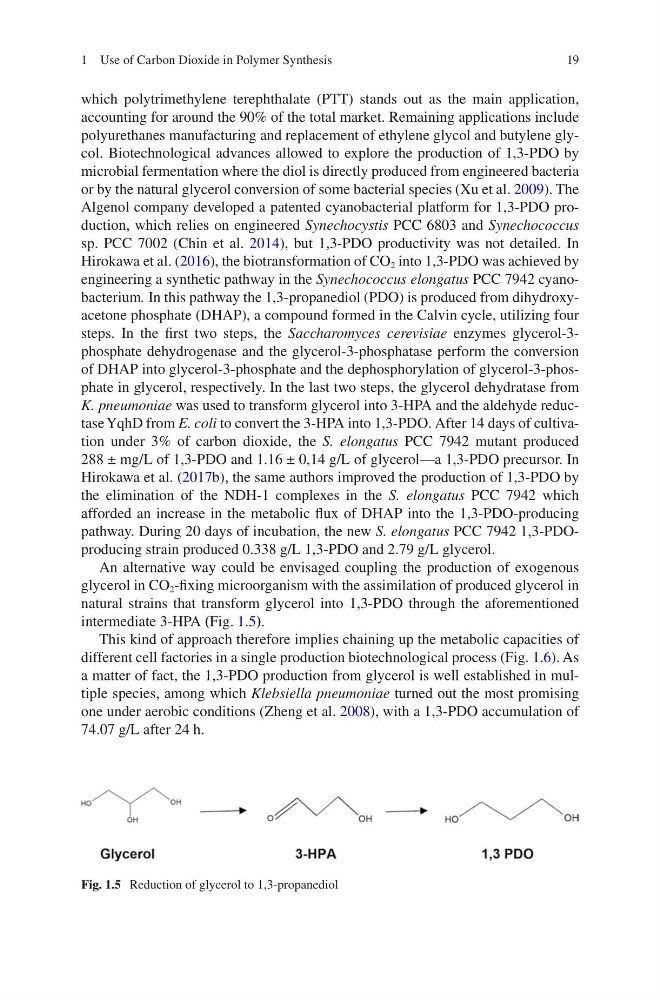
natural strains that transform glycerol into 1,3- PDO through the aforementioned
intermediate 3-HPA (Fig. 1.5).
This kind of approach therefore implies chaining up the metabolic capacities of
different cell factories in a single production biotechnological process (Fig. 1.6). As
a matter of fact, the 1,3-PDO production from glycerol is well established in multiple species, among which Klebsiella pneumoniae turned out the most promising
one under aerobic conditions (Zheng et al. 2008), with a 1,3-PDO accumulation of
74.07 g/L after 24 h.
Fig. 1.5 Reduction of glycerol to 1,3-propanediol
1 Use of Carbon Dioxide in Polymer Synthesis
which polytrimethylene terephthalate (PTT) stands out as the main application,
accounting for around the 90% of the total market. Remaining applications include
polyurethanes manufacturing and replacement of ethylene glycol and butylene glycol. Biotechnological advances allowed to explore the production of 1,3-PDO by
microbial fermentation where the diol is directly produced from engineered bacteria
or by the natural glycerol conversion of some bacterial species (Xu et al. 2009). The
Algenol company developed a patented cyanobacterial platform for 1,3-PDO production, which relies on engineered Synechocystis PCC 6803 and Synechococcus
sp. PCC 7002 (Chin et al. 2014), but 1,3-PDO productivity was not detailed. In
Hirokawa et al. (2016), the biotransformation of CO 2 into 1,3-PDO was achieved by
engineering a synthetic pathway in the Synechococcus elongatus PCC 7942 cyanobacterium. In this pathway the 1,3-propanediol (PDO) is produced from dihydroxyacetone phosphate (DHAP), a compound formed in the Calvin cycle, utilizing four
steps. In the first two steps, the Saccharomyces cerevisiae enzymes glycerol- 3phosphate dehydrogenase and the glycerol-3-phosphatase perform the conversion
of DHAP into glycerol-3-phosphate and the dephosphorylation of glycerol-3-phosphate in glycerol, respectively. In the last two steps, the glycerol dehydratase from
K. pneumoniae was used to transform glycerol into 3-HPA and the aldehyde reductase YqhD from E. coli to convert the 3-HPA into 1,3-PDO. After 14 days of cultivation under 3% of carbon dioxide, the S. elongatus PCC 7942 mutant produced
288 ± mg/L of 1,3-PDO and 1.16 ± 0,14 g/L of glycerol—a 1,3-PDO precursor. In
Hirokawa et al. (2017b), the same authors improved the production of 1,3-PDO by
the elimination of the NDH-1 complexes in the S. elongatus PCC 7942 which
afforded an increase in the metabolic flux of DHAP into the 1,3-PDO-producing
pathway. During 20 days of incubation, the new S. elongatus PCC 7942 1,3-PDOproducing strain produced 0.338 g/L 1,3-PDO and 2.79 g/L glycerol.
An alternative way could be envisaged coupling the production of exogenous
glycerol in CO 2 -fixing microorganism with the assimilation of produced glycerol in
natural strains that transform glycerol into 1,3- PDO through the aforementioned
intermediate 3-HPA (Fig. 1.5).
This kind of approach therefore implies chaining up the metabolic capacities of
different cell factories in a single production biotechnological process (Fig. 1.6). As
a matter of fact, the 1,3-PDO production from glycerol is well established in multiple species, among which Klebsiella pneumoniae turned out the most promising
one under aerobic conditions (Zheng et al. 2008), with a 1,3-PDO accumulation of
74.07 g/L after 24 h.
Fig. 1.5 Reduction of glycerol to 1,3-propanediol
1 Use of Carbon Dioxide in Polymer Synthesis