

10
Additional factors include rising demand of adipic acid in the textile production as
well as in advanced engineering products addressing the electrical and electronic
sectors. The market is then propelled by the adipic acid demand for manufacturing
polyurethanes, which are employed, for instance, in construction and building, bedding, footwear, coatings, adhesives, and elastomers, and for manufacturing adipic
acid esters, which are used in the synthesis of resins through the polymerization of
vinyl chloride. Nevertheless, the series of chemical transformations which are
needed to derive the final products represent a significant environmental burden. For
instance, only in the last step of nylon-6,6 production, which is conducted with a
copper or vanadium catalyst and nitric acid, nitrogen oxides (NOx) are released.
Thus, much efforts have been focused in establishing sustainable production process based on renewable resources during the last decades, including the research of
adipic acid sustainable production processes. Lignocellulosic biomass and lipids
represent the most recently studied molecules for biological routes to adipic acid
(Kruyer and Peralta-Yahya 2017). Indeed, cis,cis-muconic acid and glucaric acid
can be produced via biological fermentation and then applied as precursors of adipic
acid. Concerning metabolic engineering, many microbial strains have been modified in order to produce adipic acid. Le Yu et al. (2014) inserted a synthetic pathway
in E. coli for the conversion of glucose to adipic acid in a six-step reaction.
Despite the availability of different bio-based approaches for adipic acid production, no one is using CO 2 as feedstock. However, we can report a combination of
routes which involve CO 2 reduction for obtaining adipic acid.
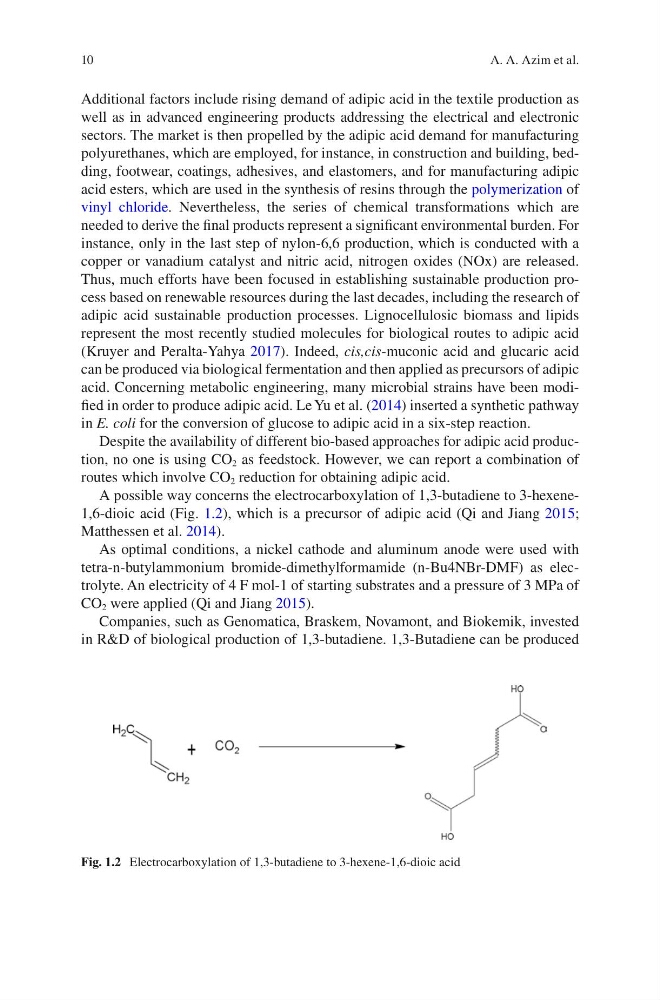
A possible way concerns the electrocarboxylation of 1,3-butadiene to 3-hexene1,6-dioic acid (Fig. 1.2), which is a precursor of adipic acid (Qi and Jiang 2015;
Matthessen et al. 2014).
As optimal conditions, a nickel cathode and aluminum anode were used with
tetra-n-butylammonium bromide-dimethylformamide (n-Bu4NBr-DMF) as electrolyte. An electricity of 4 F mol-1 of starting substrates and a pressure of 3 MPa of
CO 2 were applied (Qi and Jiang 2015).
Companies, such as Genomatica, Braskem, Novamont, and Biokemik, invested
in R&D of biological production of 1,3-butadiene. 1,3-Butadiene can be produced
Fig. 1.2 Electrocarboxylation of 1,3-butadiene to 3-hexene-1,6-dioic acid
A. A. Azim et al.
Additional factors include rising demand of adipic acid in the textile production as
well as in advanced engineering products addressing the electrical and electronic
sectors. The market is then propelled by the adipic acid demand for manufacturing
polyurethanes, which are employed, for instance, in construction and building, bedding, footwear, coatings, adhesives, and elastomers, and for manufacturing adipic
acid esters, which are used in the synthesis of resins through the polymerization of
vinyl chloride. Nevertheless, the series of chemical transformations which are
needed to derive the final products represent a significant environmental burden. For
instance, only in the last step of nylon-6,6 production, which is conducted with a
copper or vanadium catalyst and nitric acid, nitrogen oxides (NOx) are released.
Thus, much efforts have been focused in establishing sustainable production process based on renewable resources during the last decades, including the research of
adipic acid sustainable production processes. Lignocellulosic biomass and lipids
represent the most recently studied molecules for biological routes to adipic acid
(Kruyer and Peralta-Yahya 2017). Indeed, cis,cis-muconic acid and glucaric acid
can be produced via biological fermentation and then applied as precursors of adipic
acid. Concerning metabolic engineering, many microbial strains have been modified in order to produce adipic acid. Le Yu et al. (2014) inserted a synthetic pathway
in E. coli for the conversion of glucose to adipic acid in a six-step reaction.
Despite the availability of different bio-based approaches for adipic acid production, no one is using CO 2 as feedstock. However, we can report a combination of
routes which involve CO 2 reduction for obtaining adipic acid.
A possible way concerns the electrocarboxylation of 1,3-butadiene to 3-hexene1,6-dioic acid (Fig. 1.2), which is a precursor of adipic acid (Qi and Jiang 2015;
Matthessen et al. 2014).
As optimal conditions, a nickel cathode and aluminum anode were used with
tetra-n-butylammonium bromide-dimethylformamide (n-Bu4NBr-DMF) as electrolyte. An electricity of 4 F mol-1 of starting substrates and a pressure of 3 MPa of
CO 2 were applied (Qi and Jiang 2015).
Companies, such as Genomatica, Braskem, Novamont, and Biokemik, invested
in R&D of biological production of 1,3-butadiene. 1,3-Butadiene can be produced
Fig. 1.2 Electrocarboxylation of 1,3-butadiene to 3-hexene-1,6-dioic acid
A. A. Azim et al.