

195
ln K
RT
p =
−∆G
(7.11)
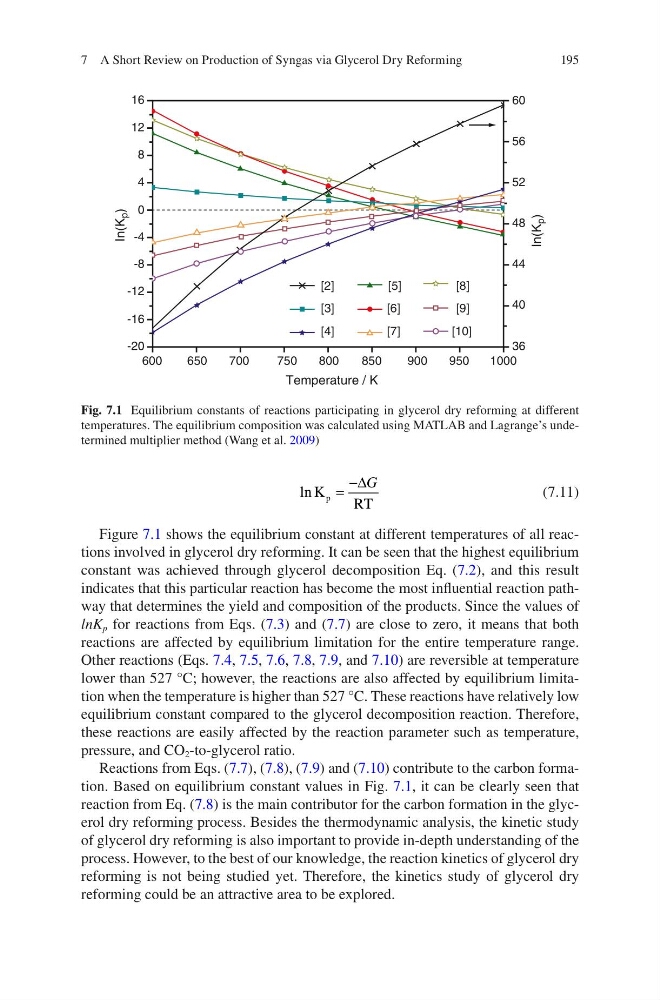
Figure 7.1 shows the equilibrium constant at different temperatures of all reactions involved in glycerol dry reforming. It can be seen that the highest equilibrium
constant was achieved through glycerol decomposition Eq. (7.2), and this result
indicates that this particular reaction has become the most influential reaction pathway that determines the yield and composition of the products. Since the values of
lnK p for reactions from Eqs. (7.3) and (7.7) are close to zero, it means that both
reactions are affected by equilibrium limitation for the entire temperature range.
Other reactions (Eqs. 7.4, 7.5, 7.6, 7.8, 7.9, and 7.10) are reversible at temperature
lower than 527 °C; however, the reactions are also affected by equilibrium limitation when the temperature is higher than 527 °C. These reactions have relatively low
equilibrium constant compared to the glycerol decomposition reaction. Therefore,
these reactions are easily affected by the reaction parameter such as temperature,
pressure, and CO 2 -to-glycerol ratio.
Reactions from Eqs. (7.7), (7.8), (7.9) and (7.10) contribute to the carbon formation. Based on equilibrium constant values in Fig. 7.1, it can be clearly seen that
reaction from Eq. (7.8) is the main contributor for the carbon formation in the glycerol dry reforming process. Besides the thermodynamic analysis, the kinetic study
of glycerol dry reforming is also important to provide in-depth understanding of the
process. However, to the best of our knowledge, the reaction kinetics of glycerol dry
reforming is not being studied yet. Therefore, the kinetics study of glycerol dry
reforming could be an attractive area to be explored.
16
12
8
4
-4
-8
-12
-16
-20
600
650
750
700
800
[2]
[5]
[8]
[9]
[10]
[6]
[7]
[3]
[4]
Temperature / K
In(K
p )
In(K
p )
850
900
950
1000
36
40
44
48
52
56
60
0
Fig. 7.1 Equilibrium constants of reactions participating in glycerol dry reforming at different
temperatures. The equilibrium composition was calculated using MATLAB and Lagrange’s undetermined multiplier method (Wang et al. 2009)
7 A Short Review on Production of Syngas via Glycerol Dry Reforming
ln K
RT
p =
−∆G
(7.11)
Figure 7.1 shows the equilibrium constant at different temperatures of all reactions involved in glycerol dry reforming. It can be seen that the highest equilibrium
constant was achieved through glycerol decomposition Eq. (7.2), and this result
indicates that this particular reaction has become the most influential reaction pathway that determines the yield and composition of the products. Since the values of
lnK p for reactions from Eqs. (7.3) and (7.7) are close to zero, it means that both
reactions are affected by equilibrium limitation for the entire temperature range.
Other reactions (Eqs. 7.4, 7.5, 7.6, 7.8, 7.9, and 7.10) are reversible at temperature
lower than 527 °C; however, the reactions are also affected by equilibrium limitation when the temperature is higher than 527 °C. These reactions have relatively low
equilibrium constant compared to the glycerol decomposition reaction. Therefore,
these reactions are easily affected by the reaction parameter such as temperature,
pressure, and CO 2 -to-glycerol ratio.
Reactions from Eqs. (7.7), (7.8), (7.9) and (7.10) contribute to the carbon formation. Based on equilibrium constant values in Fig. 7.1, it can be clearly seen that
reaction from Eq. (7.8) is the main contributor for the carbon formation in the glycerol dry reforming process. Besides the thermodynamic analysis, the kinetic study
of glycerol dry reforming is also important to provide in-depth understanding of the
process. However, to the best of our knowledge, the reaction kinetics of glycerol dry
reforming is not being studied yet. Therefore, the kinetics study of glycerol dry
reforming could be an attractive area to be explored.
16
12
8
4
-4
-8
-12
-16
-20
600
650
750
700
800
[2]
[5]
[8]
[9]
[10]
[6]
[7]
[3]
[4]
Temperature / K
In(K
p )
In(K
p )
850
900
950
1000
36
40
44
48
52
56
60
0
Fig. 7.1 Equilibrium constants of reactions participating in glycerol dry reforming at different
temperatures. The equilibrium composition was calculated using MATLAB and Lagrange’s undetermined multiplier method (Wang et al. 2009)
7 A Short Review on Production of Syngas via Glycerol Dry Reforming