

188
duced per one gallon of biodiesel generated (Demsash et al. 2018). Hence, the production of syngas from glycerol will be a cost-effective way to boost up the potential
of glycerol as the value-added by-product from biodiesel, simultaneously lowering
the production cost of biodiesel.
A number of literatures found that syngas could be potentially produced using
different routes of gasification processes such as steam reforming, autothermal
reforming, pyrolysis, partial oxidation, dry reforming, and supercritical water
reforming (Demsash et al. 2018; Charisiou et al. 2017). Steam reforming has been
widely investigated for the production of H 2 and currently employed in industry for
syngas production from glycerol (Harun et al. 2019). It is an attractive process since
it produces higher yield of hydrogen gas, i.e., seven moles of hydrogen are theoretically produced for every mole of glycerol fed to the reactor. However, this approach
suffers from carbon attack and carbon dioxide (CO 2 ) greenhouse gas emission and
leads to various side reactions such as methanation and water-gas shift. The level of
steam needs to be carefully controlled as excess steam will reduce the efficiency of
the process and insufficient amount of steam will result in carbon formation. The
high H 2 /CO ratio also makes the process undesirable for Fischer–Tropsch synthesis
(FTS) (Lee et al. 2014a).
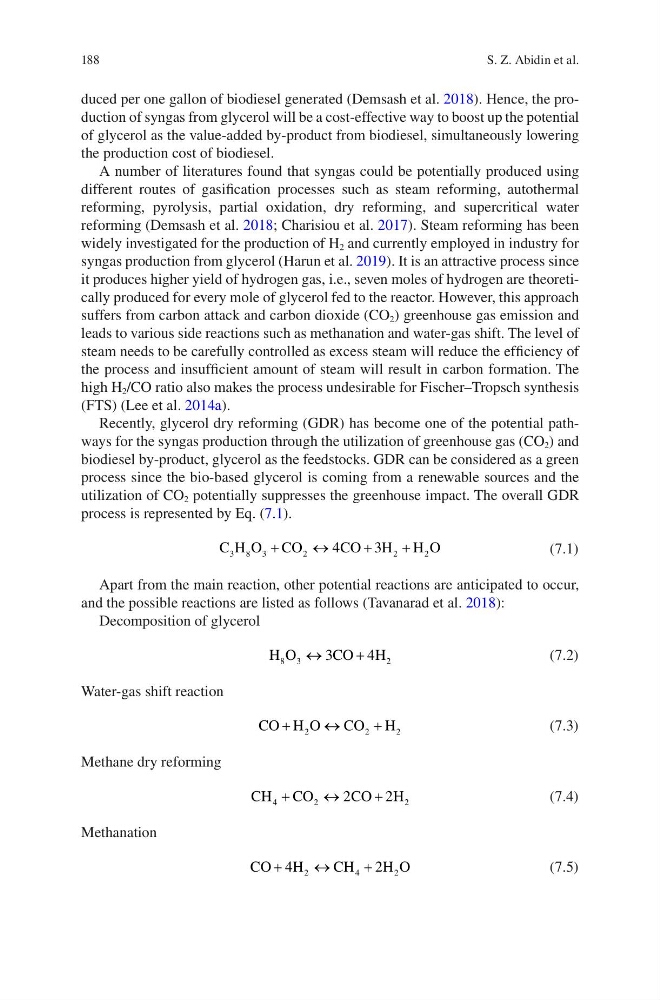
Recently, glycerol dry reforming (GDR) has become one of the potential pathways for the syngas production through the utilization of greenhouse gas (CO 2 ) and
biodiesel by-product, glycerol as the feedstocks. GDR can be considered as a green
process since the bio-based glycerol is coming from a renewable sources and the
utilization of CO 2 potentially suppresses the greenhouse impact. The overall GDR
process is represented by Eq. (7.1).
C H O CO
CO H H O
3 8 3
2
2
2
4
3
+
↔
+
+
(7.1)
Apart from the main reaction, other potential reactions are anticipated to occur,
and the possible reactions are listed as follows (Tavanarad et al. 2018):
Decomposition of glycerol
H O
CO H
8 3
2
3
4
↔
+
(7.2)
Water-gas shift reaction
CO H O
CO H
+
↔
+
2
2
2
(7.3)
Methane dry reforming
CH CO
CO H
4
2
2
2
2
+
↔
+
(7.4)
Methanation
CO H
CH
H O
+
↔
+
4
2
2
4
2
(7.5)
S. Z. Abidin et al.
duced per one gallon of biodiesel generated (Demsash et al. 2018). Hence, the production of syngas from glycerol will be a cost-effective way to boost up the potential
of glycerol as the value-added by-product from biodiesel, simultaneously lowering
the production cost of biodiesel.
A number of literatures found that syngas could be potentially produced using
different routes of gasification processes such as steam reforming, autothermal
reforming, pyrolysis, partial oxidation, dry reforming, and supercritical water
reforming (Demsash et al. 2018; Charisiou et al. 2017). Steam reforming has been
widely investigated for the production of H 2 and currently employed in industry for
syngas production from glycerol (Harun et al. 2019). It is an attractive process since
it produces higher yield of hydrogen gas, i.e., seven moles of hydrogen are theoretically produced for every mole of glycerol fed to the reactor. However, this approach
suffers from carbon attack and carbon dioxide (CO 2 ) greenhouse gas emission and
leads to various side reactions such as methanation and water-gas shift. The level of
steam needs to be carefully controlled as excess steam will reduce the efficiency of
the process and insufficient amount of steam will result in carbon formation. The
high H 2 /CO ratio also makes the process undesirable for Fischer–Tropsch synthesis
(FTS) (Lee et al. 2014a).
Recently, glycerol dry reforming (GDR) has become one of the potential pathways for the syngas production through the utilization of greenhouse gas (CO 2 ) and
biodiesel by-product, glycerol as the feedstocks. GDR can be considered as a green
process since the bio-based glycerol is coming from a renewable sources and the
utilization of CO 2 potentially suppresses the greenhouse impact. The overall GDR
process is represented by Eq. (7.1).
C H O CO
CO H H O
3 8 3
2
2
2
4
3
+
↔
+
+
(7.1)
Apart from the main reaction, other potential reactions are anticipated to occur,
and the possible reactions are listed as follows (Tavanarad et al. 2018):
Decomposition of glycerol
H O
CO H
8 3
2
3
4
↔
+
(7.2)
Water-gas shift reaction
CO H O
CO H
+
↔
+
2
2
2
(7.3)
Methane dry reforming
CH CO
CO H
4
2
2
2
2
+
↔
+
(7.4)
Methanation
CO H
CH
H O
+
↔
+
4
2
2
4
2
(7.5)
S. Z. Abidin et al.