

139
As illustrated in Fig. 5.8, the combination of three homogeneous catalysts including (PMe 3 ) 4 Ru(Cl)(OAc) or chlorotetrakis(trimethylphosphine)ruthenium(II)
acetate, Sc(OTf) 3 or scandium (III) trifluoromethanesulfonate, and (PNN)Ru(CO)
(H) was used for promoting three different consecutive reactions which are (i) carbon dioxide hydrogenation by “cat. A,” (ii) esterification of formed formic acid by
“cat. B,” and (iii) formate ester hydrogenation to final methanol by “cat. C,” respectively, using a mixture containing the molar ratio of hydrogen to carbon dioxide of
3 to 1, at 40 bar.
However, the abovementioned multicomponent catalytic system required a complex mixture of three varied catalysts with high compatibility, and it had a drawback
of low turnover number of 2.5 for methanol formation. In order to overcome this
weakness, Wesselbaum et al. (2012) employed a single ruthenium phosphine complex with equivalent acid bis(trifluoromethane)sulfonimide (HNTf 2 ) for improving
carbon dioxide hydrogenation to methanol, thereby achieving a high turnover number of about 221 in ethanol additive at 140 °C, 80 bar, and the molar ratio of hydrogen to carbon monoxide of 3 to 1. The same study revealed that ethanol played the
2l -
2Hl
MeOH
2H 2 , l -
2Hl
2H 2 O + 2l -
[Ru 4 (CO) 12 ]
4[Ru 4 (CO) 13 ]
2H 2
H 2 , CO, l -
CO
[H 2 Ru 4 (CO) 12 ]
2[HRu 3 (CO) 11 ] -
+[Ru(CO) 3 l 3 ] -
[HRu 3 (CO) 11 ] -
+[Ru(CO) 4 l 2 ]
l -
CO 2
[Ru 4 (CO) 12 (CO 2 )]
-
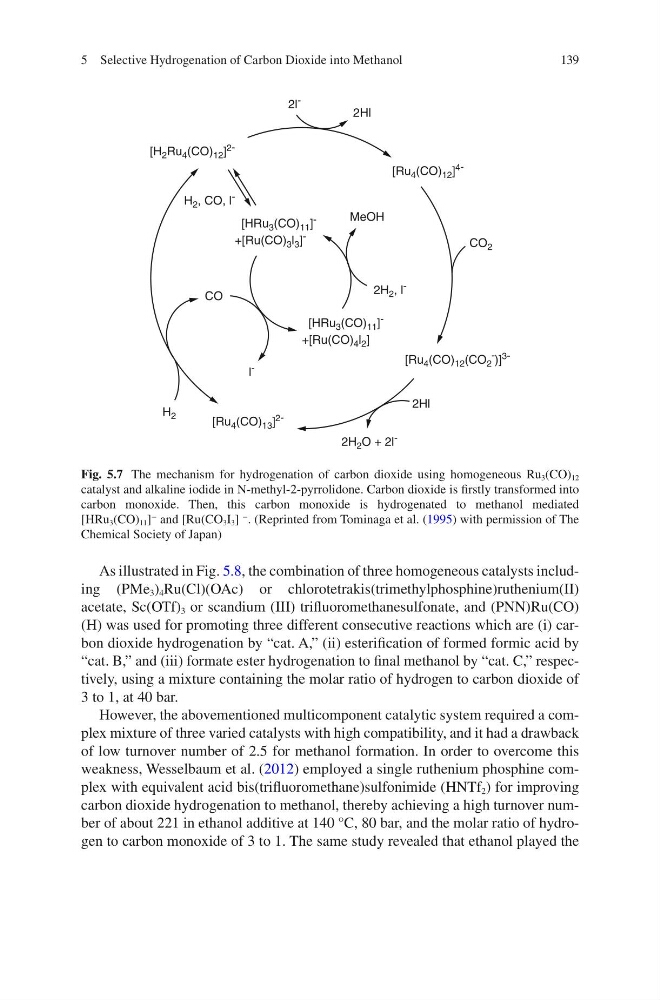
Fig. 5.7 The mechanism for hydrogenation of carbon dioxide using homogeneous Ru 3 (CO) 12
catalyst and alkaline iodide in N-methyl-2-pyrrolidone. Carbon dioxide is firstly transformed into
carbon monoxide. Then, this carbon monoxide is hydrogenated to methanol mediated
[HRu 3 (CO) 11 ]
− and [Ru(CO 3 I 3 ]
− . (Reprinted from Tominaga et al. (1995) with permission of The
Chemical Society of Japan)
5 Selective Hydrogenation of Carbon Dioxide into Methanol
As illustrated in Fig. 5.8, the combination of three homogeneous catalysts including (PMe 3 ) 4 Ru(Cl)(OAc) or chlorotetrakis(trimethylphosphine)ruthenium(II)
acetate, Sc(OTf) 3 or scandium (III) trifluoromethanesulfonate, and (PNN)Ru(CO)
(H) was used for promoting three different consecutive reactions which are (i) carbon dioxide hydrogenation by “cat. A,” (ii) esterification of formed formic acid by
“cat. B,” and (iii) formate ester hydrogenation to final methanol by “cat. C,” respectively, using a mixture containing the molar ratio of hydrogen to carbon dioxide of
3 to 1, at 40 bar.
However, the abovementioned multicomponent catalytic system required a complex mixture of three varied catalysts with high compatibility, and it had a drawback
of low turnover number of 2.5 for methanol formation. In order to overcome this
weakness, Wesselbaum et al. (2012) employed a single ruthenium phosphine complex with equivalent acid bis(trifluoromethane)sulfonimide (HNTf 2 ) for improving
carbon dioxide hydrogenation to methanol, thereby achieving a high turnover number of about 221 in ethanol additive at 140 °C, 80 bar, and the molar ratio of hydrogen to carbon monoxide of 3 to 1. The same study revealed that ethanol played the
2l -
2Hl
MeOH
2H 2 , l -
2Hl
2H 2 O + 2l -
[Ru 4 (CO) 12 ]
4[Ru 4 (CO) 13 ]
2H 2
H 2 , CO, l -
CO
[H 2 Ru 4 (CO) 12 ]
2[HRu 3 (CO) 11 ] -
+[Ru(CO) 3 l 3 ] -
[HRu 3 (CO) 11 ] -
+[Ru(CO) 4 l 2 ]
l -
CO 2
[Ru 4 (CO) 12 (CO 2 )]
-
Fig. 5.7 The mechanism for hydrogenation of carbon dioxide using homogeneous Ru 3 (CO) 12
catalyst and alkaline iodide in N-methyl-2-pyrrolidone. Carbon dioxide is firstly transformed into
carbon monoxide. Then, this carbon monoxide is hydrogenated to methanol mediated
[HRu 3 (CO) 11 ]
− and [Ru(CO 3 I 3 ]
− . (Reprinted from Tominaga et al. (1995) with permission of The
Chemical Society of Japan)
5 Selective Hydrogenation of Carbon Dioxide into Methanol