

117
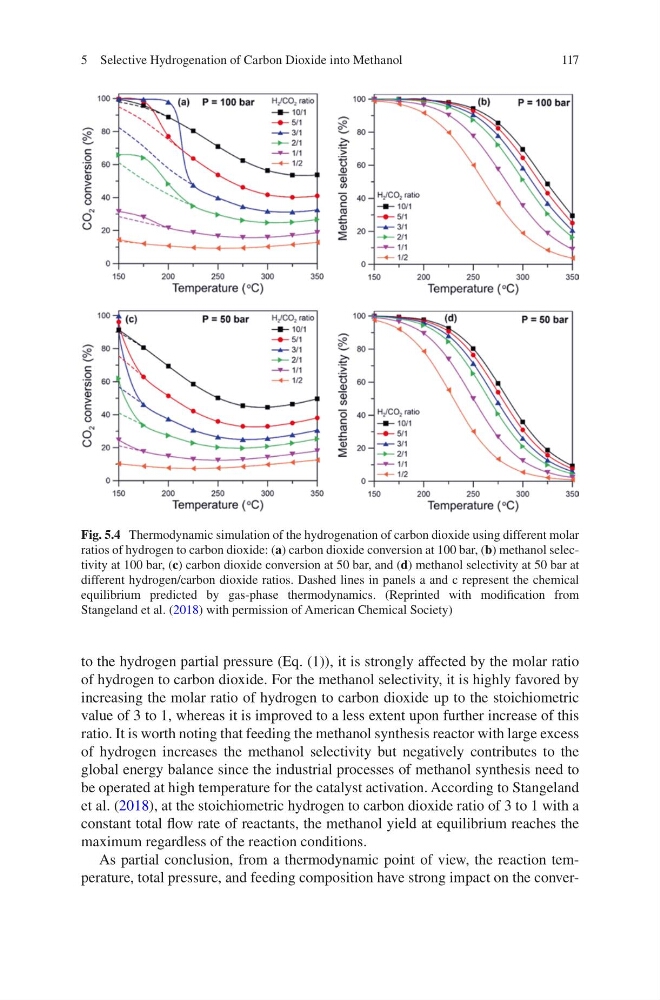
to the hydrogen partial pressure (Eq. (1)), it is strongly affected by the molar ratio
of hydrogen to carbon dioxide. For the methanol selectivity, it is highly favored by
increasing the molar ratio of hydrogen to carbon dioxide up to the stoichiometric
value of 3 to 1, whereas it is improved to a less extent upon further increase of this
ratio. It is worth noting that feeding the methanol synthesis reactor with large excess
of hydrogen increases the methanol selectivity but negatively contributes to the
global energy balance since the industrial processes of methanol synthesis need to
be operated at high temperature for the catalyst activation. According to Stangeland
et al. (2018), at the stoichiometric hydrogen to carbon dioxide ratio of 3 to 1 with a
constant total flow rate of reactants, the methanol yield at equilibrium reaches the
maximum regardless of the reaction conditions.
As partial conclusion, from a thermodynamic point of view, the reaction temperature, total pressure, and feeding composition have strong impact on the converFig. 5.4 Thermodynamic simulation of the hydrogenation of carbon dioxide using different molar
ratios of hydrogen to carbon dioxide: (a) carbon dioxide conversion at 100 bar, (b) methanol selectivity at 100 bar, (c) carbon dioxide conversion at 50 bar, and (d) methanol selectivity at 50 bar at
different hydrogen/carbon dioxide ratios. Dashed lines in panels a and c represent the chemical
equilibrium predicted by gas-phase thermodynamics. (Reprinted with modification from
Stangeland et al. (2018) with permission of American Chemical Society)
5 Selective Hydrogenation of Carbon Dioxide into Methanol
to the hydrogen partial pressure (Eq. (1)), it is strongly affected by the molar ratio
of hydrogen to carbon dioxide. For the methanol selectivity, it is highly favored by
increasing the molar ratio of hydrogen to carbon dioxide up to the stoichiometric
value of 3 to 1, whereas it is improved to a less extent upon further increase of this
ratio. It is worth noting that feeding the methanol synthesis reactor with large excess
of hydrogen increases the methanol selectivity but negatively contributes to the
global energy balance since the industrial processes of methanol synthesis need to
be operated at high temperature for the catalyst activation. According to Stangeland
et al. (2018), at the stoichiometric hydrogen to carbon dioxide ratio of 3 to 1 with a
constant total flow rate of reactants, the methanol yield at equilibrium reaches the
maximum regardless of the reaction conditions.
As partial conclusion, from a thermodynamic point of view, the reaction temperature, total pressure, and feeding composition have strong impact on the converFig. 5.4 Thermodynamic simulation of the hydrogenation of carbon dioxide using different molar
ratios of hydrogen to carbon dioxide: (a) carbon dioxide conversion at 100 bar, (b) methanol selectivity at 100 bar, (c) carbon dioxide conversion at 50 bar, and (d) methanol selectivity at 50 bar at
different hydrogen/carbon dioxide ratios. Dashed lines in panels a and c represent the chemical
equilibrium predicted by gas-phase thermodynamics. (Reprinted with modification from
Stangeland et al. (2018) with permission of American Chemical Society)
5 Selective Hydrogenation of Carbon Dioxide into Methanol