

103
end enhancing CO 2 hydrogenation, at low pressure. The CO 2 adsorption ability is
changing by M
2+
/M
3+
ratio in LDH; the highest experiential result was for Mg
2+
/
Al
3+
= 5 (Mori et al. 2017).
Katherine R. Phillips et al. (2018) observed that CuS reduce to sulfide-derived
copper (SD-Cu) in CO 2 reduction reaction (CO 2 RR) conditions found to be selective towards production of hydrogen and formic acid. This selectivity can be
enhanced by increasing the concentration of dissolved CO 2. Authors proposed that
hydrogen molecules are formed via Tafel (surface) mechanism due to blocking
some surface sites with CO and hindrance between adsorbed hydrogens (H ads) on the
surface site limits the H 2 production rate and mechanism shifting towards the
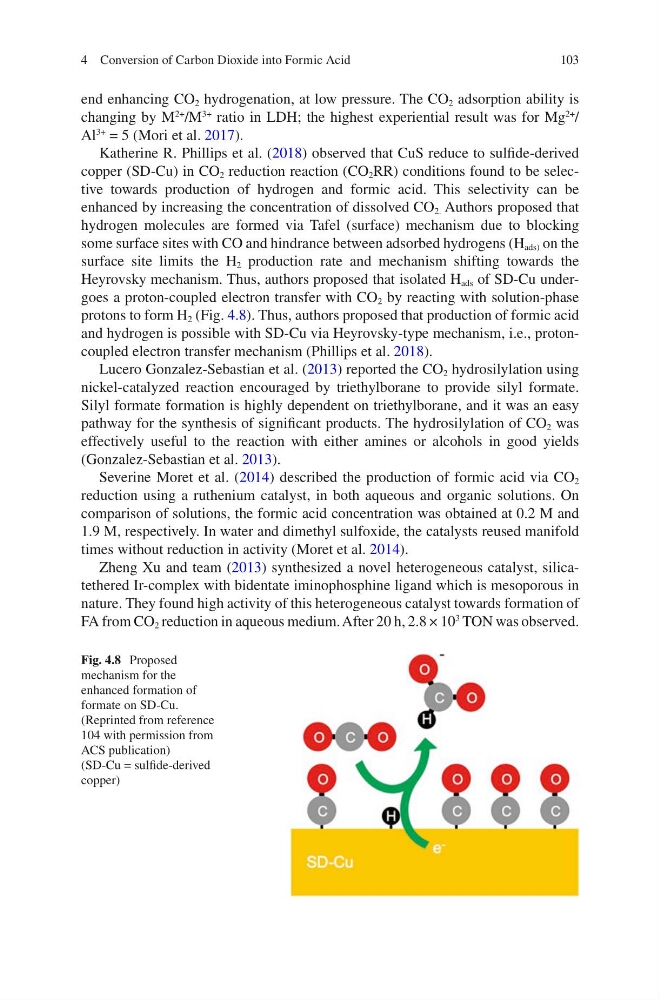
Heyrovsky mechanism. Thus, authors proposed that isolated H ads of SD-Cu undergoes a proton-coupled electron transfer with CO 2 by reacting with solution-phase
protons to form H 2 (Fig. 4.8). Thus, authors proposed that production of formic acid
and hydrogen is possible with SD-Cu via Heyrovsky-type mechanism, i.e., protoncoupled electron transfer mechanism (Phillips et al. 2018).
Lucero Gonzalez-Sebastian et al. (2013) reported the CO 2 hydrosilylation using
nickel-catalyzed reaction encouraged by triethylborane to provide silyl formate.
Silyl formate formation is highly dependent on triethylborane, and it was an easy
pathway for the synthesis of significant products. The hydrosilylation of CO 2 was
effectively useful to the reaction with either amines or alcohols in good yields
(Gonzalez- Sebastian et al. 2013).
Severine Moret et al. (2014) described the production of formic acid via CO 2
reduction using a ruthenium catalyst, in both aqueous and organic solutions. On
comparison of solutions, the formic acid concentration was obtained at 0.2 M and
1.9 M, respectively. In water and dimethyl sulfoxide, the catalysts reused manifold
times without reduction in activity (Moret et al. 2014).
Zheng Xu and team (2013) synthesized a novel heterogeneous catalyst, silicatethered Ir-complex with bidentate iminophosphine ligand which is mesoporous in
nature. They found high activity of this heterogeneous catalyst towards formation of
FA from CO 2 reduction in aqueous medium. After 20 h, 2.8 × 10
3
TON was observed.
Fig. 4.8 Proposed
mechanism for the
enhanced formation of
formate on SD-Cu.
(Reprinted from reference
104 with permission from
ACS publication)
(SD-Cu = sulfide-derived
copper)
4 Conversion of Carbon Dioxide into Formic Acid
end enhancing CO 2 hydrogenation, at low pressure. The CO 2 adsorption ability is
changing by M
2+
/M
3+
ratio in LDH; the highest experiential result was for Mg
2+
/
Al
3+
= 5 (Mori et al. 2017).
Katherine R. Phillips et al. (2018) observed that CuS reduce to sulfide-derived
copper (SD-Cu) in CO 2 reduction reaction (CO 2 RR) conditions found to be selective towards production of hydrogen and formic acid. This selectivity can be
enhanced by increasing the concentration of dissolved CO 2. Authors proposed that
hydrogen molecules are formed via Tafel (surface) mechanism due to blocking
some surface sites with CO and hindrance between adsorbed hydrogens (H ads) on the
surface site limits the H 2 production rate and mechanism shifting towards the
Heyrovsky mechanism. Thus, authors proposed that isolated H ads of SD-Cu undergoes a proton-coupled electron transfer with CO 2 by reacting with solution-phase
protons to form H 2 (Fig. 4.8). Thus, authors proposed that production of formic acid
and hydrogen is possible with SD-Cu via Heyrovsky-type mechanism, i.e., protoncoupled electron transfer mechanism (Phillips et al. 2018).
Lucero Gonzalez-Sebastian et al. (2013) reported the CO 2 hydrosilylation using
nickel-catalyzed reaction encouraged by triethylborane to provide silyl formate.
Silyl formate formation is highly dependent on triethylborane, and it was an easy
pathway for the synthesis of significant products. The hydrosilylation of CO 2 was
effectively useful to the reaction with either amines or alcohols in good yields
(Gonzalez- Sebastian et al. 2013).
Severine Moret et al. (2014) described the production of formic acid via CO 2
reduction using a ruthenium catalyst, in both aqueous and organic solutions. On
comparison of solutions, the formic acid concentration was obtained at 0.2 M and
1.9 M, respectively. In water and dimethyl sulfoxide, the catalysts reused manifold
times without reduction in activity (Moret et al. 2014).
Zheng Xu and team (2013) synthesized a novel heterogeneous catalyst, silicatethered Ir-complex with bidentate iminophosphine ligand which is mesoporous in
nature. They found high activity of this heterogeneous catalyst towards formation of
FA from CO 2 reduction in aqueous medium. After 20 h, 2.8 × 10
3
TON was observed.
Fig. 4.8 Proposed
mechanism for the
enhanced formation of
formate on SD-Cu.
(Reprinted from reference
104 with permission from
ACS publication)
(SD-Cu = sulfide-derived
copper)
4 Conversion of Carbon Dioxide into Formic Acid