

99
Ooyama 2002; Rosenthal et al. 2005; Heinze et al. 2006; Windman et al. 2007; Reda
et al. 2008; Loges et al. 2008; Yu and Pickup 2008; Boddien et al. 2011).
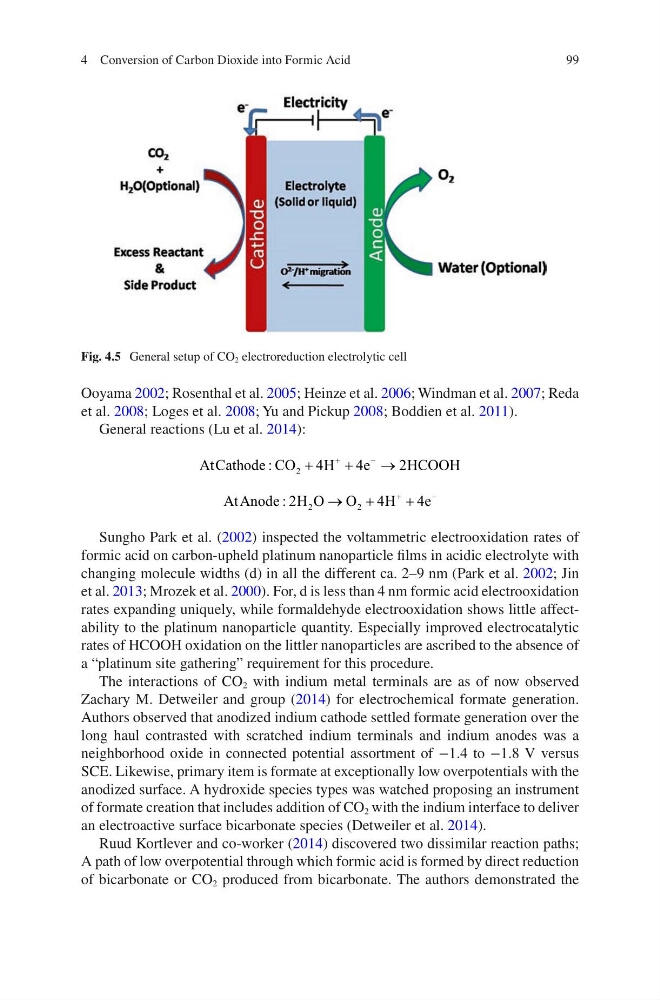
General reactions (Lu et al. 2014):
AtCathode CO
H
e
HCOOH
:
2
4
4
2
+
+
→
+
−
At Anode H O O
H
e
: 2
4
4
2
2
→
+
+
+
−
Sungho Park et al. (2002) inspected the voltammetric electrooxidation rates of
formic acid on carbon-upheld platinum nanoparticle films in acidic electrolyte with
changing molecule widths (d) in all the different ca. 2–9 nm (Park et al. 2002; Jin
et al. 2013; Mrozek et al. 2000). For, d is less than 4 nm formic acid electrooxidation
rates expanding uniquely, while formaldehyde electrooxidation shows little affectability to the platinum nanoparticle quantity. Especially improved electrocatalytic
rates of HCOOH oxidation on the littler nanoparticles are ascribed to the absence of
a “platinum site gathering” requirement for this procedure.
The interactions of CO 2 with indium metal terminals are as of now observed
Zachary M. Detweiler and group (2014) for electrochemical formate generation.
Authors observed that anodized indium cathode settled formate generation over the
long haul contrasted with scratched indium terminals and indium anodes was a
neighborhood oxide in connected potential assortment of −1.4 to −1.8 V versus
SCE. Likewise, primary item is formate at exceptionally low overpotentials with the
anodized surface. A hydroxide species types was watched proposing an instrument
of formate creation that includes addition of CO 2 with the indium interface to deliver
an electroactive surface bicarbonate species (Detweiler et al. 2014).
Ruud Kortlever and co-worker (2014) discovered two dissimilar reaction paths;
A path of low overpotential through which formic acid is formed by direct reduction
of bicarbonate or CO 2 produced from bicarbonate. The authors demonstrated the
Fig. 4.5 General setup of CO 2 electroreduction electrolytic cell
4 Conversion of Carbon Dioxide into Formic Acid
Ooyama 2002; Rosenthal et al. 2005; Heinze et al. 2006; Windman et al. 2007; Reda
et al. 2008; Loges et al. 2008; Yu and Pickup 2008; Boddien et al. 2011).
General reactions (Lu et al. 2014):
AtCathode CO
H
e
HCOOH
:
2
4
4
2
+
+
→
+
−
At Anode H O O
H
e
: 2
4
4
2
2
→
+
+
+
−
Sungho Park et al. (2002) inspected the voltammetric electrooxidation rates of
formic acid on carbon-upheld platinum nanoparticle films in acidic electrolyte with
changing molecule widths (d) in all the different ca. 2–9 nm (Park et al. 2002; Jin
et al. 2013; Mrozek et al. 2000). For, d is less than 4 nm formic acid electrooxidation
rates expanding uniquely, while formaldehyde electrooxidation shows little affectability to the platinum nanoparticle quantity. Especially improved electrocatalytic
rates of HCOOH oxidation on the littler nanoparticles are ascribed to the absence of
a “platinum site gathering” requirement for this procedure.
The interactions of CO 2 with indium metal terminals are as of now observed
Zachary M. Detweiler and group (2014) for electrochemical formate generation.
Authors observed that anodized indium cathode settled formate generation over the
long haul contrasted with scratched indium terminals and indium anodes was a
neighborhood oxide in connected potential assortment of −1.4 to −1.8 V versus
SCE. Likewise, primary item is formate at exceptionally low overpotentials with the
anodized surface. A hydroxide species types was watched proposing an instrument
of formate creation that includes addition of CO 2 with the indium interface to deliver
an electroactive surface bicarbonate species (Detweiler et al. 2014).
Ruud Kortlever and co-worker (2014) discovered two dissimilar reaction paths;
A path of low overpotential through which formic acid is formed by direct reduction
of bicarbonate or CO 2 produced from bicarbonate. The authors demonstrated the
Fig. 4.5 General setup of CO 2 electroreduction electrolytic cell
4 Conversion of Carbon Dioxide into Formic Acid