

The determination of total organic carbon (TOC) is a fundamental parameter for a
fast and rough characterization of samples. In contrast to analytical pyrolysis, that is
exclusively performed under anaerobic conditions, TOC measurement is a combustion process heating up the sample material in presence of oxygen. This combustion
converts organic matter more or less completely to CO 2 , H 2 O and further inorganic
gases (H 2 S, NO 2 . . . .), however, the organically bound carbon is converted to CO 2
that is measured easily by a simple IR detector (see Sect. 4.3.3). The differentiation
of organic and inorganic carbon (e.g. in carbonates) is related to the combustion
temperature. Since inorganic carbon is mainly more stable during combustion than
organic one, first the TOC can be measured at temperatures up to approx. 550
C,
thereafter inorganic carbon will be released by temperatures up to 1000
C. The total
amount of TOC is finally calculated by the initially amount of sample and the
measured CO 2 amount as analyzed by the calibrated IR detector.
A more precious information about the bulk organic matter can be obtained by the
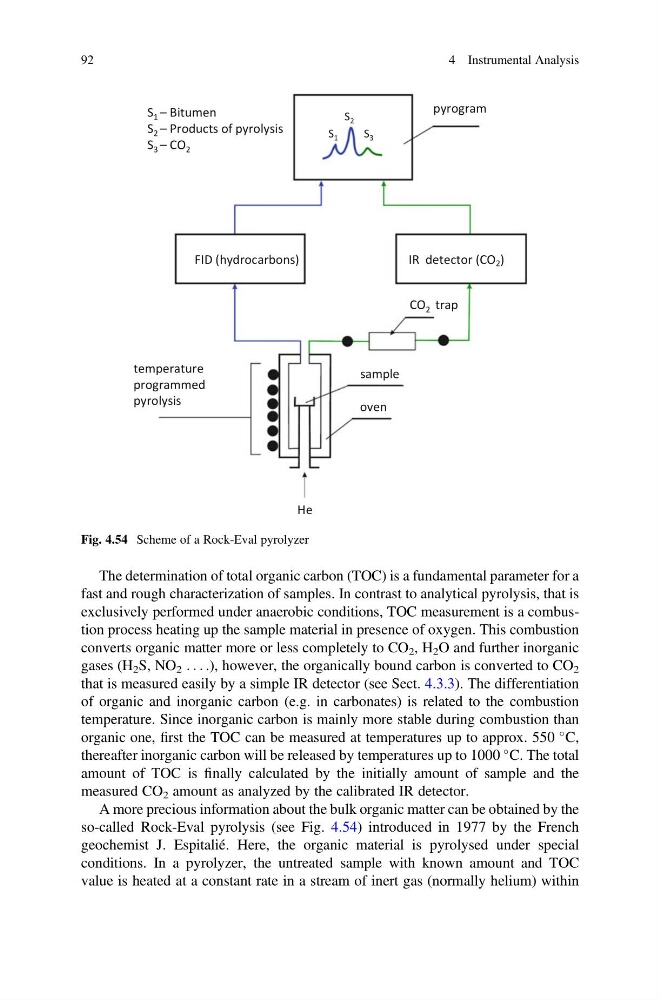
so-called Rock-Eval pyrolysis (see Fig. 4.54) introduced in 1977 by the French
geochemist J. Espitalié. Here, the organic material is pyrolysed under special
conditions. In a pyrolyzer, the untreated sample with known amount and TOC
value is heated at a constant rate in a stream of inert gas (normally helium) within
S 1 – Bitumen
S 2 – Products of pyrolysis
S 3 – CO 2
IR detector (CO 2 )
FID (hydrocarbons)
CO 2 trap
sample
oven
He
temperature
programmed
pyrolysis
pyrogram
S 1
S 2
S 3
Fig. 4.54 Scheme of a Rock-Eval pyrolyzer
92
4 Instrumental Analysis
fast and rough characterization of samples. In contrast to analytical pyrolysis, that is
exclusively performed under anaerobic conditions, TOC measurement is a combustion process heating up the sample material in presence of oxygen. This combustion
converts organic matter more or less completely to CO 2 , H 2 O and further inorganic
gases (H 2 S, NO 2 . . . .), however, the organically bound carbon is converted to CO 2
that is measured easily by a simple IR detector (see Sect. 4.3.3). The differentiation
of organic and inorganic carbon (e.g. in carbonates) is related to the combustion
temperature. Since inorganic carbon is mainly more stable during combustion than
organic one, first the TOC can be measured at temperatures up to approx. 550
C,
thereafter inorganic carbon will be released by temperatures up to 1000
C. The total
amount of TOC is finally calculated by the initially amount of sample and the
measured CO 2 amount as analyzed by the calibrated IR detector.
A more precious information about the bulk organic matter can be obtained by the
so-called Rock-Eval pyrolysis (see Fig. 4.54) introduced in 1977 by the French
geochemist J. Espitalié. Here, the organic material is pyrolysed under special
conditions. In a pyrolyzer, the untreated sample with known amount and TOC
value is heated at a constant rate in a stream of inert gas (normally helium) within
S 1 – Bitumen
S 2 – Products of pyrolysis
S 3 – CO 2
IR detector (CO 2 )
FID (hydrocarbons)
CO 2 trap
sample
oven
He
temperature
programmed
pyrolysis
pyrogram
S 1
S 2
S 3
Fig. 4.54 Scheme of a Rock-Eval pyrolyzer
92
4 Instrumental Analysis