

pellet. Compression of this pellet forms a transparent matrix of crystalline KBr in
which the solid sample is fixed. This pellet can be directly measured in an IR beam
without interferences by the KBr matrix.
For common IR spectroscopy the vibration transitions are used. The
corresponding vibrations within a molecule can be divided into different groups of
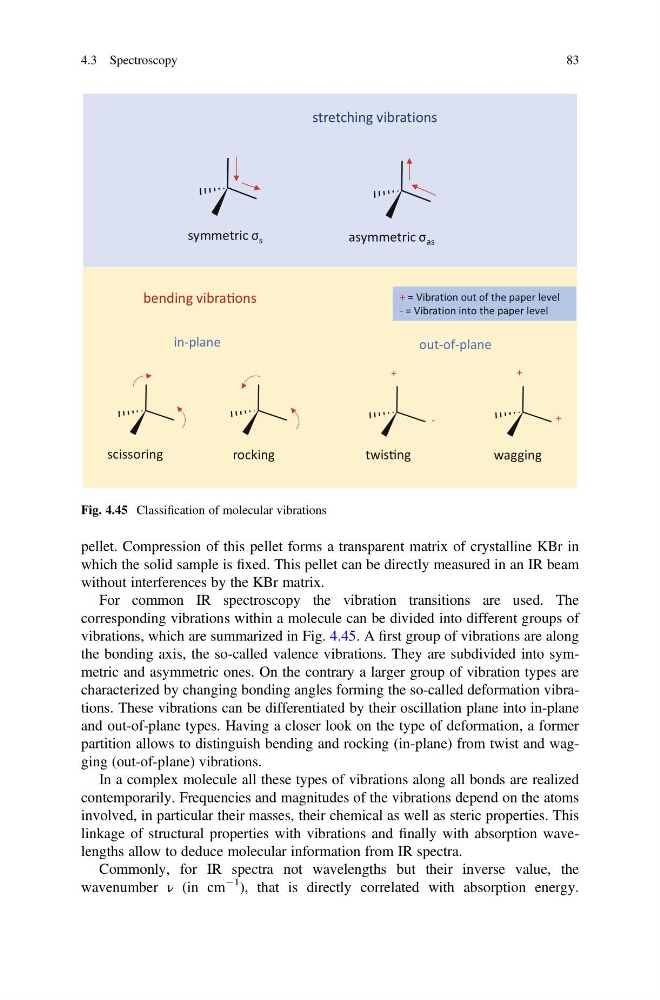
vibrations, which are summarized in Fig. 4.45. A first group of vibrations are along
the bonding axis, the so-called valence vibrations. They are subdivided into symmetric and asymmetric ones. On the contrary a larger group of vibration types are
characterized by changing bonding angles forming the so-called deformation vibrations. These vibrations can be differentiated by their oscillation plane into in-plane
and out-of-plane types. Having a closer look on the type of deformation, a former
partition allows to distinguish bending and rocking (in-plane) from twist and wagging (out-of-plane) vibrations.
In a complex molecule all these types of vibrations along all bonds are realized
contemporarily. Frequencies and magnitudes of the vibrations depend on the atoms
involved, in particular their masses, their chemical as well as steric properties. This
linkage of structural properties with vibrations and finally with absorption wavelengths allow to deduce molecular information from IR spectra.
Commonly, for IR spectra not wavelengths but their inverse value, the
wavenumber ν (in cm
À1 ), that is directly correlated with absorption energy.
stretching vibrat ions
bending vibraƟons
+ = Vibrat ion out of the paper level
- = Vibrat ion into the paper level
symmetric σ s
asymmetric σ as
scissoring
+
in-plane
out-of-plane
+
-
twisƟng
rocking
+
wagging
Fig. 4.45 Classification of molecular vibrations
4.3 Spectroscopy
83
which the solid sample is fixed. This pellet can be directly measured in an IR beam
without interferences by the KBr matrix.
For common IR spectroscopy the vibration transitions are used. The
corresponding vibrations within a molecule can be divided into different groups of
vibrations, which are summarized in Fig. 4.45. A first group of vibrations are along
the bonding axis, the so-called valence vibrations. They are subdivided into symmetric and asymmetric ones. On the contrary a larger group of vibration types are
characterized by changing bonding angles forming the so-called deformation vibrations. These vibrations can be differentiated by their oscillation plane into in-plane
and out-of-plane types. Having a closer look on the type of deformation, a former
partition allows to distinguish bending and rocking (in-plane) from twist and wagging (out-of-plane) vibrations.
In a complex molecule all these types of vibrations along all bonds are realized
contemporarily. Frequencies and magnitudes of the vibrations depend on the atoms
involved, in particular their masses, their chemical as well as steric properties. This
linkage of structural properties with vibrations and finally with absorption wavelengths allow to deduce molecular information from IR spectra.
Commonly, for IR spectra not wavelengths but their inverse value, the
wavenumber ν (in cm
À1 ), that is directly correlated with absorption energy.
stretching vibrat ions
bending vibraƟons
+ = Vibrat ion out of the paper level
- = Vibrat ion into the paper level
symmetric σ s
asymmetric σ as
scissoring
+
in-plane
out-of-plane
+
-
twisƟng
rocking
+
wagging
Fig. 4.45 Classification of molecular vibrations
4.3 Spectroscopy
83