

double bonds (C¼C, C¼O . . .). For absorption in the region of visible light
structural moieties like conjugated double bonds are needed, since the conjugation
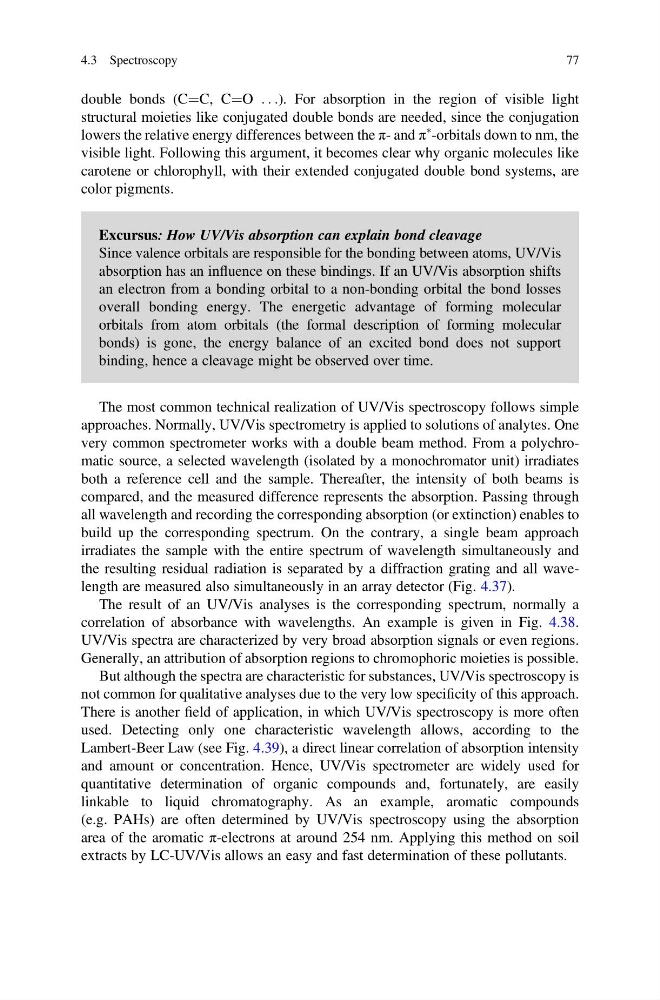
lowers the relative energy differences between the π- and π
à -orbitals down to nm, the
visible light. Following this argument, it becomes clear why organic molecules like
carotene or chlorophyll, with their extended conjugated double bond systems, are
color pigments.
Excursus: How UV/Vis absorption can explain bond cleavage
Since valence orbitals are responsible for the bonding between atoms, UV/Vis
absorption has an influence on these bindings. If an UV/Vis absorption shifts
an electron from a bonding orbital to a non-bonding orbital the bond losses
overall bonding energy. The energetic advantage of forming molecular
orbitals from atom orbitals (the formal description of forming molecular
bonds) is gone, the energy balance of an excited bond does not support
binding, hence a cleavage might be observed over time.
The most common technical realization of UV/Vis spectroscopy follows simple
approaches. Normally, UV/Vis spectrometry is applied to solutions of analytes. One
very common spectrometer works with a double beam method. From a polychromatic source, a selected wavelength (isolated by a monochromator unit) irradiates
both a reference cell and the sample. Thereafter, the intensity of both beams is
compared, and the measured difference represents the absorption. Passing through
all wavelength and recording the corresponding absorption (or extinction) enables to
build up the corresponding spectrum. On the contrary, a single beam approach
irradiates the sample with the entire spectrum of wavelength simultaneously and
the resulting residual radiation is separated by a diffraction grating and all wavelength are measured also simultaneously in an array detector (Fig. 4.37).
The result of an UV/Vis analyses is the corresponding spectrum, normally a
correlation of absorbance with wavelengths. An example is given in Fig. 4.38.
UV/Vis spectra are characterized by very broad absorption signals or even regions.
Generally, an attribution of absorption regions to chromophoric moieties is possible.
But although the spectra are characteristic for substances, UV/Vis spectroscopy is
not common for qualitative analyses due to the very low specificity of this approach.
There is another field of application, in which UV/Vis spectroscopy is more often
used. Detecting only one characteristic wavelength allows, according to the
Lambert-Beer Law (see Fig. 4.39), a direct linear correlation of absorption intensity
and amount or concentration. Hence, UV/Vis spectrometer are widely used for
quantitative determination of organic compounds and, fortunately, are easily
linkable to liquid chromatography. As an example, aromatic compounds
(e.g. PAHs) are often determined by UV/Vis spectroscopy using the absorption
area of the aromatic π-electrons at around 254 nm. Applying this method on soil
extracts by LC-UV/Vis allows an easy and fast determination of these pollutants.
4.3 Spectroscopy
77
structural moieties like conjugated double bonds are needed, since the conjugation
lowers the relative energy differences between the π- and π
à -orbitals down to nm, the
visible light. Following this argument, it becomes clear why organic molecules like
carotene or chlorophyll, with their extended conjugated double bond systems, are
color pigments.
Excursus: How UV/Vis absorption can explain bond cleavage
Since valence orbitals are responsible for the bonding between atoms, UV/Vis
absorption has an influence on these bindings. If an UV/Vis absorption shifts
an electron from a bonding orbital to a non-bonding orbital the bond losses
overall bonding energy. The energetic advantage of forming molecular
orbitals from atom orbitals (the formal description of forming molecular
bonds) is gone, the energy balance of an excited bond does not support
binding, hence a cleavage might be observed over time.
The most common technical realization of UV/Vis spectroscopy follows simple
approaches. Normally, UV/Vis spectrometry is applied to solutions of analytes. One
very common spectrometer works with a double beam method. From a polychromatic source, a selected wavelength (isolated by a monochromator unit) irradiates
both a reference cell and the sample. Thereafter, the intensity of both beams is
compared, and the measured difference represents the absorption. Passing through
all wavelength and recording the corresponding absorption (or extinction) enables to
build up the corresponding spectrum. On the contrary, a single beam approach
irradiates the sample with the entire spectrum of wavelength simultaneously and
the resulting residual radiation is separated by a diffraction grating and all wavelength are measured also simultaneously in an array detector (Fig. 4.37).
The result of an UV/Vis analyses is the corresponding spectrum, normally a
correlation of absorbance with wavelengths. An example is given in Fig. 4.38.
UV/Vis spectra are characterized by very broad absorption signals or even regions.
Generally, an attribution of absorption regions to chromophoric moieties is possible.
But although the spectra are characteristic for substances, UV/Vis spectroscopy is
not common for qualitative analyses due to the very low specificity of this approach.
There is another field of application, in which UV/Vis spectroscopy is more often
used. Detecting only one characteristic wavelength allows, according to the
Lambert-Beer Law (see Fig. 4.39), a direct linear correlation of absorption intensity
and amount or concentration. Hence, UV/Vis spectrometer are widely used for
quantitative determination of organic compounds and, fortunately, are easily
linkable to liquid chromatography. As an example, aromatic compounds
(e.g. PAHs) are often determined by UV/Vis spectroscopy using the absorption
area of the aromatic π-electrons at around 254 nm. Applying this method on soil
extracts by LC-UV/Vis allows an easy and fast determination of these pollutants.
4.3 Spectroscopy
77