

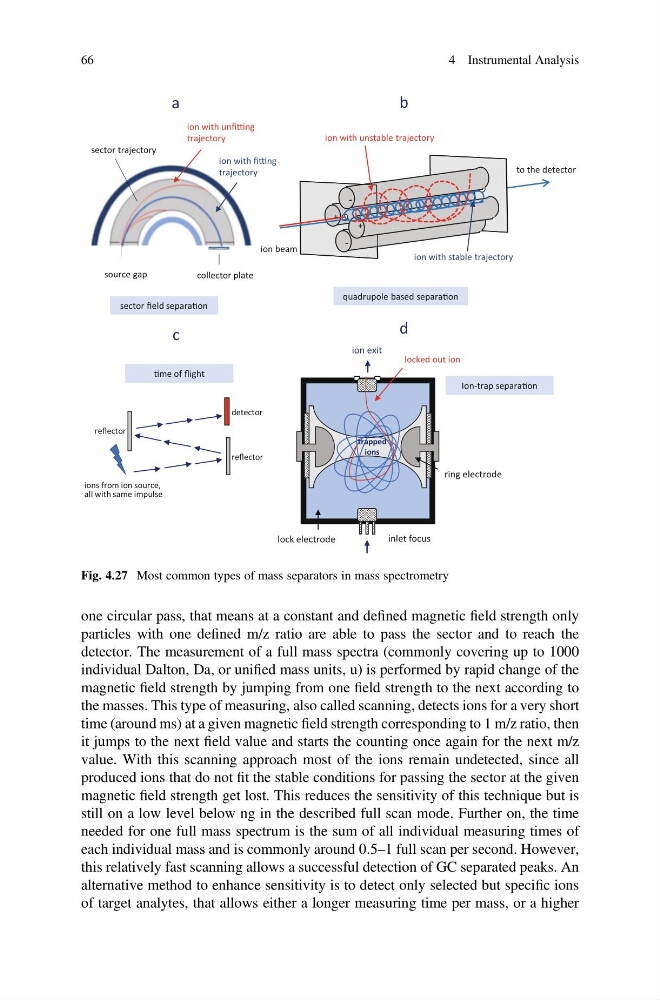
one circular pass, that means at a constant and defined magnetic field strength only
particles with one defined m/z ratio are able to pass the sector and to reach the
detector. The measurement of a full mass spectra (commonly covering up to 1000
individual Dalton, Da, or unified mass units, u) is performed by rapid change of the
magnetic field strength by jumping from one field strength to the next according to
the masses. This type of measuring, also called scanning, detects ions for a very short
time (around ms) at a given magnetic field strength corresponding to 1 m/z ratio, then
it jumps to the next field value and starts the counting once again for the next m/z
value. With this scanning approach most of the ions remain undetected, since all
produced ions that do not fit the stable conditions for passing the sector at the given
magnetic field strength get lost. This reduces the sensitivity of this technique but is
still on a low level below ng in the described full scan mode. Further on, the time
needed for one full mass spectrum is the sum of all individual measuring times of
each individual mass and is commonly around 0.5–1 full scan per second. However,
this relatively fast scanning allows a successful detection of GC separated peaks. An
alternative method to enhance sensitivity is to detect only selected but specific ions
of target analytes, that allows either a longer measuring time per mass, or a higher
source gap
sector trajectory
collector plate
sector field separaƟon
-
-
+
-
-
+
+
+
to the detector
ion with stable trajectory
ion with unstable trajectory
ion beam
quadrupole based separaƟon
ring electrode
inlet focus
lock electrode
ion exit
Ion-trap separaƟon
ions from ion source,
all with same impulse
Ɵme of flight
reflector
detector
reflector
trapped
ions
ion with unfiƫng
trajectory
ion with fiƫng
trajectory
locked out ion
a
b
c
d
Fig. 4.27 Most common types of mass separators in mass spectrometry
66
4 Instrumental Analysis
particles with one defined m/z ratio are able to pass the sector and to reach the
detector. The measurement of a full mass spectra (commonly covering up to 1000
individual Dalton, Da, or unified mass units, u) is performed by rapid change of the
magnetic field strength by jumping from one field strength to the next according to
the masses. This type of measuring, also called scanning, detects ions for a very short
time (around ms) at a given magnetic field strength corresponding to 1 m/z ratio, then
it jumps to the next field value and starts the counting once again for the next m/z
value. With this scanning approach most of the ions remain undetected, since all
produced ions that do not fit the stable conditions for passing the sector at the given
magnetic field strength get lost. This reduces the sensitivity of this technique but is
still on a low level below ng in the described full scan mode. Further on, the time
needed for one full mass spectrum is the sum of all individual measuring times of
each individual mass and is commonly around 0.5–1 full scan per second. However,
this relatively fast scanning allows a successful detection of GC separated peaks. An
alternative method to enhance sensitivity is to detect only selected but specific ions
of target analytes, that allows either a longer measuring time per mass, or a higher
source gap
sector trajectory
collector plate
sector field separaƟon
-
-
+
-
-
+
+
+
to the detector
ion with stable trajectory
ion with unstable trajectory
ion beam
quadrupole based separaƟon
ring electrode
inlet focus
lock electrode
ion exit
Ion-trap separaƟon
ions from ion source,
all with same impulse
Ɵme of flight
reflector
detector
reflector
trapped
ions
ion with unfiƫng
trajectory
ion with fiƫng
trajectory
locked out ion
a
b
c
d
Fig. 4.27 Most common types of mass separators in mass spectrometry
66
4 Instrumental Analysis