

different spatial resolutions. Applications of such technique are known e.g. for
material analyses, geomaterials and pharmaceuticals.
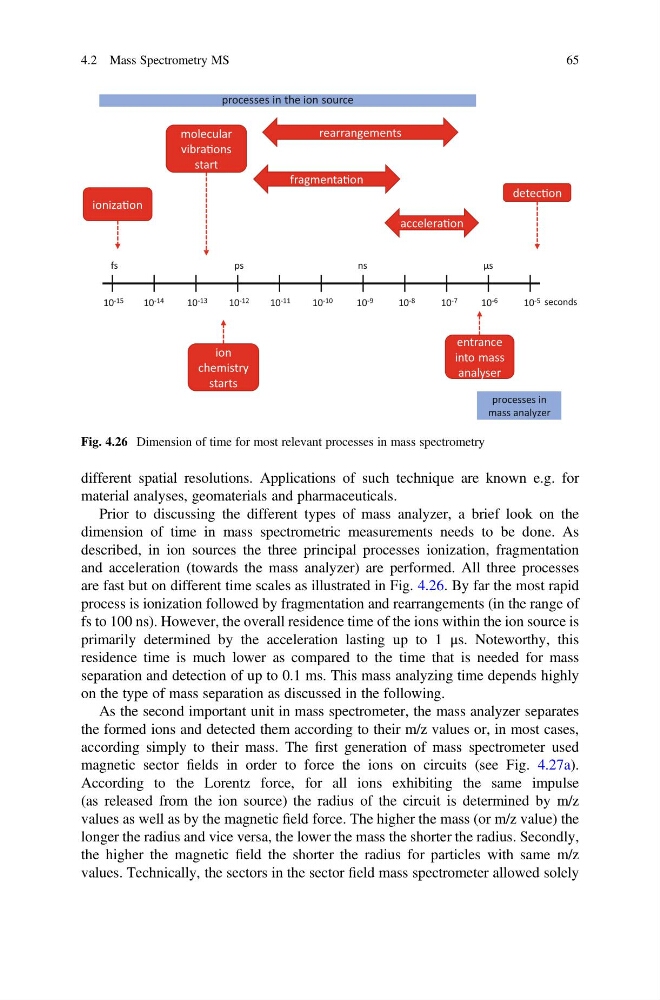
Prior to discussing the different types of mass analyzer, a brief look on the
dimension of time in mass spectrometric measurements needs to be done. As
described, in ion sources the three principal processes ionization, fragmentation
and acceleration (towards the mass analyzer) are performed. All three processes
are fast but on different time scales as illustrated in Fig. 4.26. By far the most rapid
process is ionization followed by fragmentation and rearrangements (in the range of
fs to 100 ns). However, the overall residence time of the ions within the ion source is
primarily determined by the acceleration lasting up to 1 μs. Noteworthy, this
residence time is much lower as compared to the time that is needed for mass
separation and detection of up to 0.1 ms. This mass analyzing time depends highly
on the type of mass separation as discussed in the following.
As the second important unit in mass spectrometer, the mass analyzer separates
the formed ions and detected them according to their m/z values or, in most cases,
according simply to their mass. The first generation of mass spectrometer used
magnetic sector fields in order to force the ions on circuits (see Fig. 4.27a).
According to the Lorentz force, for all ions exhibiting the same impulse
(as released from the ion source) the radius of the circuit is determined by m/z
values as well as by the magnetic field force. The higher the mass (or m/z value) the
longer the radius and vice versa, the lower the mass the shorter the radius. Secondly,
the higher the magnetic field the shorter the radius for particles with same m/z
values. Technically, the sectors in the sector field mass spectrometer allowed solely
10 -5
10 -6
10 -7
10 -8
10 -9
10 -10
10 -11
10 -12
10 -13
10 -14
10 -15
processes in the ion source
seconds
entrance
into mass
analyser
rearrangements
ion
chemistry
starts
molecular
vibraƟons
start
fragmentaƟon
acceleraƟon
ionizaƟon
detecƟon
processes in
mass analyzer
fs
ps
ns
μs
Fig. 4.26 Dimension of time for most relevant processes in mass spectrometry
4.2 Mass Spectrometry MS
65
material analyses, geomaterials and pharmaceuticals.
Prior to discussing the different types of mass analyzer, a brief look on the
dimension of time in mass spectrometric measurements needs to be done. As
described, in ion sources the three principal processes ionization, fragmentation
and acceleration (towards the mass analyzer) are performed. All three processes
are fast but on different time scales as illustrated in Fig. 4.26. By far the most rapid
process is ionization followed by fragmentation and rearrangements (in the range of
fs to 100 ns). However, the overall residence time of the ions within the ion source is
primarily determined by the acceleration lasting up to 1 μs. Noteworthy, this
residence time is much lower as compared to the time that is needed for mass
separation and detection of up to 0.1 ms. This mass analyzing time depends highly
on the type of mass separation as discussed in the following.
As the second important unit in mass spectrometer, the mass analyzer separates
the formed ions and detected them according to their m/z values or, in most cases,
according simply to their mass. The first generation of mass spectrometer used
magnetic sector fields in order to force the ions on circuits (see Fig. 4.27a).
According to the Lorentz force, for all ions exhibiting the same impulse
(as released from the ion source) the radius of the circuit is determined by m/z
values as well as by the magnetic field force. The higher the mass (or m/z value) the
longer the radius and vice versa, the lower the mass the shorter the radius. Secondly,
the higher the magnetic field the shorter the radius for particles with same m/z
values. Technically, the sectors in the sector field mass spectrometer allowed solely
10 -5
10 -6
10 -7
10 -8
10 -9
10 -10
10 -11
10 -12
10 -13
10 -14
10 -15
processes in the ion source
seconds
entrance
into mass
analyser
rearrangements
ion
chemistry
starts
molecular
vibraƟons
start
fragmentaƟon
acceleraƟon
ionizaƟon
detecƟon
processes in
mass analyzer
fs
ps
ns
μs
Fig. 4.26 Dimension of time for most relevant processes in mass spectrometry
4.2 Mass Spectrometry MS
65