

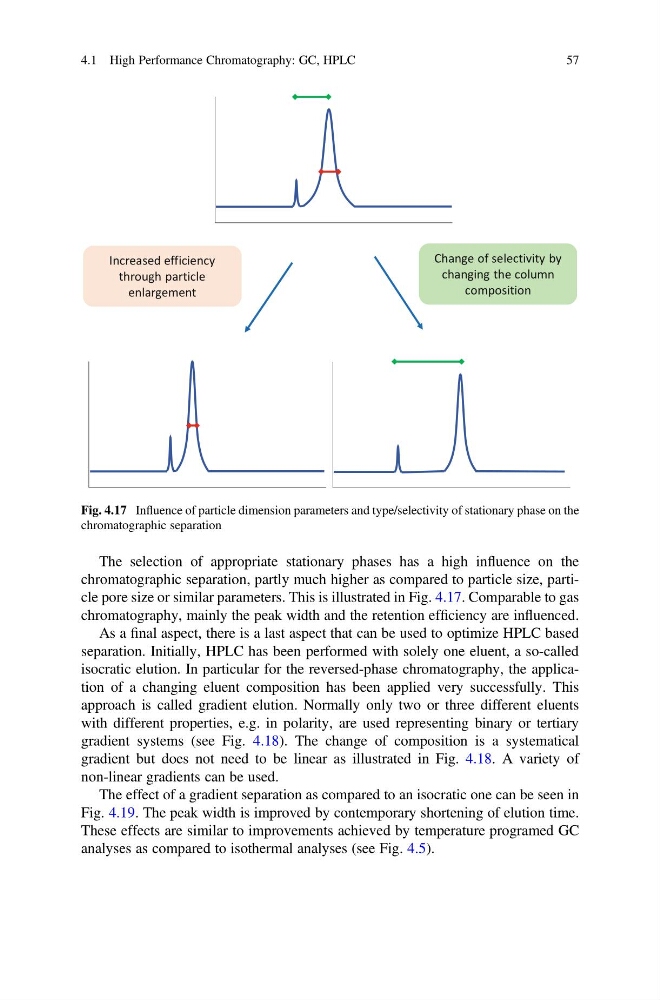
The selection of appropriate stationary phases has a high influence on the
chromatographic separation, partly much higher as compared to particle size, particle pore size or similar parameters. This is illustrated in Fig. 4.17. Comparable to gas
chromatography, mainly the peak width and the retention efficiency are influenced.
As a final aspect, there is a last aspect that can be used to optimize HPLC based
separation. Initially, HPLC has been performed with solely one eluent, a so-called
isocratic elution. In particular for the reversed-phase chromatography, the application of a changing eluent composition has been applied very successfully. This
approach is called gradient elution. Normally only two or three different eluents
with different properties, e.g. in polarity, are used representing binary or tertiary
gradient systems (see Fig. 4.18). The change of composition is a systematical
gradient but does not need to be linear as illustrated in Fig. 4.18. A variety of
non-linear gradients can be used.
The effect of a gradient separation as compared to an isocratic one can be seen in
Fig. 4.19. The peak width is improved by contemporary shortening of elution time.
These effects are similar to improvements achieved by temperature programed GC
analyses as compared to isothermal analyses (see Fig. 4.5).
Change of selectivity by
changing the column
composition
Increased efficiency
through particle
enlargement
Fig. 4.17 Influence of particle dimension parameters and type/selectivity of stationary phase on the
chromatographic separation
4.1 High Performance Chromatography: GC, HPLC
57
chromatographic separation, partly much higher as compared to particle size, particle pore size or similar parameters. This is illustrated in Fig. 4.17. Comparable to gas
chromatography, mainly the peak width and the retention efficiency are influenced.
As a final aspect, there is a last aspect that can be used to optimize HPLC based
separation. Initially, HPLC has been performed with solely one eluent, a so-called
isocratic elution. In particular for the reversed-phase chromatography, the application of a changing eluent composition has been applied very successfully. This
approach is called gradient elution. Normally only two or three different eluents
with different properties, e.g. in polarity, are used representing binary or tertiary
gradient systems (see Fig. 4.18). The change of composition is a systematical
gradient but does not need to be linear as illustrated in Fig. 4.18. A variety of
non-linear gradients can be used.
The effect of a gradient separation as compared to an isocratic one can be seen in
Fig. 4.19. The peak width is improved by contemporary shortening of elution time.
These effects are similar to improvements achieved by temperature programed GC
analyses as compared to isothermal analyses (see Fig. 4.5).
Change of selectivity by
changing the column
composition
Increased efficiency
through particle
enlargement
Fig. 4.17 Influence of particle dimension parameters and type/selectivity of stationary phase on the
chromatographic separation
4.1 High Performance Chromatography: GC, HPLC
57