

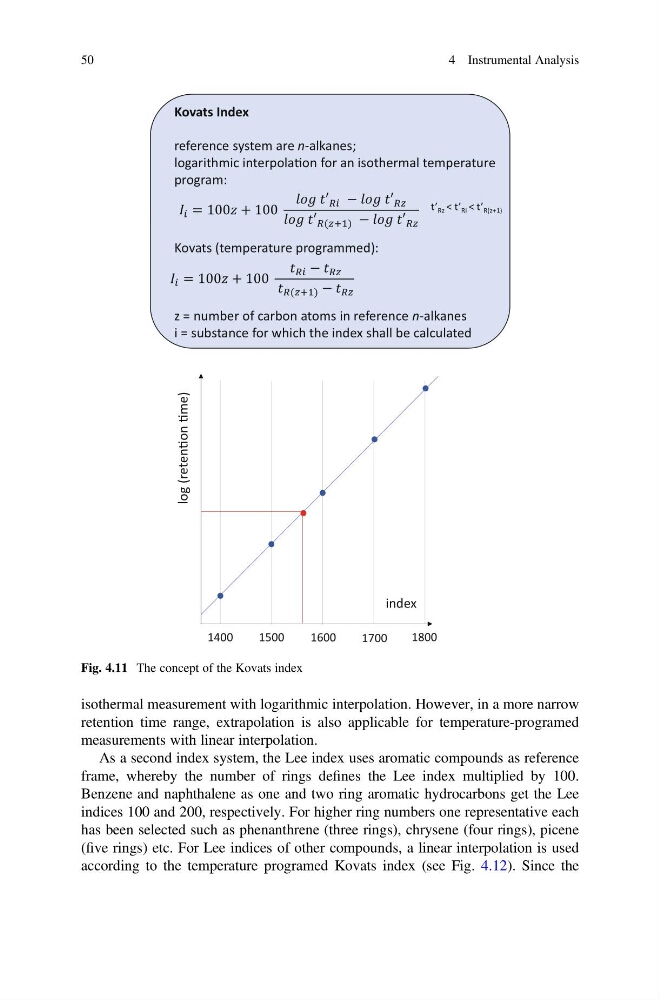
isothermal measurement with logarithmic interpolation. However, in a more narrow
retention time range, extrapolation is also applicable for temperature-programed
measurements with linear interpolation.
As a second index system, the Lee index uses aromatic compounds as reference
frame, whereby the number of rings defines the Lee index multiplied by 100.
Benzene and naphthalene as one and two ring aromatic hydrocarbons get the Lee
indices 100 and 200, respectively. For higher ring numbers one representative each
has been selected such as phenanthrene (three rings), chrysene (four rings), picene
(five rings) etc. For Lee indices of other compounds, a linear interpolation is used
according to the temperature programed Kovats index (see Fig. 4.12). Since the
Kovats Index
reference system are n-alkanes;
logarithmic interpolaƟon for an isothermal temperature
program:
Kovats (temperature programmed):
z = number of carbon atoms in reference n-alkanes
i = substance for which the index shall be calculated
t’ Rz < t’ Ri < t’ R(z+1)
index
1400
1500
1600
1700
1800
log (retenƟon Ɵme)
Fig. 4.11 The concept of the Kovats index
50
4 Instrumental Analysis
retention time range, extrapolation is also applicable for temperature-programed
measurements with linear interpolation.
As a second index system, the Lee index uses aromatic compounds as reference
frame, whereby the number of rings defines the Lee index multiplied by 100.
Benzene and naphthalene as one and two ring aromatic hydrocarbons get the Lee
indices 100 and 200, respectively. For higher ring numbers one representative each
has been selected such as phenanthrene (three rings), chrysene (four rings), picene
(five rings) etc. For Lee indices of other compounds, a linear interpolation is used
according to the temperature programed Kovats index (see Fig. 4.12). Since the
Kovats Index
reference system are n-alkanes;
logarithmic interpolaƟon for an isothermal temperature
program:
Kovats (temperature programmed):
z = number of carbon atoms in reference n-alkanes
i = substance for which the index shall be calculated
t’ Rz < t’ Ri < t’ R(z+1)
index
1400
1500
1600
1700
1800
log (retenƟon Ɵme)
Fig. 4.11 The concept of the Kovats index
50
4 Instrumental Analysis