

Finally, gas chromatography is a separation method that can provide first evidence on compound identification. The retention behavior is a characteristic property
and can be used for characterization of individual substances. However, the absolute
retention time is not suitable since it varies depending on the machine, the gas
velocity, temperature program, column length and many other parameters. But using
a same type of column film (e.g. methyl siloxanes like ZB1, HP1 or OV1, see
Fig. 4.3) the relative retention and the corresponding retention order is always the
same regardless of all other parameters. This phenomenon has been used to define
so-called retention indices that can be used for compound characterization instead of
retention times.
Two index systems are well-known, the Kovats index and the Lee index. They
differ in one basic aspect, they have a different frame of defined reference index
values. The Kovats index is related to the retention of n-alkanes, where each nalkane gets the index composed by the number of carbon atoms multiplied by 100.
The retention index of another substance can be calculated by interpolation of
retention times of both substance and reference alkanes related to retention index
of reference alkanes. Both normal or logarithmic interpolation is used for isothermal
or temperature programed measurements, respectively. This is illustrated in
Fig. 4.11. Main advantage of this method is the possibility not only to interpolate
but also to extrapolate to some extent from given n-alkane values due to the very
regular retention behavior of the reference compounds, the n-alkanes. To be accurate, extrapolation over the whole range of a chromatogram is only valid for an
R
OH
O
diazomethane
R
O
O
R
OH
BSTFA
O Si
R
OH
O
R
O
O
Derivat izat ion of polar compounds
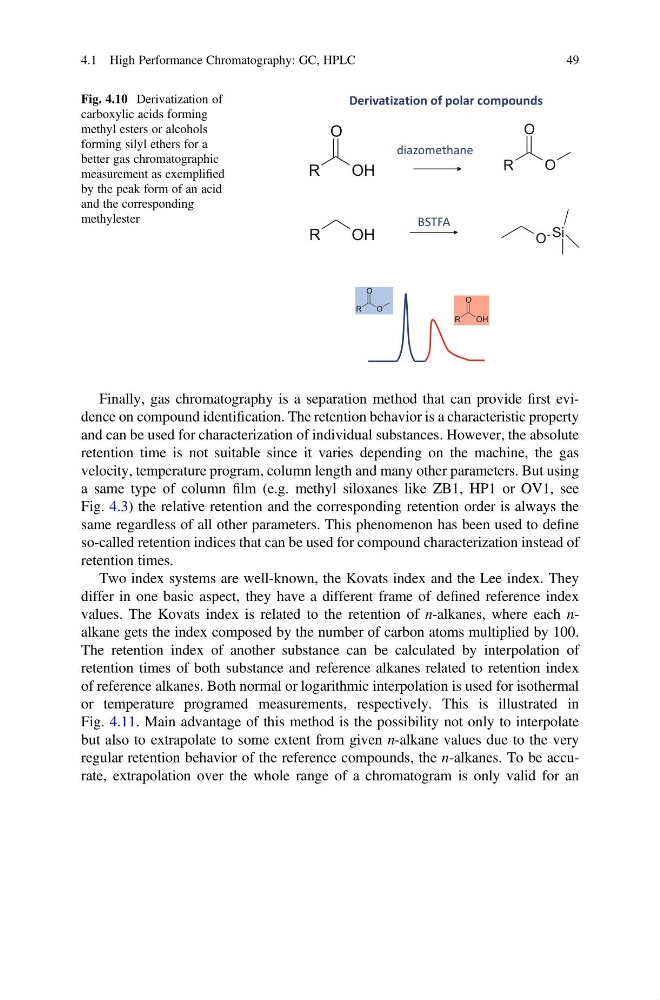
Fig. 4.10 Derivatization of
carboxylic acids forming
methyl esters or alcohols
forming silyl ethers for a
better gas chromatographic
measurement as exemplified
by the peak form of an acid
and the corresponding
methylester
4.1 High Performance Chromatography: GC, HPLC
49
and can be used for characterization of individual substances. However, the absolute
retention time is not suitable since it varies depending on the machine, the gas
velocity, temperature program, column length and many other parameters. But using
a same type of column film (e.g. methyl siloxanes like ZB1, HP1 or OV1, see
Fig. 4.3) the relative retention and the corresponding retention order is always the
same regardless of all other parameters. This phenomenon has been used to define
so-called retention indices that can be used for compound characterization instead of
retention times.
Two index systems are well-known, the Kovats index and the Lee index. They
differ in one basic aspect, they have a different frame of defined reference index
values. The Kovats index is related to the retention of n-alkanes, where each nalkane gets the index composed by the number of carbon atoms multiplied by 100.
The retention index of another substance can be calculated by interpolation of
retention times of both substance and reference alkanes related to retention index
of reference alkanes. Both normal or logarithmic interpolation is used for isothermal
or temperature programed measurements, respectively. This is illustrated in
Fig. 4.11. Main advantage of this method is the possibility not only to interpolate
but also to extrapolate to some extent from given n-alkane values due to the very
regular retention behavior of the reference compounds, the n-alkanes. To be accurate, extrapolation over the whole range of a chromatogram is only valid for an
R
OH
O
diazomethane
R
O
O
R
OH
BSTFA
O Si
R
OH
O
R
O
O
Derivat izat ion of polar compounds
Fig. 4.10 Derivatization of
carboxylic acids forming
methyl esters or alcohols
forming silyl ethers for a
better gas chromatographic
measurement as exemplified
by the peak form of an acid
and the corresponding
methylester
4.1 High Performance Chromatography: GC, HPLC
49