

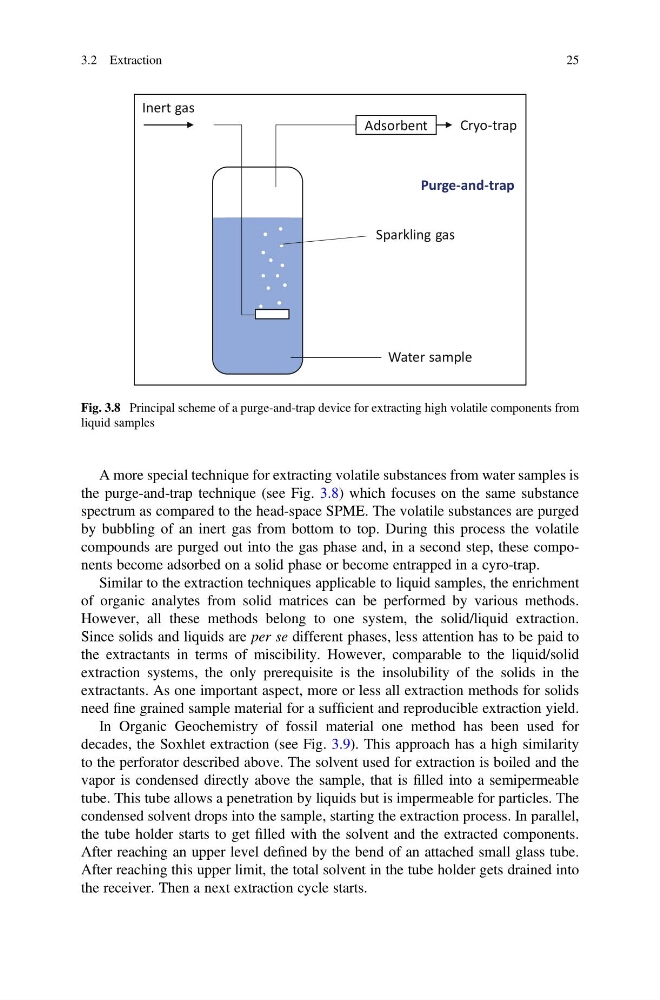
A more special technique for extracting volatile substances from water samples is
the purge-and-trap technique (see Fig. 3.8) which focuses on the same substance
spectrum as compared to the head-space SPME. The volatile substances are purged
by bubbling of an inert gas from bottom to top. During this process the volatile
compounds are purged out into the gas phase and, in a second step, these components become adsorbed on a solid phase or become entrapped in a cyro-trap.
Similar to the extraction techniques applicable to liquid samples, the enrichment
of organic analytes from solid matrices can be performed by various methods.
However, all these methods belong to one system, the solid/liquid extraction.
Since solids and liquids are per se different phases, less attention has to be paid to
the extractants in terms of miscibility. However, comparable to the liquid/solid
extraction systems, the only prerequisite is the insolubility of the solids in the
extractants. As one important aspect, more or less all extraction methods for solids
need fine grained sample material for a sufficient and reproducible extraction yield.
In Organic Geochemistry of fossil material one method has been used for
decades, the Soxhlet extraction (see Fig. 3.9). This approach has a high similarity
to the perforator described above. The solvent used for extraction is boiled and the
vapor is condensed directly above the sample, that is filled into a semipermeable
tube. This tube allows a penetration by liquids but is impermeable for particles. The
condensed solvent drops into the sample, starting the extraction process. In parallel,
the tube holder starts to get filled with the solvent and the extracted components.
After reaching an upper level defined by the bend of an attached small glass tube.
After reaching this upper limit, the total solvent in the tube holder gets drained into
the receiver. Then a next extraction cycle starts.
Adsorbent
Cryo-trap
Inert gas
Purge-and-trap
Sparkling gas
Water sample
Fig. 3.8 Principal scheme of a purge-and-trap device for extracting high volatile components from
liquid samples
3.2 Extraction
25
the purge-and-trap technique (see Fig. 3.8) which focuses on the same substance
spectrum as compared to the head-space SPME. The volatile substances are purged
by bubbling of an inert gas from bottom to top. During this process the volatile
compounds are purged out into the gas phase and, in a second step, these components become adsorbed on a solid phase or become entrapped in a cyro-trap.
Similar to the extraction techniques applicable to liquid samples, the enrichment
of organic analytes from solid matrices can be performed by various methods.
However, all these methods belong to one system, the solid/liquid extraction.
Since solids and liquids are per se different phases, less attention has to be paid to
the extractants in terms of miscibility. However, comparable to the liquid/solid
extraction systems, the only prerequisite is the insolubility of the solids in the
extractants. As one important aspect, more or less all extraction methods for solids
need fine grained sample material for a sufficient and reproducible extraction yield.
In Organic Geochemistry of fossil material one method has been used for
decades, the Soxhlet extraction (see Fig. 3.9). This approach has a high similarity
to the perforator described above. The solvent used for extraction is boiled and the
vapor is condensed directly above the sample, that is filled into a semipermeable
tube. This tube allows a penetration by liquids but is impermeable for particles. The
condensed solvent drops into the sample, starting the extraction process. In parallel,
the tube holder starts to get filled with the solvent and the extracted components.
After reaching an upper level defined by the bend of an attached small glass tube.
After reaching this upper limit, the total solvent in the tube holder gets drained into
the receiver. Then a next extraction cycle starts.
Adsorbent
Cryo-trap
Inert gas
Purge-and-trap
Sparkling gas
Water sample
Fig. 3.8 Principal scheme of a purge-and-trap device for extracting high volatile components from
liquid samples
3.2 Extraction
25