

restrictions in technical handling and, in particular, the necessary reduction step of
extractant volume after extraction. Further on, a one-step volume enlargement is not
recommended, but a two- or multiple-step extraction with minor volumes (see
example box).
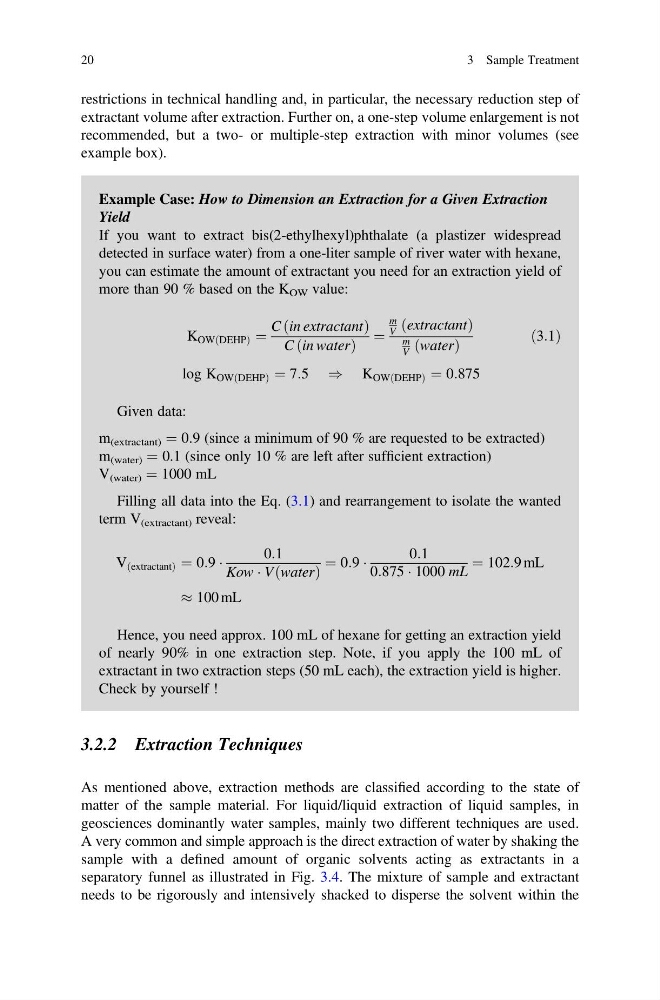
Example Case: How to Dimension an Extraction for a Given Extraction
Yield
If you want to extract bis(2-ethylhexyl)phthalate (a plastizer widespread
detected in surface water) from a one-liter sample of river water with hexane,
you can estimate the amount of extractant you need for an extraction yield of
more than 90 % based on the K OW value:
K OW DEHP
ð
Þ ¼
C in extractant
ð
Þ
C in water
ð
Þ
¼
m
V extractant
ð
Þ
m
V water
ð
Þ
ð3:1Þ
log K OW DEHP
ð
Þ ¼ 7:5 ) K OW DEHP
ð
Þ ¼ 0:875
Given data:
m (extractant) ¼ 0.9 (since a minimum of 90 % are requested to be extracted)
m (water) ¼ 0.1 (since only 10 % are left after sufficient extraction)
V (water) ¼ 1000 mL
Filling all data into the Eq. (3.1) and rearrangement to isolate the wanted
term V (extractant) reveal:
V extractant
ð
Þ ¼ 0:9 Á
0:1
Kow Á V water
ð
Þ
¼ 0:9 Á
0:1
0:875 Á 1000 mL
¼ 102:9 mL
% 100 mL
Hence, you need approx. 100 mL of hexane for getting an extraction yield
of nearly 90% in one extraction step. Note, if you apply the 100 mL of
extractant in two extraction steps (50 mL each), the extraction yield is higher.
Check by yourself !
3.2.2 Extraction Techniques
As mentioned above, extraction methods are classified according to the state of
matter of the sample material. For liquid/liquid extraction of liquid samples, in
geosciences dominantly water samples, mainly two different techniques are used.
A very common and simple approach is the direct extraction of water by shaking the
sample with a defined amount of organic solvents acting as extractants in a
separatory funnel as illustrated in Fig. 3.4. The mixture of sample and extractant
needs to be rigorously and intensively shacked to disperse the solvent within the
20
3 Sample Treatment
extractant volume after extraction. Further on, a one-step volume enlargement is not
recommended, but a two- or multiple-step extraction with minor volumes (see
example box).
Example Case: How to Dimension an Extraction for a Given Extraction
Yield
If you want to extract bis(2-ethylhexyl)phthalate (a plastizer widespread
detected in surface water) from a one-liter sample of river water with hexane,
you can estimate the amount of extractant you need for an extraction yield of
more than 90 % based on the K OW value:
K OW DEHP
ð
Þ ¼
C in extractant
ð
Þ
C in water
ð
Þ
¼
m
V extractant
ð
Þ
m
V water
ð
Þ
ð3:1Þ
log K OW DEHP
ð
Þ ¼ 7:5 ) K OW DEHP
ð
Þ ¼ 0:875
Given data:
m (extractant) ¼ 0.9 (since a minimum of 90 % are requested to be extracted)
m (water) ¼ 0.1 (since only 10 % are left after sufficient extraction)
V (water) ¼ 1000 mL
Filling all data into the Eq. (3.1) and rearrangement to isolate the wanted
term V (extractant) reveal:
V extractant
ð
Þ ¼ 0:9 Á
0:1
Kow Á V water
ð
Þ
¼ 0:9 Á
0:1
0:875 Á 1000 mL
¼ 102:9 mL
% 100 mL
Hence, you need approx. 100 mL of hexane for getting an extraction yield
of nearly 90% in one extraction step. Note, if you apply the 100 mL of
extractant in two extraction steps (50 mL each), the extraction yield is higher.
Check by yourself !
3.2.2 Extraction Techniques
As mentioned above, extraction methods are classified according to the state of
matter of the sample material. For liquid/liquid extraction of liquid samples, in
geosciences dominantly water samples, mainly two different techniques are used.
A very common and simple approach is the direct extraction of water by shaking the
sample with a defined amount of organic solvents acting as extractants in a
separatory funnel as illustrated in Fig. 3.4. The mixture of sample and extractant
needs to be rigorously and intensively shacked to disperse the solvent within the
20
3 Sample Treatment