

but different concentrations in both phases. Noteworthy, this steady state is specific
for the both phases as well as the analyte. The constant ratio of both concentrations at
equilibrium is expressed as partition or distribution coefficient that is specific for a
certain system of phases and analyte. The coefficient is given in the following
equation:
Distribution coefficient in steady state
K ¼
C sample matrix
C extraction solvent
This approach implies several potentialities for optimization as well as restrictions. Due to the fact, that extraction works generally as a partition of analytes
between phases under steady-state conditions, a 100% extraction yield cannot be
achieved. A minimum concentration and an according amount of analytes remain in
the sample matrix. However, the yield can be optimized generally by two different
approaches. Firstly, an optimized selection of the extractant leads to a high partition
potential for the selected analytes and, consequently, increases the extraction yield.
As a rule of thumb, the polarity of the solvent should match well with the polarity of
the analyte. In simple words, lipophilic compounds can be extracted best by nonpolar extractants, whereas for hydrophilic compounds polar extractants should be
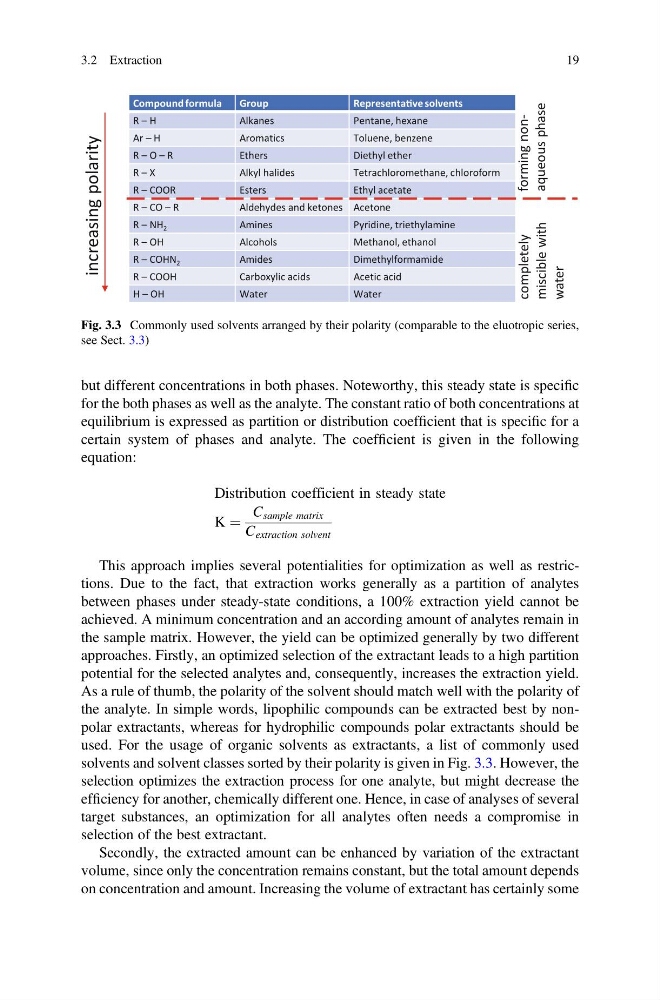
used. For the usage of organic solvents as extractants, a list of commonly used
solvents and solvent classes sorted by their polarity is given in Fig. 3.3. However, the
selection optimizes the extraction process for one analyte, but might decrease the
efficiency for another, chemically different one. Hence, in case of analyses of several
target substances, an optimization for all analytes often needs a compromise in
selection of the best extractant.
Secondly, the extracted amount can be enhanced by variation of the extractant
volume, since only the concentration remains constant, but the total amount depends
on concentration and amount. Increasing the volume of extractant has certainly some
Compound formula
Group
RepresentaƟve solvents
R – H
Alkanes
Pentane, hexane
Ar – H
Aromatics
Toluene, benzene
R – O – R
Ethers
Diethyl ether
R – X
Alkyl halides
Tetrachloromethane, chloroform
R – COOR
Esters
Ethyl acetate
R – CO – R
Aldehydes and ketones Acetone
R – NH 2
Amines
Pyridine, triethylamine
R – OH
Alcohols
Methanol, ethanol
R – COHN 2
Amides
Dimethylformamide
R – COOH
Carboxylic acids
Acetic acid
H – OH
Water
Water
y
t
i
r
a
l
o
p
g
n
i
s
a
e
r
c
n
i
forming nonaqueous phase
completely
miscible with
water
Fig. 3.3 Commonly used solvents arranged by their polarity (comparable to the eluotropic series,
see Sect. 3.3)
3.2 Extraction
19
for the both phases as well as the analyte. The constant ratio of both concentrations at
equilibrium is expressed as partition or distribution coefficient that is specific for a
certain system of phases and analyte. The coefficient is given in the following
equation:
Distribution coefficient in steady state
K ¼
C sample matrix
C extraction solvent
This approach implies several potentialities for optimization as well as restrictions. Due to the fact, that extraction works generally as a partition of analytes
between phases under steady-state conditions, a 100% extraction yield cannot be
achieved. A minimum concentration and an according amount of analytes remain in
the sample matrix. However, the yield can be optimized generally by two different
approaches. Firstly, an optimized selection of the extractant leads to a high partition
potential for the selected analytes and, consequently, increases the extraction yield.
As a rule of thumb, the polarity of the solvent should match well with the polarity of
the analyte. In simple words, lipophilic compounds can be extracted best by nonpolar extractants, whereas for hydrophilic compounds polar extractants should be
used. For the usage of organic solvents as extractants, a list of commonly used
solvents and solvent classes sorted by their polarity is given in Fig. 3.3. However, the
selection optimizes the extraction process for one analyte, but might decrease the
efficiency for another, chemically different one. Hence, in case of analyses of several
target substances, an optimization for all analytes often needs a compromise in
selection of the best extractant.
Secondly, the extracted amount can be enhanced by variation of the extractant
volume, since only the concentration remains constant, but the total amount depends
on concentration and amount. Increasing the volume of extractant has certainly some
Compound formula
Group
RepresentaƟve solvents
R – H
Alkanes
Pentane, hexane
Ar – H
Aromatics
Toluene, benzene
R – O – R
Ethers
Diethyl ether
R – X
Alkyl halides
Tetrachloromethane, chloroform
R – COOR
Esters
Ethyl acetate
R – CO – R
Aldehydes and ketones Acetone
R – NH 2
Amines
Pyridine, triethylamine
R – OH
Alcohols
Methanol, ethanol
R – COHN 2
Amides
Dimethylformamide
R – COOH
Carboxylic acids
Acetic acid
H – OH
Water
Water
y
t
i
r
a
l
o
p
g
n
i
s
a
e
r
c
n
i
forming nonaqueous phase
completely
miscible with
water
Fig. 3.3 Commonly used solvents arranged by their polarity (comparable to the eluotropic series,
see Sect. 3.3)
3.2 Extraction
19