

m/z 191
α,β-hopane
β,α-hopane (moretane)
(22S)-α,β-homohopane
(22R)-α,β-homohopane
(22R)-α,β-bishomohopane
(22S)-α,β-bishomohopane
e
n
a
p
o
h
o
e
n
r
o
n
s
i
r
t
T
s
trisnorhopane T
m
α,β-norhopane
(Gammacerane)
area 22S = 12.355
area 22R = 11.799
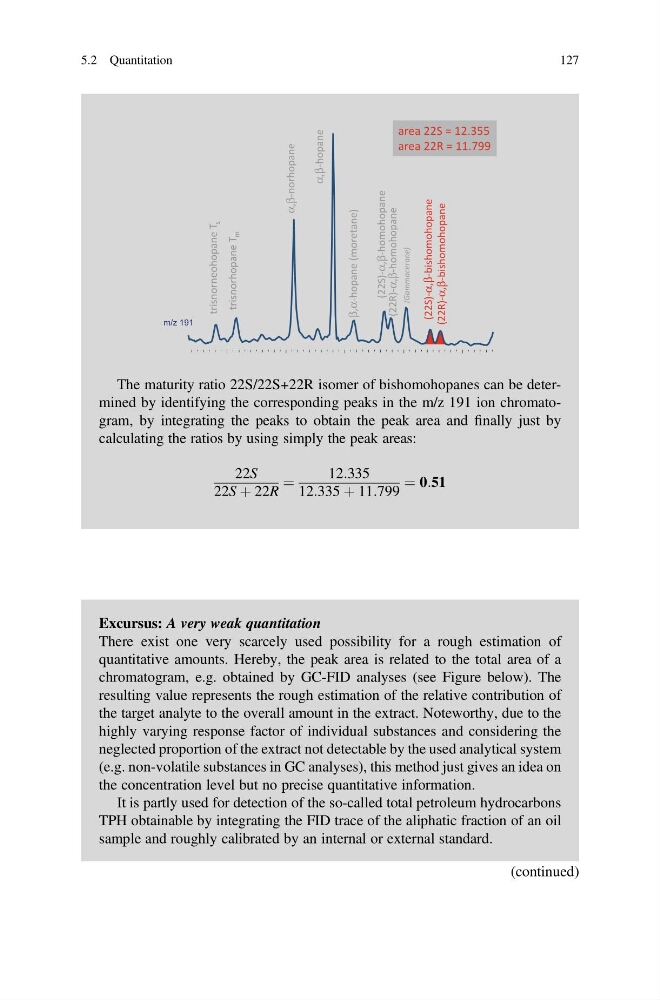
The maturity ratio 22S/22S+22R isomer of bishomohopanes can be determined by identifying the corresponding peaks in the m/z 191 ion chromatogram, by integrating the peaks to obtain the peak area and finally just by
calculating the ratios by using simply the peak areas:
22S
22S þ 22R
¼
12:335
12:335 þ 11:799
¼ 0:51
Excursus: A very weak quantitation
There exist one very scarcely used possibility for a rough estimation of
quantitative amounts. Hereby, the peak area is related to the total area of a
chromatogram, e.g. obtained by GC-FID analyses (see Figure below). The
resulting value represents the rough estimation of the relative contribution of
the target analyte to the overall amount in the extract. Noteworthy, due to the
highly varying response factor of individual substances and considering the
neglected proportion of the extract not detectable by the used analytical system
(e.g. non-volatile substances in GC analyses), this method just gives an idea on
the concentration level but no precise quantitative information.
It is partly used for detection of the so-called total petroleum hydrocarbons
TPH obtainable by integrating the FID trace of the aliphatic fraction of an oil
sample and roughly calibrated by an internal or external standard.
(continued)
5.2 Quantitation
127
α,β-hopane
β,α-hopane (moretane)
(22S)-α,β-homohopane
(22R)-α,β-homohopane
(22R)-α,β-bishomohopane
(22S)-α,β-bishomohopane
e
n
a
p
o
h
o
e
n
r
o
n
s
i
r
t
T
s
trisnorhopane T
m
α,β-norhopane
(Gammacerane)
area 22S = 12.355
area 22R = 11.799
The maturity ratio 22S/22S+22R isomer of bishomohopanes can be determined by identifying the corresponding peaks in the m/z 191 ion chromatogram, by integrating the peaks to obtain the peak area and finally just by
calculating the ratios by using simply the peak areas:
22S
22S þ 22R
¼
12:335
12:335 þ 11:799
¼ 0:51
Excursus: A very weak quantitation
There exist one very scarcely used possibility for a rough estimation of
quantitative amounts. Hereby, the peak area is related to the total area of a
chromatogram, e.g. obtained by GC-FID analyses (see Figure below). The
resulting value represents the rough estimation of the relative contribution of
the target analyte to the overall amount in the extract. Noteworthy, due to the
highly varying response factor of individual substances and considering the
neglected proportion of the extract not detectable by the used analytical system
(e.g. non-volatile substances in GC analyses), this method just gives an idea on
the concentration level but no precise quantitative information.
It is partly used for detection of the so-called total petroleum hydrocarbons
TPH obtainable by integrating the FID trace of the aliphatic fraction of an oil
sample and roughly calibrated by an internal or external standard.
(continued)
5.2 Quantitation
127