

methyl ketones forms also specific peaks, here at m/z 58. Noteworthy, from a formal
point of view, this reaction is an elimination by cleaving two separate bonds, hence
even fragments are produced that are easily to identify among all the commonly odd
peaks resulting from fragmentations by solely one cleavage.
Finally, there is one main aspect that facilitates especially the identification of
many organic pollutants. Going back to historical aspects, mass spectrometry has
260
270
280
290
300
210
220
230
240
250
y
t
i
s
n
e
t
n
i
e
v
i
t
a
l
e
r
m/z
256
260
270
280
290
300
210
220
230
240
250
y
t
i
s
n
e
t
n
i
e
v
i
t
a
l
e
r
m/z
256
260
270
280
290
300
210
220
230
240
250
y
t
i
s
n
e
t
n
i
e
v
i
t
a
l
e
r
m/z
256
225
227
227
225
225
227
MeO
O
m/z 225
m/z 227
MeO
O
m/z 225
m/z 227
MeO
O
m/z 225
m/z 227
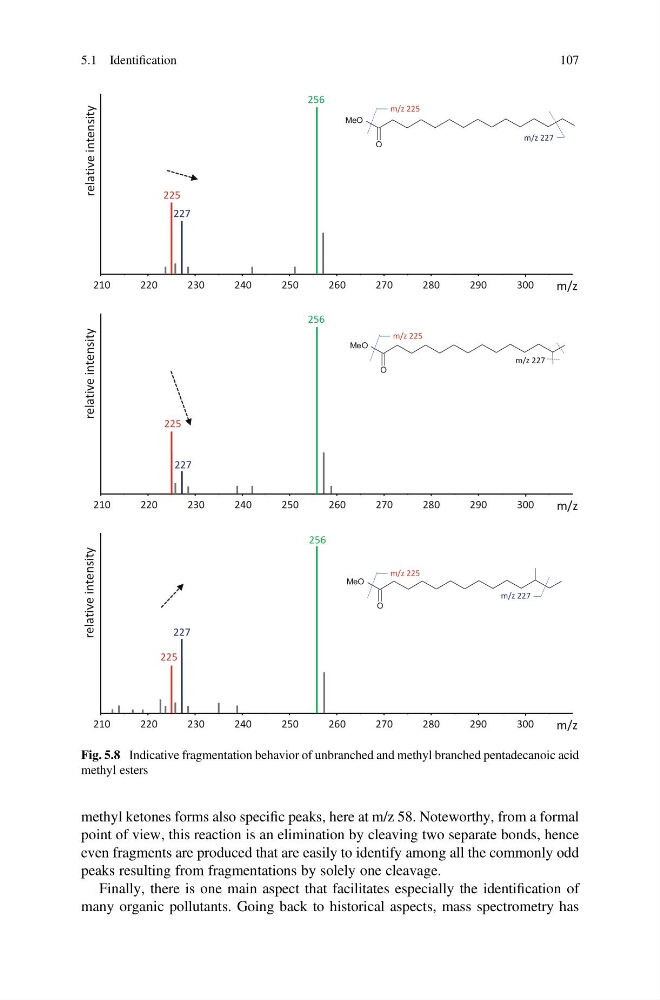
Fig. 5.8 Indicative fragmentation behavior of unbranched and methyl branched pentadecanoic acid
methyl esters
5.1 Identification
107
point of view, this reaction is an elimination by cleaving two separate bonds, hence
even fragments are produced that are easily to identify among all the commonly odd
peaks resulting from fragmentations by solely one cleavage.
Finally, there is one main aspect that facilitates especially the identification of
many organic pollutants. Going back to historical aspects, mass spectrometry has
260
270
280
290
300
210
220
230
240
250
y
t
i
s
n
e
t
n
i
e
v
i
t
a
l
e
r
m/z
256
260
270
280
290
300
210
220
230
240
250
y
t
i
s
n
e
t
n
i
e
v
i
t
a
l
e
r
m/z
256
260
270
280
290
300
210
220
230
240
250
y
t
i
s
n
e
t
n
i
e
v
i
t
a
l
e
r
m/z
256
225
227
227
225
225
227
MeO
O
m/z 225
m/z 227
MeO
O
m/z 225
m/z 227
MeO
O
m/z 225
m/z 227
Fig. 5.8 Indicative fragmentation behavior of unbranched and methyl branched pentadecanoic acid
methyl esters
5.1 Identification
107