

Further on, Fig. 5.5 also illustrates the systematic shift from a pure aromatic
pattern towards a mixed pattern by superimposition of an aliphatic unit.
General Note
Based on the mass spectral patterns aromatic and aliphatic molecules or even
corresponding moieties can be distinguished.
Excursus: Illustration of fragmentation in mass spectra
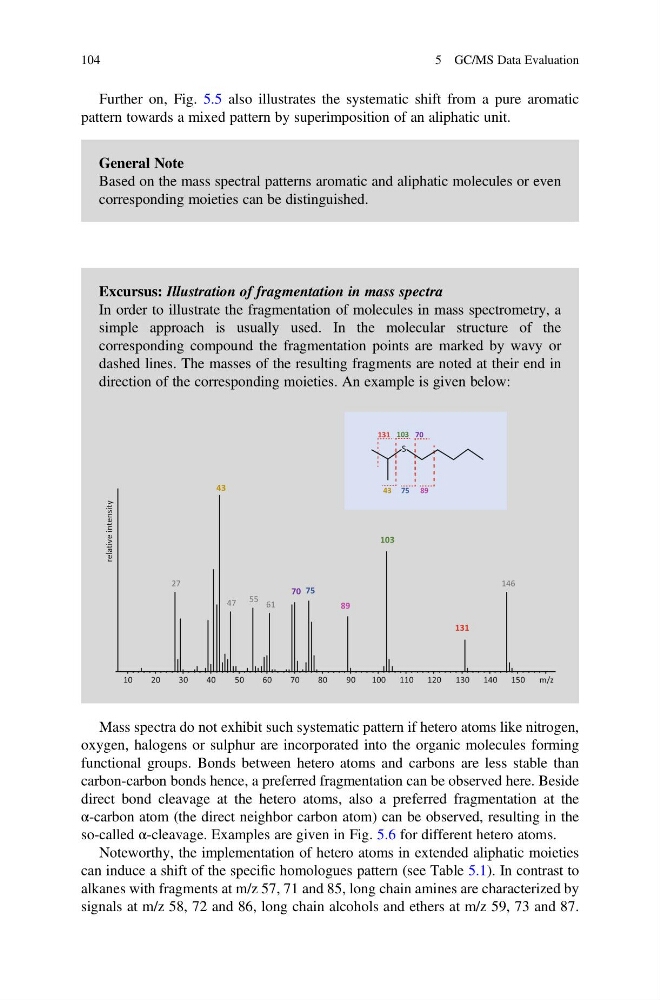
In order to illustrate the fragmentation of molecules in mass spectrometry, a
simple approach is usually used. In the molecular structure of the
corresponding compound the fragmentation points are marked by wavy or
dashed lines. The masses of the resulting fragments are noted at their end in
direction of the corresponding moieties. An example is given below:
43 75 89
131 103 70
10
20
30
40
50
60
70
80
90
100
110
120
130
140
150
m/z
27
43
47 55 61
70 75
89
103
131
146
y
t
i
s
n
e
t
n
i
e
v
i
t
a
l
e
r
S
Mass spectra do not exhibit such systematic pattern if hetero atoms like nitrogen,
oxygen, halogens or sulphur are incorporated into the organic molecules forming
functional groups. Bonds between hetero atoms and carbons are less stable than
carbon-carbon bonds hence, a preferred fragmentation can be observed here. Beside
direct bond cleavage at the hetero atoms, also a preferred fragmentation at the
α-carbon atom (the direct neighbor carbon atom) can be observed, resulting in the
so-called α-cleavage. Examples are given in Fig. 5.6 for different hetero atoms.
Noteworthy, the implementation of hetero atoms in extended aliphatic moieties
can induce a shift of the specific homologues pattern (see Table 5.1). In contrast to
alkanes with fragments at m/z 57, 71 and 85, long chain amines are characterized by
signals at m/z 58, 72 and 86, long chain alcohols and ethers at m/z 59, 73 and 87.
104
5 GC/MS Data Evaluation
pattern towards a mixed pattern by superimposition of an aliphatic unit.
General Note
Based on the mass spectral patterns aromatic and aliphatic molecules or even
corresponding moieties can be distinguished.
Excursus: Illustration of fragmentation in mass spectra
In order to illustrate the fragmentation of molecules in mass spectrometry, a
simple approach is usually used. In the molecular structure of the
corresponding compound the fragmentation points are marked by wavy or
dashed lines. The masses of the resulting fragments are noted at their end in
direction of the corresponding moieties. An example is given below:
43 75 89
131 103 70
10
20
30
40
50
60
70
80
90
100
110
120
130
140
150
m/z
27
43
47 55 61
70 75
89
103
131
146
y
t
i
s
n
e
t
n
i
e
v
i
t
a
l
e
r
S
Mass spectra do not exhibit such systematic pattern if hetero atoms like nitrogen,
oxygen, halogens or sulphur are incorporated into the organic molecules forming
functional groups. Bonds between hetero atoms and carbons are less stable than
carbon-carbon bonds hence, a preferred fragmentation can be observed here. Beside
direct bond cleavage at the hetero atoms, also a preferred fragmentation at the
α-carbon atom (the direct neighbor carbon atom) can be observed, resulting in the
so-called α-cleavage. Examples are given in Fig. 5.6 for different hetero atoms.
Noteworthy, the implementation of hetero atoms in extended aliphatic moieties
can induce a shift of the specific homologues pattern (see Table 5.1). In contrast to
alkanes with fragments at m/z 57, 71 and 85, long chain amines are characterized by
signals at m/z 58, 72 and 86, long chain alcohols and ethers at m/z 59, 73 and 87.
104
5 GC/MS Data Evaluation