

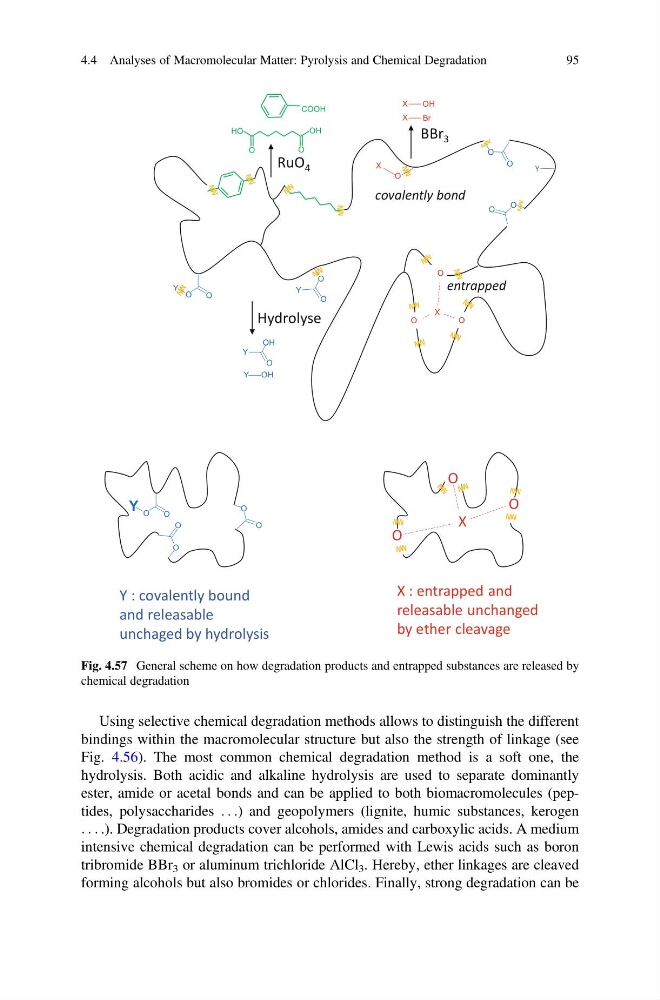
Using selective chemical degradation methods allows to distinguish the different
bindings within the macromolecular structure but also the strength of linkage (see
Fig. 4.56). The most common chemical degradation method is a soft one, the
hydrolysis. Both acidic and alkaline hydrolysis are used to separate dominantly
ester, amide or acetal bonds and can be applied to both biomacromolecules (peptides, polysaccharides . . .) and geopolymers (lignite, humic substances, kerogen
. . . .). Degradation products cover alcohols, amides and carboxylic acids. A medium
intensive chemical degradation can be performed with Lewis acids such as boron
tribromide BBr 3 or aluminum trichloride AlCl 3 . Hereby, ether linkages are cleaved
forming alcohols but also bromides or chlorides. Finally, strong degradation can be
covalently bond
BBr 3
O
Y
O
O
Y
O
X
Hydrolyse
OH
Y
OH
Y
OH
X
Br
X
RuO 4
COOH
OH
O
O
HO
O
O
O
X
X : entrapped and
releasable unchanged
by ether cleavage
O
O
Y : covalently bound
and releasable
unchaged by hydrolysis
O
X
O
O
O
O
O
Y
entrapped
O
O
Y
Fig. 4.57 General scheme on how degradation products and entrapped substances are released by
chemical degradation
4.4 Analyses of Macromolecular Matter: Pyrolysis and Chemical Degradation
95
bindings within the macromolecular structure but also the strength of linkage (see
Fig. 4.56). The most common chemical degradation method is a soft one, the
hydrolysis. Both acidic and alkaline hydrolysis are used to separate dominantly
ester, amide or acetal bonds and can be applied to both biomacromolecules (peptides, polysaccharides . . .) and geopolymers (lignite, humic substances, kerogen
. . . .). Degradation products cover alcohols, amides and carboxylic acids. A medium
intensive chemical degradation can be performed with Lewis acids such as boron
tribromide BBr 3 or aluminum trichloride AlCl 3 . Hereby, ether linkages are cleaved
forming alcohols but also bromides or chlorides. Finally, strong degradation can be
covalently bond
BBr 3
O
Y
O
O
Y
O
X
Hydrolyse
OH
Y
OH
Y
OH
X
Br
X
RuO 4
COOH
OH
O
O
HO
O
O
O
X
X : entrapped and
releasable unchanged
by ether cleavage
O
O
Y : covalently bound
and releasable
unchaged by hydrolysis
O
X
O
O
O
O
O
Y
entrapped
O
O
Y
Fig. 4.57 General scheme on how degradation products and entrapped substances are released by
chemical degradation
4.4 Analyses of Macromolecular Matter: Pyrolysis and Chemical Degradation
95